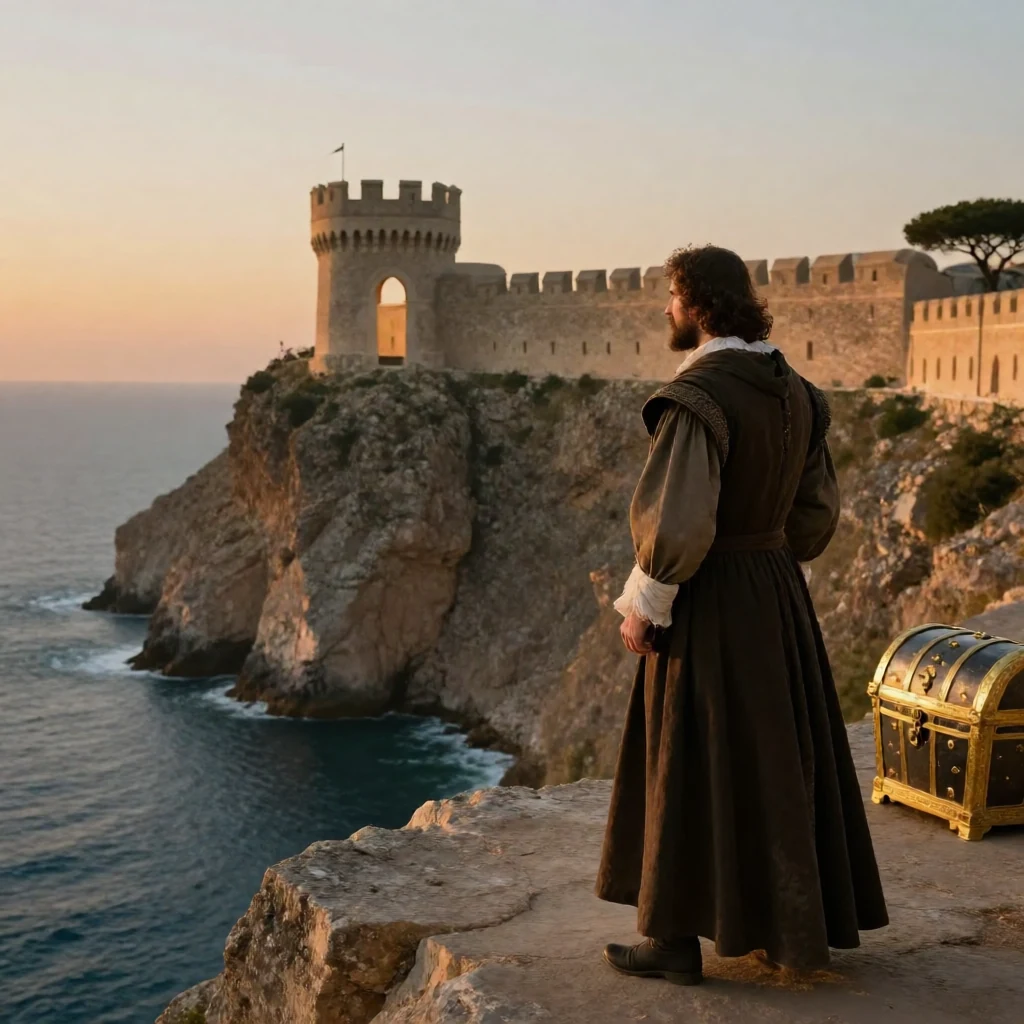
A Toast to Dantès
Danglars, pouring out a glass for Fernand, remarks that Dantès’s return will bring Fernand ill-luck, and Caderousse, heavy with wine, insists that in the meantime Dantès will marry the lovely Mercédès, and even become captain of the Pharaon. Danglars stiffens at the mention of the captaincy and scrutinizes Caderousse for any sign of design, but reads nothing in his drunken, envious face. He recovers, raises his glass, and proposes a toast to Captain Edmond Dantès and his bride, the beautiful Catalane. Caderousse drains his glass at a gulp; Fernand dashes his to the ground. Caderousse, squinting through the wine, thinks he sees two lovers walking hand in hand and embracing down by the wall in the direction of the Catalans, ignorant, he says, that they can be seen, and so the chapter closes on the image of Dantès and Mercédès in each other’s arms while the embittered Fernand and his two companions look on.
Chapter 3. The Catalans
Chapter 3 continues the scene in the Catalan village, where Danglars, Fernand, and Caderousse observe the engagement of Edmond Dantès and Mercédès. The chapter develops the jealous scheming of Danglars, the drunken intrusions of Caderousse, the restrained rage of Fernand, and the happy couple’s plans for an imminent wedding, culminating in Edmond’s announcement of a sacred Paris commission that sparks Danglars’ plotting.
Danglars Taunts Fernand’s Jealousy of Edmond
Danglars observes Fernand’s silent suffering as he watches Edmond and Mercédès together and begins to needle him with the question, “Do you know them, Fernand?” Caderousse drunkenly leans from the arbor and calls out to the couple, demanding to know the wedding date, while Danglars feebly pretends to restrain him and sarcastically urges Fernand to follow the lovers’ example and be “well-behaved.”
Caderousse Hails the Engaged Couple
Caderousse, with the tenacity of a drunkard, hails Dantès and the “lovely damsel” from the arbor. Dantès responds warmly that happiness, rather than pride, blinds him. When Caderousse addresses Mercédès as “Madame Dantès,” she gently but gravely rebukes him, explaining that in her country it bodes ill fortune to call a young girl by her betrothed’s name before marriage. Dantès diplomatically excuses his neighbor’s mistake.
Mercédès Deters Fernand’s Attack
Stung beyond endurance by Danglars’ provocations, Fernand rises as if to dash headlong at his rival. At that moment Mercédès turns and looks at them with her clear, bright eyes, reminding Fernand of her vow to die if Edmond died. The memory of her threat causes him to collapse heavily back into his seat, overwhelmed and paralyzed. Danglars surveys the broken men with contempt.
Danglars Plots Against Edmond
Danglars concludes privately that he will get nothing from “these fools” — dismissing Caderousse as a drunkard and Fernand as a coward — even as he notes the Catalan’s vengeful, Spanish-like eyes and the tailor’s ox-crushing fists. He reflects that Edmond’s star is ascendant and that he will marry Mercédès and become captain, “unless” Danglars himself takes a hand in the affair, a sinister smile crossing his lips as the plot forms.
Wedding Plans and Invitations Are Discussed
Dantès announces that the preliminaries will be arranged today at his father’s and the wedding festival held tomorrow or the day after at La Réserve. He invites Danglars and Caderousse, and when Caderousse chuckles about Fernand, Dantès warmly proclaims Mercédès’ brother as his own. Fernand tries to speak but his voice dies on his lips. Danglars remarks on the haste, and Dantès answers that those who have suffered long hurry toward happiness.
Edmond Announces His Paris Commission
Pressed on his urgency, Dantès explains he must go to Paris to fulfill the last commission of the deceased Captain Leclere, calling it a sacred duty he will complete quickly. Danglars, in a low aside, deduces that Dantès is delivering a letter given to him by the grand marshal, and a “capital idea” sparks in his mind — that Dantès is not yet “registered number one” aboard the Pharaon. He cries a pleasant journey as the joyful lovers walk on, unaware.
The original text of this work is in the public domain. This page offers a compressed quick-read summary for educational purposes.