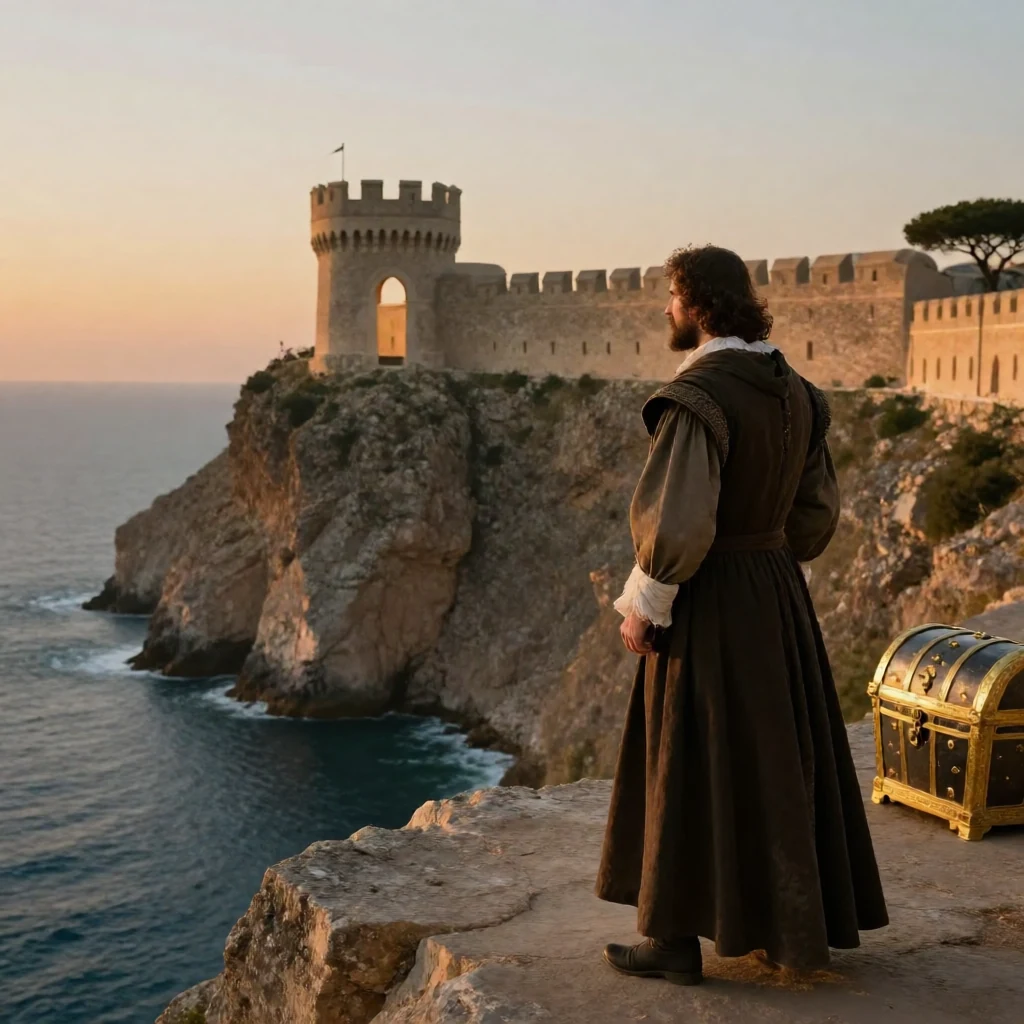
Chapter 87. The Challenge
Devastated by his father’s exposure, Albert told Beauchamp he would find the man responsible and kill him, or die trying. Beauchamp relented and gave him a clue: the banker Danglars had written to Yanina about Morcerf’s past, on the advice of the Count of Monte Cristo. Albert realized Monte Cristo had orchestrated the exposure to punish Fernand, and had lured him to Normandy so he could not stop it.
Albert and Beauchamp confronted Danglars, who admitted he had written to Yanina on Monte Cristo’s advice, with no idea what the answer would be. Realizing Danglars would never fight, Albert turned his rage on Monte Cristo and had Beauchamp arrange a duel: pistols, eight o’clock the next morning, in the Bois de Vincennes. Monte Cristo agreed at once, saying he would leave the choice of arms to Albert, that he was sure to win, and asked Beauchamp to keep Albert away from the Opera that night to avoid a public scene.
Chapter 88. The Insult
Albert went to his mother Mercédès before keeping his appointment at the Opera. She had refused to see anyone since the previous day’s events and lay in bed, overwhelmed with grief. Albert stood speechless, his resolution visibly wavering. He asked if Morcerf had any enemy, and Mercédès—who alone had recognized Edmond Dantès by his voice the moment she saw him and had watched his every move since—paled at the mention of the count. She answered in riddles, urging Albert to retain Monte Cristo’s friendship, terrified to reveal what she knew. Albert’s ironic smile told her he understood; she, prudent and strong-minded, concealed both her sorrows and her fears. She tried to keep him at her side, but he left. Scarcely had he shut her door when Mercédès called a confidential servant and ordered him to follow Albert that evening, then rang for her lady’s maid and, weak as she was, dressed, in order to be ready for whatever might happen.
Albert wandered the theatre until the curtain rose. At the beginning of the second act Monte Cristo entered his box, and his eye at once fell on the pale, threatening face in the pit. He recognized Albert but thought it better not to notice him. At the end of the second act, Albert left the orchestra with his two friends. Albert went to the Opera anyway, confronting Monte Cristo in his box in front of the entire audience, his voice trembling with rage. “We are not here for hypocritical politeness. We are here to demand an explanation.”
Monte Cristo remained calm, telling Albert the Opera was no place for such a demand. Albert reminded him he had visited his house the day before, “when I knew not who you were.” The audience murmured, recognizing the disgraced Count of Morcerf. Monte Cristo told Albert his tone was too high, that he was in Monte Cristo’s home, and ordered him to leave. Albert clenched his glove, threatening to make Monte Cristo leave his own home, and Monte Cristo took the glove from his hand. “I consider your glove thrown. I will return it to you wrapped around a bullet. Now leave me, or I will have my servants throw you out.”
Albert stepped back, wild with rage, and Morrel closed the door behind him. Monte Cristo sat back down as if nothing had happened. When Beauchamp arrived to confirm the duel terms, he agreed at once, asking him to keep Albert away from the Opera for the rest of the night. He then asked Morrel to be his second the next morning, and the two watched the rest of the opera in silence.
Chapter 89. The Night
After the opera, Monte Cristo went home and told Ali to bring his special target pistols with the ivory cross. He was examining the weapons when a veiled woman entered, followed by Baptistin. Monte Cristo sent Baptistin away, and the woman threw back her veil: Mercédès, his former fiancée, Albert’s mother. She fell to her knees, begging him to spare her son. “Edmond, you will not kill my son!”
Monte Cristo was stunned, letting the pistol fall. She told him she had recognized him by his voice the moment she saw him, had watched his every move since, and knew he was behind the scandal that destroyed her husband. She begged him to punish her instead: she should have waited for Edmond, refused to marry Fernand, believed he was alive instead of mourning him as dead.
Monte Cristo looked at the woman he had loved, now on her knees begging for the life of the son of the man who had betrayed him. He thought of his fourteen years in the Château d’If, his father’s starvation, the daily vow of vengeance. He thought of Albert, innocent, ashamed of a sin he did not commit. Finally, he relented. “He shall live. I will not harm him.”
Mercédès wept with gratitude, but Monte Cristo told her there was still a duel: Albert had publicly insulted him, thrown his glove in front of all Paris. He could not avoid fighting without losing his honor, so he had decided to let Albert kill him, sacrificing his own life to spare the boy. Mercédès tried to protest, but he was firm. She touched his face gently, thanked him, and left. When she was gone, Monte Cristo stood alone in his study and whispered, “What a fool I was, not to tear my heart out on the day when I resolved to avenge myself!” as the Invalides clock struck one.
The original text of this work is in the public domain. This page focuses on a guided summary article, reading notes, selected quotes, and visual learning materials for educational purposes.