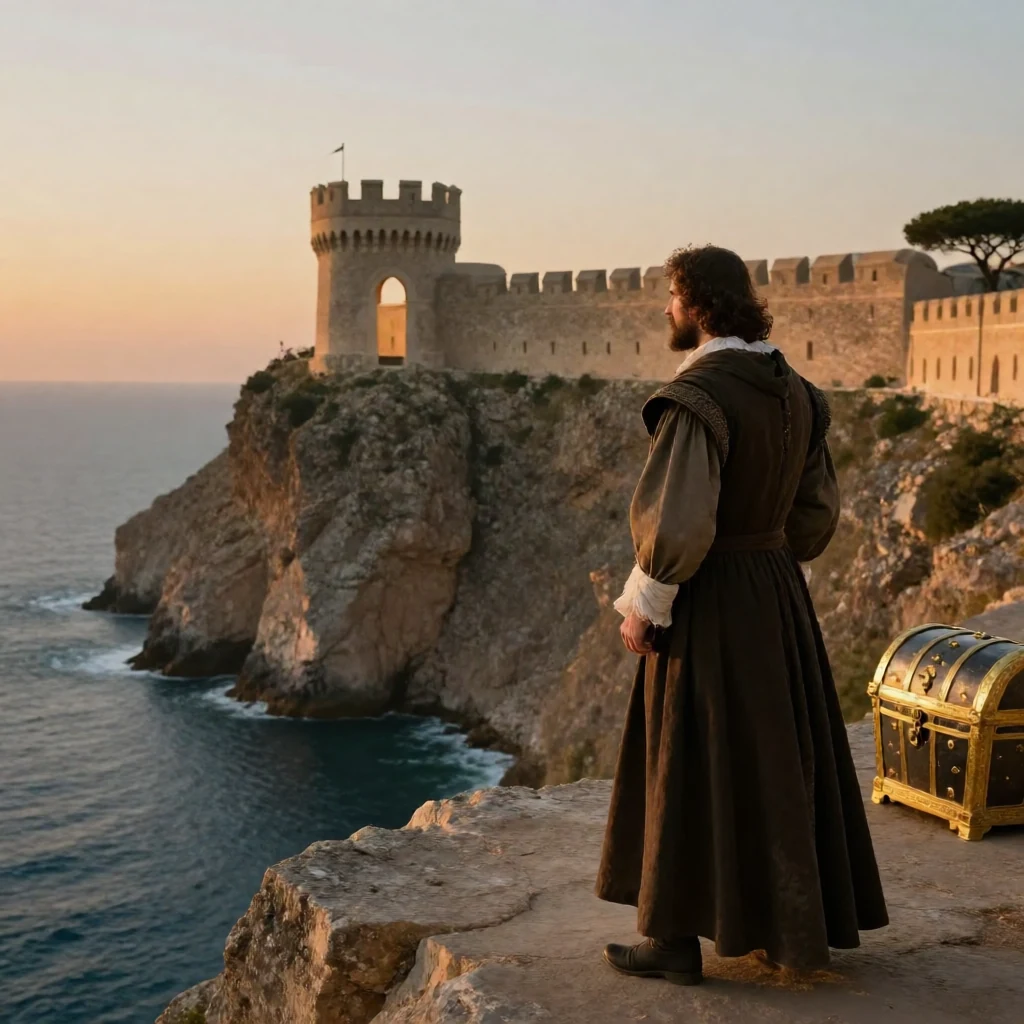
Chapter 90. The Meeting
After Mercédès departed, Monte Cristo slumped into profound gloom. His energetic mind seemed paralyzed as he weighed whether to fall by his own hand rather than be killed in combat. Seizing a pen, he amended his will, leaving twenty millions to Maximilian Morrel with instructions to marry his beloved Haydée if his heart were free. He was finishing the codicil when Haydée, who had been watching outside his door, cried out and tore the will to pieces, fainting as she did so. The count carried her away, rewrote the will, sealed it, and sent it to his solicitor. At dawn Maximilian and Emmanuel arrived. Maximilian had come twenty minutes before the appointed time, pale and sleepless, confessing he had not closed his eyes all night and seeking to draw strength from the count’s calm assurance. Monte Cristo welcomed him with open arms, deeply moved by such devotion. Emmanuel cheerfully accepted his part as second, and the three sat down to a quiet morning repast. Morrel reported that his attempt the previous evening at Tortoni’s to substitute swords for pistols had failed because of the count’s renowned swordsmanship. To reassure his anxious friend, the count took up a pistol, fixed an ace of clubs against the iron plate, and with four successive shots sheared off the four sides of the card, demonstrating such deadly precision that both young men turned pale. Pistols were verified, and the carriage bore them toward the dueling ground. They arrived first at the appointed place to find Beauchamp and Château-Renaud already waiting as Albert’s seconds, the former producing a box of new, unused pistols purchased days earlier for a similar purpose. As the gentlemen conferred about the weapons, another carriage approached carrying Franz and Debray, who explained that Albert had summoned them that morning, presumably wishing them to witness the combat as they had witnessed the challenge. The appointed hour drew near amid uneasy conversation beneath the trees. Yet when Albert de Morcerf appeared, pale and sleepless, instead of crossing swords he delivered a public apology, acknowledging his father Fernand’s treachery toward the count. Monte Cristo, deeply moved, accepted the apology, recognizing the influence of Mercédès’s sacrifice, while witnesses stood stunned at the unexpected reconciliation.
Chapter 91. Mother and Son
Beauchamp and Château-Renaud congratulated Albert with awkward warmth, then departed after receiving only a muttered farewell from the humbled young man. Albert galloped back to Paris, where he found his household in disarray. He began a methodical inventory of his possessions, leaving behind his mother’s portrait and arranging everything in perfect order. The servant informed him the count had called, asking questions about the morning’s events; Albert instructed him to tell the truth. Meanwhile his mother Mercédès was performing the same ritual in her own rooms, packing jewels and counting keys. When Albert entered her chamber and threw himself at her neck, she revealed she too intended to leave. A carriage was ordered, and at the door Bertuccio handed Albert a letter from the count. It revealed the hiding place of a sum long ago buried by a young sailor in a Marseilles garden, and offered it for Mercédès’s sake. She accepted with tears, and the two departed together for a modest lodging.
Chapter 92. The Suicide
Meanwhile Monte Cristo and his companions returned cheerfully to Paris. At the Champs-Élysées, Bertuccio reported that both Mercédès and the valet Florentin believed she was leaving her house. The count dispatched the letter and was greeted by Haydée with transports of joy. This tender reunion was interrupted by the announcement of Count de Morcerf, who had come to denounce Monte Cristo as the cause of his ruin. In a chilling transformation, the count tore off his cravat and waistcoat, appearing in a sailor’s jacket, and revealed his true identity as Edmond Dantès, the young man Fernand had once betrayed and condemned to the Château d’If. The general staggered from the house in horror, crying out the name of his victim. Returning home, Morcerf found his wife and son departing in a hackney-coach. As the wheels rolled away and his family abandoned him forever, he raised a pistol and fired a shot that cracked through the empty window.
The original text of this work is in the public domain. This page focuses on a guided summary article, reading notes, selected quotes, and visual learning materials for educational purposes.