The Butter-fly to His Love
Blanche composes the lyric poem The Butter-fly to His Love, in which a male butterfly addresses his absent lover, describing his long watch for her among natural landscapes, his devotion to the lily’s cell as their shared home, his offer to guide her to fragrant blooms and mountain heights, and his ecstatic joy when she finally arrives to join him.
Exploring the Ancient Château
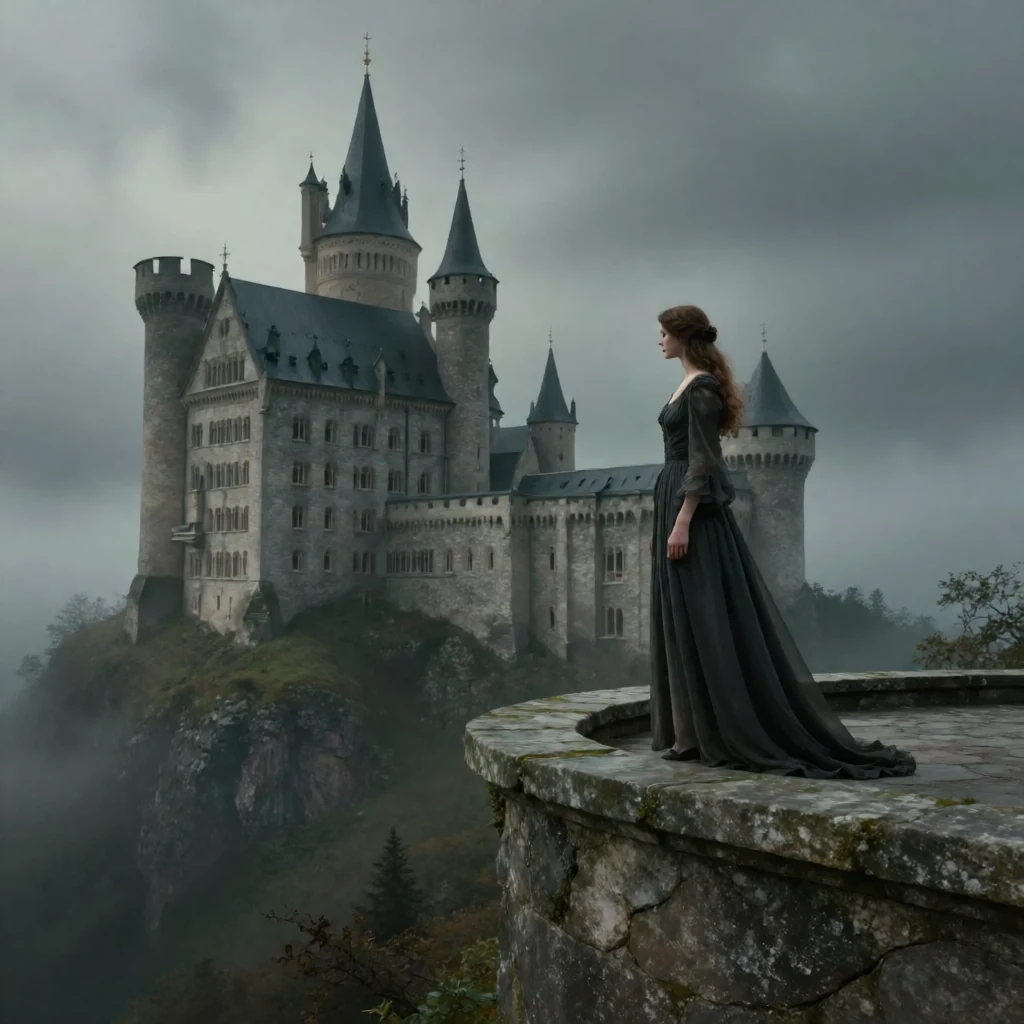
After her woodland walk, Blanche explores the older, less-visited section of the château, drawn to its more imaginative, atmospheric appeal compared to the modern elegant wings. She ascends the great staircase, passes through the oak gallery, and enters a long suite of chambers hung with tapestry or wainscoted with cedar, furnished with ancient pieces, with cold, unused fireplaces and portraits of former inhabitants on the walls that give the space an air of long neglect and desertion.
The West Turret Room
Leaving the ancient suite of chambers, Blanche enters a second gallery ending in a back staircase and a fastened door leading to the château’s north side. She descends a few steps and discovers a small square room in the château’s west turret, with three windows each framing a distinct, beautiful prospect: a view of Languedoc to the north, the Pyrenees’ awe-inspiring summits to the west, and the Mediterranean with the wild shores of Rousillon to the south.
Lost in the Passages
After leaving the turret and descending its narrow staircase, Blanche enters a dusky passage where she wanders unable to find her way, her initial impatience giving way to apprehension. She calls for assistance, and soon spots approaching footsteps and a glimmer of light from a door at the far end of the passage, which is opened cautiously by a person who does not venture out into the hall.
Dorothée’s Distress
Blanche calls out and hurries to the door, where she finds the elderly housekeeper Dorothée, who displays strong shock and terror at seeing her there. Dorothée leads Blanche through a long series of neglected, apparently century-uninhabited passages and rooms to her own apartment, where she offers Blanche sweet meats and refreshment. Blanche mentions her discovery of the pleasant west turret and her wish to use it for her own, but Dorothée does not share her enthusiasm for the view. When Blanche asks about the fastened door at the end of the upper gallery, Dorothée reveals it leads to a suite of rooms that have not been entered for many years, as her late mistress died in one of them and she has never had the heart to go inside since.
The Forbidden Chambers
Blanche wishes to see the forbidden chambers but forbears asking Dorothée to unlock them when she sees Dorothée’s eyes filled with tears. She soon after goes to dress for dinner, where the party meets in good spirits and good humour except for the Countess, whose idle, vacant mind leaves her unable to be happy herself or contribute to others’ happiness. Mademoiselle Bearn attempts witty badinage aimed at Henri, who responds only to avoid rudeness, as he finds her conceit and insensibility often disgusting, even if her liveliness sometimes amuses him.
The Boat Excursion
After dinner, the party proceeds to the shore for the planned evening boat excursion. Blanche is initially apprehensive of the vast ocean expanse she previously admired only from a distance, but overcomes her fears with a strong effort to follow her father into the boat. A light breeze stirs the water, the boat’s silk awning, and the foliage of the receding shore woods, which the Count surveys with pride of ownership and aesthetic appreciation. The boat sails toward a distant pavilion in the woods, winding along the shore past many wooded headlands and bays, while attendants in a separate boat play horns and wind instruments whose pensive tones echo among the rocks and fade over the waves. Blanche’s fears fade, replaced by deep tranquil delight, and she is too happy to recall her convent sorrows or compare them to her present joy.
The original text of this work is in the public domain. This page focuses on a guided summary article, reading notes, selected quotes, and visual learning materials for educational purposes.