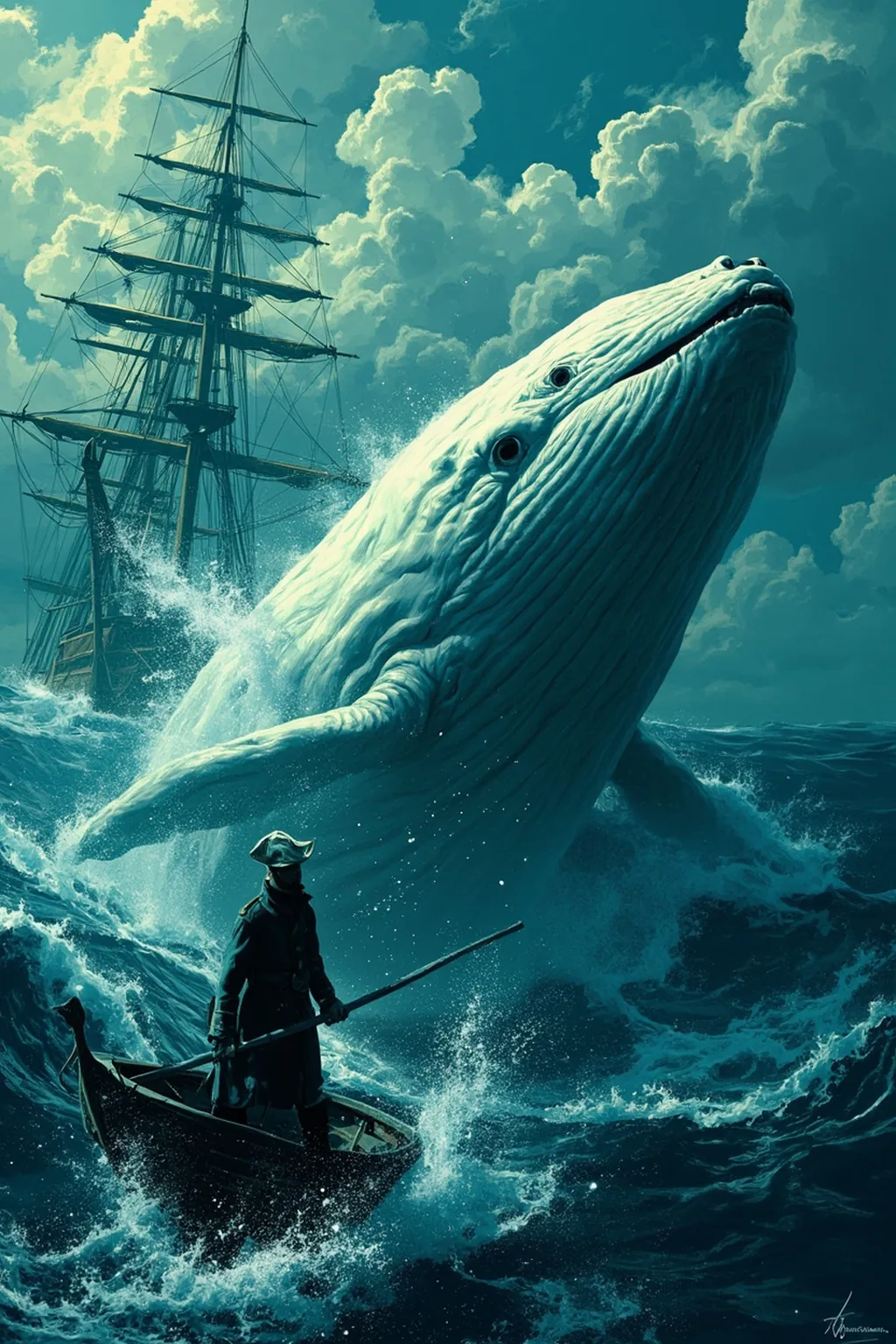
Of Fossil Whales
The chapter establishes geological context for fossil whales, explaining that early geological strata contain fossils of now-extinct monsters, while Tertiary formations preserve connecting or intercepted links between ancient creatures and those believed to have entered Noah’s Ark. All fossil whales discovered belong to the Tertiary period, the last before superficial formations. Though they do not precisely match any known living species, they are sufficiently akin to modern cetaceans to rank as legitimate Cetacean fossils. The narrator’s experience as a stone-mason and ditch-digger provides his authority to discuss geological matters.
Of Fossil Localities
Fossil remains of pre-adamite whales have been discovered across Europe and America. Fragments have been found at the base of the Alps, in Lombardy, France, England, Scotland, and the American states of Louisiana, Mississippi, and Alabama. Notable discoveries include part of a skull found in 1779 in Paris’s Rue Dauphine near the Tuileries, and bones uncovered during construction of Antwerp’s great docks under Napoleon’s direction. Cuvier examined these fragments and pronounced them belonging to an utterly unknown Leviathanic species, establishing the scientific mystery of ancient whales.
The Basilosaurus
The most extraordinary Cetacean relic was an almost complete skeleton discovered in 1842 on Judge Creagh’s Alabama plantation. Enslaved people believed the bones belonged to a fallen angel, while local doctors initially classified it as a huge reptile and named it Basilosaurus. When specimens reached English anatomist Owen, he determined it was actually a whale of a departed species, renaming it Zeuglodon. This case illustrated that whale skeletons provide little clue to the shape of the living body. Owen pronounced the Zeuglodon one of the most extraordinary creatures ever obliterated from existence by the world’s changes, confirming the whale’s extraordinary evolutionary history.
Of Antiquity
Standing among mighty Leviathan skeletons, the narrator experiences overwhelming temporal displacement, feeling borne back to “that wondrous period, ere time itself can be said to have begun; for time began with man.” He describes visions of Saturn’s grey chaos and Polar eternities when ice pressed upon what are now the Tropics and no inhabitable land existed. The entire world belonged to the whale, whose wake lines the present locations of the Andes and Himalayas. The narrator dramatically declares that Ahab’s harpoon shed older blood than the Pharaoh’s, that Methuselah seems a school-boy, and the whale’s existence before all time means it must exist after all human ages end.
Of Egyptian Attestations
Beyond geological traces in limestone and marl, Leviathan’s antiquity appears on Egyptian monuments. About fifty years before the narrative, a sculpted and painted planisphere was discovered on the granite ceiling of the great temple of Denderah. This celestial map abounded with centaurs, griffins, and dolphins resembling modern astronomical figures, but among them swam the old Leviathan—swimming in that planisphere “centuries before Solomon was cradled.” The Egyptian attestations provide cultural and historical confirmation of the whale’s immemorial presence in human consciousness.
Of the Afric Temple
The narrator cites the venerable John Leo, an old Barbary traveller, who documented a strange temple near the sea whose rafters and beams were made of whale bones. Local people believed a secret divine power prevented whales from passing without immediate death, though the truth involved rocks extending two miles into the sea that wounded whales. They preserved a whale’s rib of incredible length as a miracle—its convex part forming an arch unreachable even by a man on camelback. John Leo reported this rib had lain there a hundred years. Local historians claimed a prophet who prophesied of Mahomet came from this temple, and some asserted that the Prophet Jonah was cast forth by the whale at the temple’s base. The narrator leaves the reader at this Afric Temple of the Whale, suggesting silent worship for fellow Nantucketers and whalemen.
KAPITEL 105. Does the Whale’s Magnitude Diminish?—Will He Perish?
This chapter addresses two fundamental questions: whether whales have degenerated in size over time, and whether the species faces eventual extinction through human hunting. The narrative frames Leviathan as a creature emerging from “the head-waters of the Eternities,” establishing the cosmic scope of the inquiry.
The original text of this work is in the public domain. This page focuses on a guided summary article, reading notes, selected quotes, and visual learning materials for educational purposes.