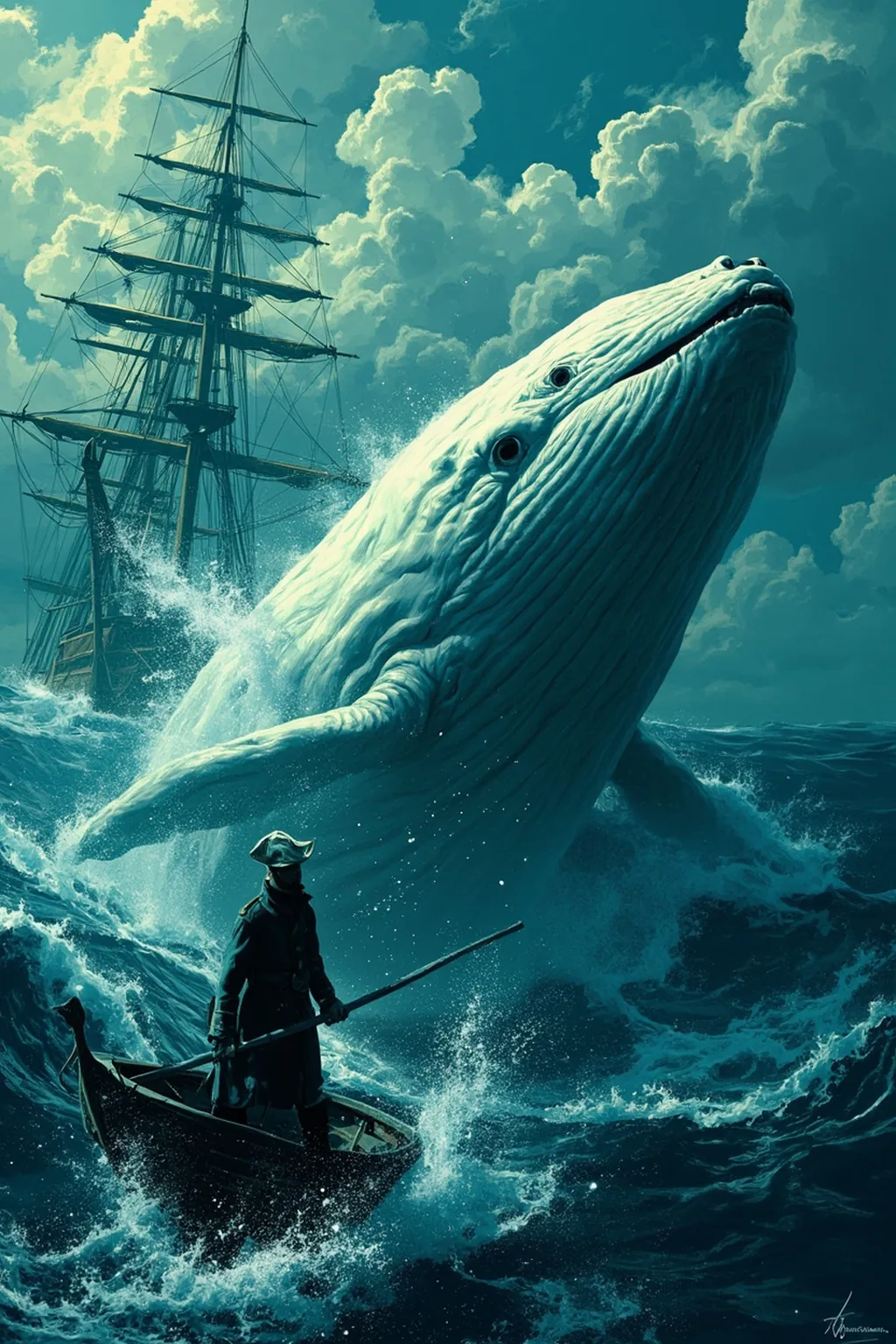
Ahab and Parsee’s Dialogue
Ahab awoke and confronted the Parsee face to face, with the surrounding darkness making them appear as the last survivors in a flooded world. Ahab mentioned dreaming again of hearses. The Parsee recalled having told him that neither hearse nor coffin would be his fate. When Ahab asked about those who die at sea, the Parsee clarified that before Ahab could die on this voyage, two hearses must be sighted on the sea—the first not made by human hands, and the second built with American-grown wood. Ahab expressed wonder at the thought of a hearse floating on the ocean waves as pall-bearers, suggesting such a sight would be long remembered.
Parsee’s Hemp Prophecy
Ahab declared his two pledges: to kill Moby Dick and survive the attempt. The Parsee offered an additional pledge, his eyes glowing like fire-flies in the darkness, claiming that hemp alone could kill Ahab. When Ahab interpreted this as referring to the gallows, he declared himself immortal on both land and sea, laughing derisively. Both fell silent afterward.
Dawn Brings Dead Whale to Ship
Grey dawn arrived, and the sleeping crew rose from the boat’s bottom. By noon, the dead whale was successfully brought to the ship.
KAPITEL 118. The Quadrant.
This chapter depicts Ahab’s final solar observation and his dramatic rejection of scientific navigation instruments, revealing his obsessive pursuit of Moby Dick above all rational seamanship.
Equator Voyage Preparation
As the season for the Line approaches, the crew grows increasingly impatient. Each day when Ahab emerges from his cabin, the helmsman ostentatiously handles the spokes while mariners gather at the braces, their eyes fixed on the nailed doubloon. They await the order to sail toward the equator. At last the command arrives.
Ahab’s Solar Quadrant Sighting
It is high noon as Ahab settles into the bow of his high-hoisted boat to take his customary daily observation of the sun. In the luminous Japanese sea, where summer days blaze with concentrated light and the horizon appears to float, the sun burns with insufferable brilliance. Ahab uses colored glasses on his quadrant to sight the solar fire. He remains motionless, astride the rolling ship, his astrological instrument pressed to his eye, waiting for the precise moment of meridian passage. Below him, the Parsee kneels on deck, gazing at the same sun with half-hooded eyes, his wild face subdued to earthly passionlessness.
Ahab’s Latitude Calculation and Soliloquy
Having taken his sight, Ahab quickly calculates his latitude upon his ivory leg. Yet he falls into reverie, addressing the sun directly: “Thou sea-mark! thou high and mighty Pilot! thou tellest me truly where I am—but canst thou cast the least hint where I shall be?” He questions whether the sun can reveal where Moby Dick swims at this very instant, wondering if his eyes and the sun’s eye behold the same whale together. His frustration with the quadrant’s limitations becomes apparent as he ponders its “numerous cabalistical contrivances.”
Ahab Destroys Quadrant, Declares New Navigation
Ahab’s frustration erupts into condemnation of his instrument. He denounces the quadrant as a “foolish toy! babies’ plaything of haughty Admirals,” which tells only where it happens to be on the planet but cannot predict the future. Cursing science and the heaven that scorches man’s eyes, he dashes the quadrant to the deck and tramples it beneath his feet. He declares he will no longer be guided by this “paltry thing”; instead, he will navigate by the ship’s compass and dead-reckoning through log and line. “Thus I split and destroy thee!” he cries.
Pequod’s Course Adjustment
As Ahab speaks and tramples the quadrant with both living and dead feet, the Parsee’s face shows a mixture of sneering triumph and fatalistic despair. The seamen cluster awestruck on the forecastle. Troubledly pacing the deck, Ahab shouts orders: “To the braces! Up helm!—square in!” The yards swing round as the Pequod half-wheels upon her heel, her three masts erectly poised like “the three Horatii pirouetting on one sufficient steed.”
The original text of this work is in the public domain. This page focuses on a guided summary article, reading notes, selected quotes, and visual learning materials for educational purposes.