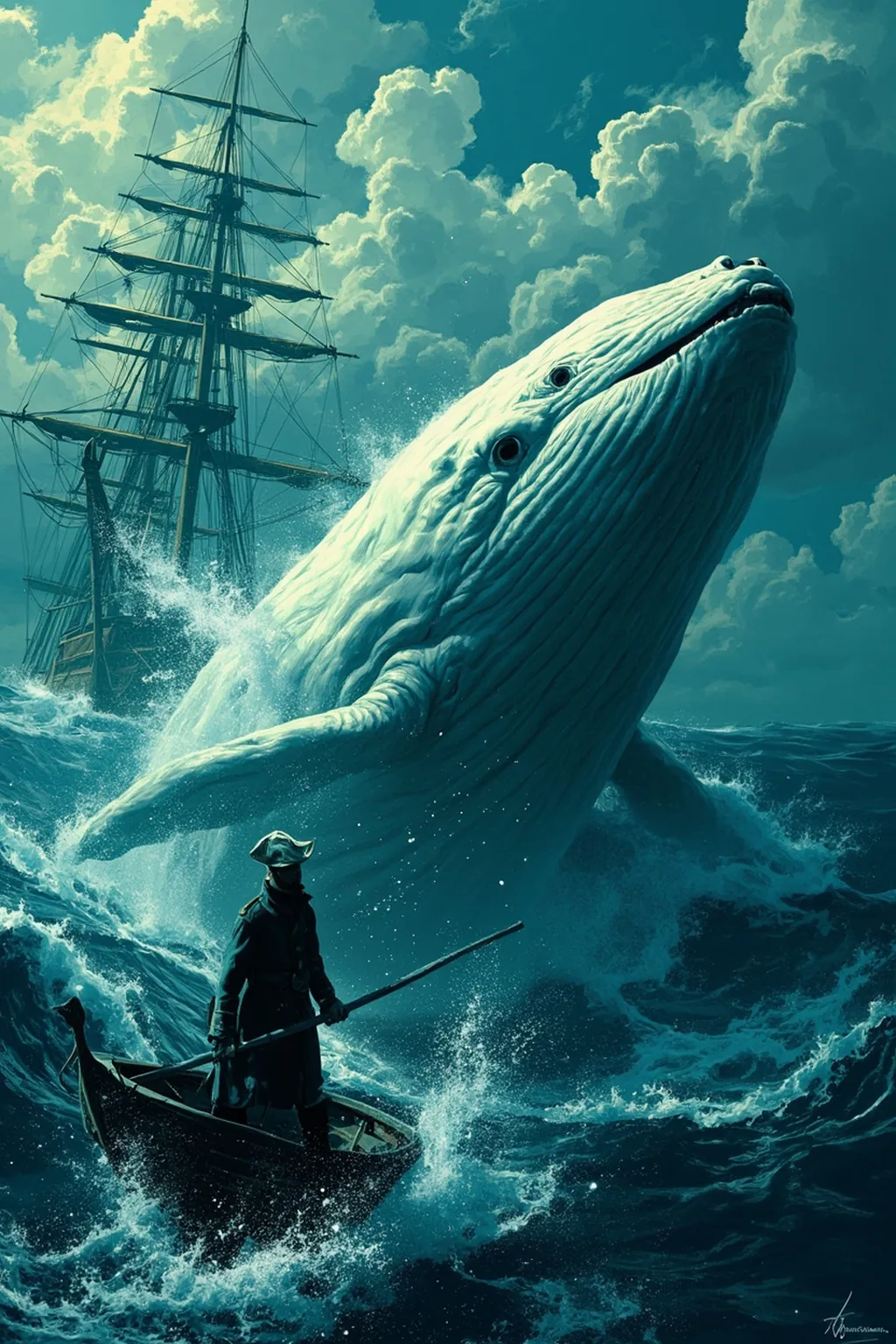
Ahab Observes the Dying Whale’s Final Waning
Though momentarily soothed by the sunset’s beauty, Ahab is drawn into deeper contemplation as he watches the dying whale from his now tranquil boat. He observes a peculiar phenomenon common to all sperm whales in their death—the turning of the head toward the sun before expiring. This spectacle, witnessed during the placid evening, strikes Ahab with a “wondrousness unknown before,” hinting at its profound effect on his brooding mind.
Ahab’s Soliloquy on the Sunward Dying Whale
Ahab delivers an extended soliloquy meditating on the dying whale’s deliberate turn toward the sun. He interprets this motion as an act of worship, describing the whale as a “most faithful, broad, baronial vassal of the sun” that renders homage through its final movements. He reflects on the irony of witnessing such “too-favouring sights” in remote waters beyond “all hum of human weal or woe,” yet notes the bitter paradox: no sooner does life die sunwards in faith than “death whirls round the corpse, and it heads some other way.”
Ahab’s Reflections on Nature and Faith
Ahab addresses what he calls the “dark Hindoo half of nature,” suggesting the destructive, drowning forces within creation. He declares himself an “infidel” to this queen of the sea, yet acknowledges her truthful voice in the “wide-slaughtering Typhoon” and its subsequent hush. The dying whale’s sunward gesture carries a personal lesson for Ahab, one that deepens his faith—though a “darker faith”—in the unnamed, mingling depths that buoy him with “breaths of once living things.”
Ahab’s Hymn to the Eternal Sea
The chapter concludes with Ahab’s celebration of the sea as eternal and all-sustaining. He hails the ocean as the wild fowl’s only rest, declaring himself “Born of earth, yet suckled by the sea.” Though hill and valley “mothered” him, the billows are his “foster-brothers.” This hymn represents Ahab’s reconciliation—however dark and defiant—with the elemental force that governs his fate and the fate of all who sail upon it.
KAPITEL 117. The Whale Watch.
After the four whales are killed on that evening, three are brought alongside the ship before nightfall, but the windward whale cannot be reached until morning, and Ahab’s boat must keep vigil beside it through the night with only a lantern casting flickering light across the dark water. While the crew sleeps, Ahab and the Parsee engage in cryptic prophecy, the Parsee warning that Ahab cannot die until he has seen two hearses upon the sea—the first made by no mortal hands, and the second with visible wood grown in America—before concluding with the ominous promise that only hemp can kill him. Ahab defiantly laughs at this, crying out that he is immortal on land and on sea, but the Parsee’s eyes light up in the gloom as he issues this final challenge. The grey dawn arrives, the crew rises from the slumbering boat, and by noon the dead whale is finally brought to the ship.
Slain Whales’ Positions
The four whales killed that evening had died spread out across the ocean at considerable distances from one another: one far to windward, one closer to leeward, one ahead of the ship, and one astern. By nightfall, three of these whales had been brought alongside the vessel, but the windward whale remained unreachable until morning.
Waif-Pole on Dead Whale
A waif-pole was driven upright into the dead whale’s spout-hole, with a lantern suspended from its top. The lantern’s flickering light illuminated the whale’s dark, glossy back and stretched across the midnight waves, which gently lapped against the massive flank like soft surf upon a beach.
Sharks Around Dead Whale
Ahab and most of his boat’s crew appeared to be sleeping, with only the Parsee keeping watch from the bow. The Parsee observed sharks circling the whale in spectral fashion, their tails tapping against the light cedar planks of the boat. The eerie sounds they made resembled the moaning of ghost squadrons over Asphaltites, creating a shuddering atmosphere.
The original text of this work is in the public domain. This page focuses on a guided summary article, reading notes, selected quotes, and visual learning materials for educational purposes.