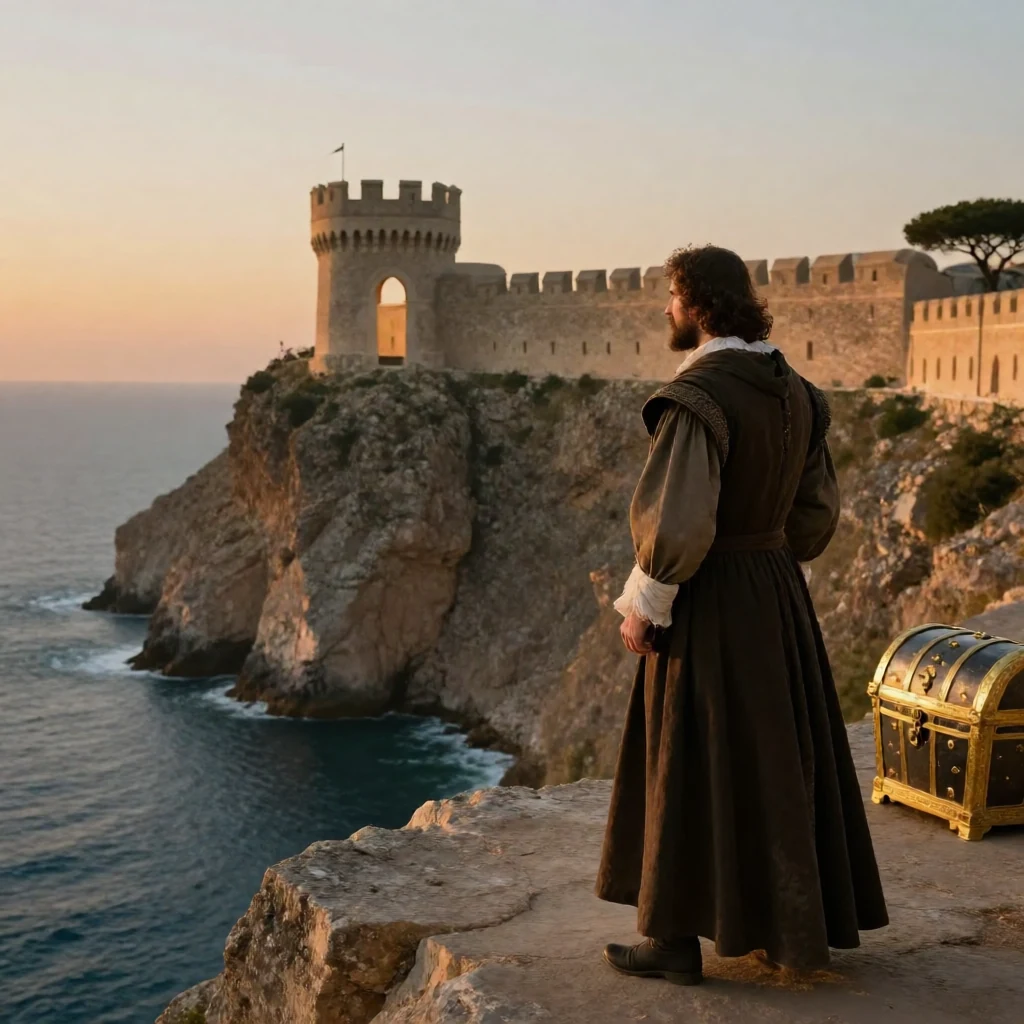
Dantès’s New Escape Proposal
Dantès reasons that another could repeat what Faria has done, only better. The corridor Faria has already bored runs parallel to the outer gallery, roughly fifteen feet from it. Dantès proposes they dig a cross-shaped opening from the corridor into the gallery, kill the sentry who patrols it, and make their escape. He offers his own strength and courage, assuring Faria that he will demonstrate the patience Faria has already shown. Inspired by the older man’s example, Dantès resolves that what has once been done may be done again.
Faria Refuses to Harm a Sentry
Faria halts the planning, making clear that Dantès misunderstands the nature of his courage and intentions. He distinguishes between waging war against circumstances, which he does not regard as sinful, and waging war against men, which he cannot bring himself to do. Though he has no scruple about boring through walls or destroying staircases, he cannot persuade himself to pierce a heart or take a life. He presses Dantès to explain why he has never thought of striking down his jailer and fleeing in the man’s clothes, and uses the question to argue that natural repugnance and moral instinct restrain even the desperate from committing such crimes.
KAPITEL 16. A Learned Italian
Chapter 16, “A Learned Italian,” continues the deepening conversation between Dantès and the Abbé Faria within the Château d’If. After Faria’s earlier revelation that Dantès himself had unknowingly thought of the possibility of exchange rather than escape, the chapter follows Dantès’s wonder at the old priest’s extraordinary self-education and resourcefulness. Faria explains how he has spent years studying historical prison escapes, manufacturing his own writing materials from prison scraps, composing a major treatise on shirt-linen, and mastering multiple languages — all while confined. The chapter closes with Faria inviting Dantès to follow him back through the subterranean passage to view his life’s work firsthand.
Dantès Reacts to Faria’s Insight Into His Unconscious Thoughts
Dantès is left confused and silent by Faria’s reading of his unspoken thoughts. The narrator distinguishes between ideas that proceed from the head and those that emanate from the heart, suggesting that Faria has touched the deeper, soul-level workings of Dantès’s mind.
Faria’s Study of Historical Prison Escapes
Faria explains that since his imprisonment he has studied the most celebrated cases of escape on record. Successful escapes, he observes, have nearly always been long meditated and carefully arranged — citing the Duc de Beaufort’s escape from the Château de Vincennes, the Abbé Dubuquoi’s from For l’Évêque, and Latude’s from the Bastille. He advises Dantès that the best opportunities come from chance, and counsels patient waiting until a favorable moment presents itself. Dantès remarks that such patience was easier for Faria, who was constantly occupied with a chosen task and sustained by hopes.
Dantès Inquires Into Faria’s Imprisonment Activities
Faria counters that he did not draw on hope for recreation or support, but rather wrote or studied. When Dantès asks how he managed without official permission for writing materials, Faria replies that he made them for himself, prompting Dantès’s astonishment.
Faria’s Homemade Writing Supplies
Faria details how he manufactured his own writing supplies. He treated two of his shirts with a chemical preparation to make the linen as smooth to write on as parchment. For pens, he selected the cartilages from the heads of the huge whitings served on maigre days, welcoming each Wednesday, Friday, and Saturday as an opportunity to increase his stock. For ink, he dissolved soot scraped from a long-sealed fireplace in his dungeon into a portion of the wine brought to him every Sunday. For especially important notes requiring closer attention, he pricked his own finger and wrote with his blood.
Faria’s Encyclopedic Self-Education
Faria describes his scholarly life. He offers to show Dantès a major work conceived during meditations at Rome’s Colosseum, Venice’s St. Mark’s column, and the banks of Florence’s Arno — A Treatise on the Possibility of a General Monarchy in Italy, which will fill one large quarto volume. Though he once owned nearly five thousand volumes at Rome, he reduced his essential library to 150 well-chosen books, committing them nearly to memory over three years; in prison, a slight memory effort lets him recall their contents as if the pages were open. He can recite the works of Thucydides, Xenophon, Plutarch, Livy, Tacitus, Strada, Jornandes, Dante, Montaigne, Shakespeare, Spinoza, Machiavelli, and Bossuet. He speaks five modern tongues — German, French, Italian, English, and Spanish — and uses ancient Greek to study modern Greek, which he continues to practice by rearranging a working vocabulary of nearly one thousand words.
The original text of this work is in the public domain. This page focuses on a guided summary article, reading notes, selected quotes, and visual learning materials for educational purposes.