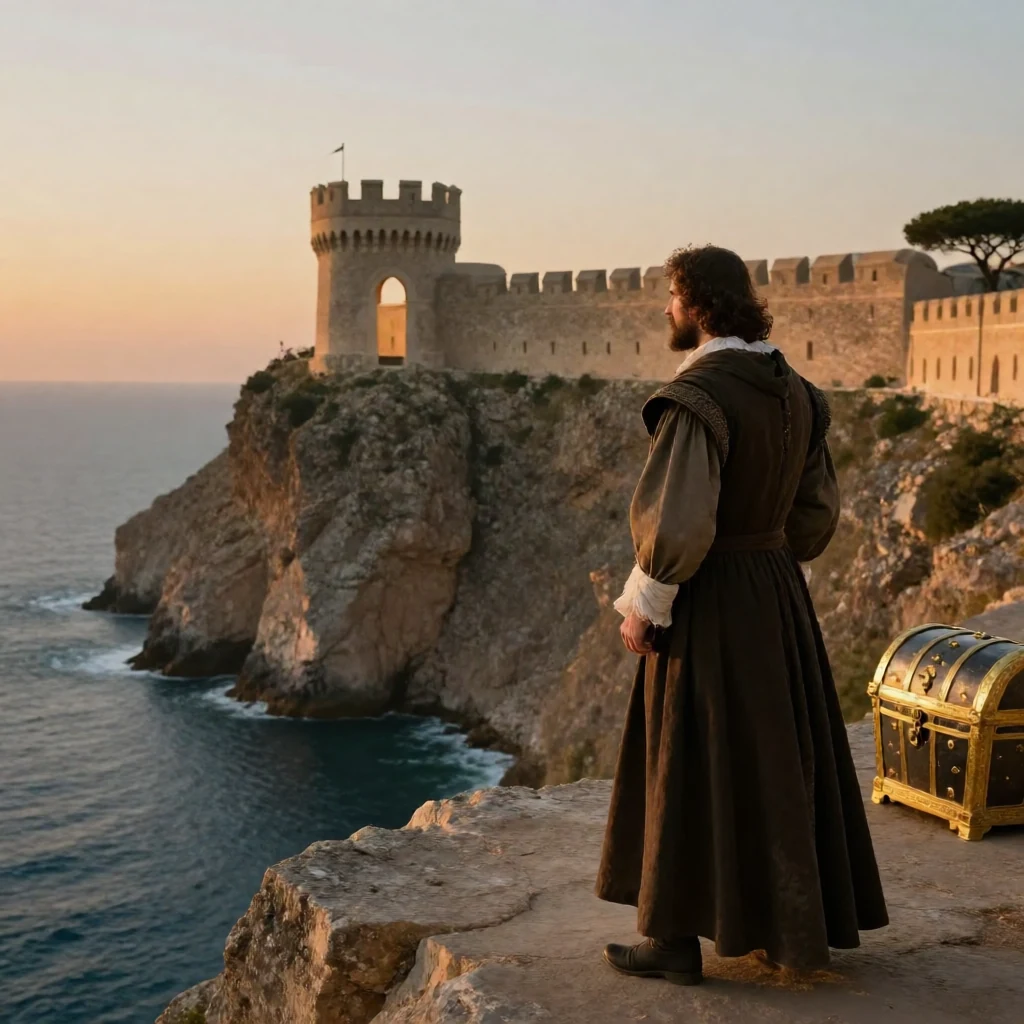
Faria Invites Dantès to View His Treatise
Dantès asks when he may see Faria’s work, and the abbé replies “whenever you please.” Dantès eagerly insists on going immediately, and Faria leads him back into the subterranean passage, with Dantès following as the old man disappears into its depths.
KAPITEL 17. The Abbé’s Chamber
Dantès reaches the Abbé Faria’s chamber through a narrow subterranean passage and is shown the remarkable tools, writings, and resources the Abbé has created during his long imprisonment. After examining these hidden treasures, Dantès recounts his own story of unjust arrest, prompting the Abbé to begin investigating the true motives behind his imprisonment through systematic questioning. Chapter 17, “The Abbé’s Chamber,” centers on the deepening collaboration between Edmond Dantès and Abbé Faria. Their conversation identifies Danglars as the letter’s author and exposes Villefort’s chilling duplicity: the deputy prosecutor destroyed the letter not out of compassion but to conceal his father’s revolutionary past. Stunned by this revelation, Dantès vows vengeance, but channels his energy into the abbé’s tutelage, rapidly mastering multiple languages and subjects over many months. While studying, Faria devises an elaborate escape plan involving a mine-like tunnel beneath the sentry’s post. After fifteen months of grueling labor with primitive tools, the excavation is complete—but the chapter ends on a cliffhanger as Faria suddenly collapses in agony. Chapter 17, “The Abbé’s Chamber,” depicts the catastrophic interruption of Dantès and Abbé Faria’s escape plan when the abbé is struck by a sudden, violent illness. The chapter traces the emergency response—Dantès’s administering of the prescribed remedy, the abbé’s grim revelation of permanent paralysis, Dantès’s solemn vow to remain with his friend, and the abbés order to conceal their excavation work.
KAPITEL 17. The Abbé’s Chamber
Dantès reaches the Abbé Faria’s chamber through a narrow subterranean passage and is shown the remarkable tools, writings, and resources the Abbé has created during his long imprisonment. After examining these hidden treasures, Dantès recounts his own story of unjust arrest, prompting the Abbé to begin investigating the true motives behind his imprisonment through systematic questioning.
Arrival at the Abbé’s Chamber
Dantès and the Abbé navigate the subterranean passage from Dantès’s cell to the Abbé’s chamber, the floor of which is paved. The Abbé had lifted a stone in the most obscure corner to begin a laborious excavation, the completion of which Dantès is about to witness. Upon entering, Dantès eagerly scans the room for marvels but sees nothing more than common furnishings.
The Abbé’s Sunlight Timekeeping Method
When Dantès questions how the Abbé can tell the time so precisely—indicating it is a quarter past twelve—the Abbé explains his method of tracing lines on the wall that correspond to the earth’s double motion and its elliptical orbit around the sun. He notes that a watch could break, but the sun and earth never vary in their appointed paths. Dantès, who believed the sun moved around the earth, finds the explanation bewildering but senses the mysteries of science within the Abbé’s words.
Opening the Hidden Treasure Cavity
Eager to see the Abbé’s treasures, Dantès is led to a disused fireplace, where the Abbé uses his chisel to raise a long stone that had served as the hearth. Beneath it lies a cavity of considerable depth that functions as a safe depository for the items the Abbé has described to Dantès.
The Abbé’s Completed Italian Monarchy Manuscript
At Dantès’s request to see the great work on the monarchy of Italy, the Abbé produces three or four rolls of linen, layered like papyrus folds. The rolls consist of cloth slips about four inches wide and eighteen inches long, carefully numbered and covered with legible Italian writing, a language Dantès understands as a Provençal. The Abbé notes he wrote “finis” at the end of the sixty-eighth strip about a week earlier, having torn up two shirts and as many handkerchiefs to complete the manuscript.
The Abbé’s Handmade Writing Tools
The Abbé shows Dantès the slender, six-inch writing stick resembling a fine painting-brush handle, to which a cartilage point is tied with thread and split at the nib like an ordinary pen. He then displays the penknife with which it was shaped, a razor-sharp blade he fashioned from an old iron candlestick, along with a larger knife that can both cut and thrust. Dantès examines these tools with the same wonder he once felt viewing curiosities from the South Seas in Marseilles shops.
The original text of this work is in the public domain. This page focuses on a guided summary article, reading notes, selected quotes, and visual learning materials for educational purposes.