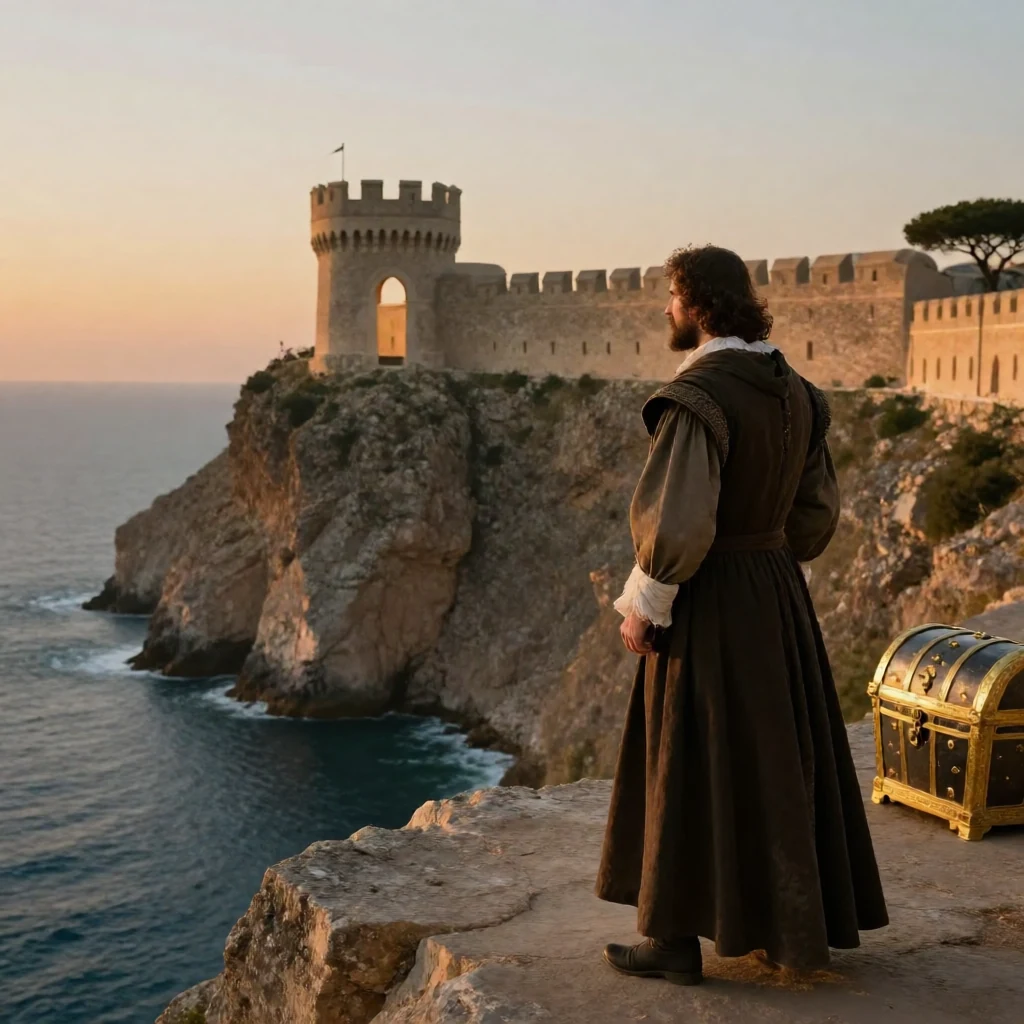
Sighting Monte Cristo
The next morning, going on deck at his usual early hour, the patron finds Dantès leaning against the bulwarks, gazing with intense earnestness at a pile of granite rocks that the rising sun tinges with rosy light. It is the Island of Monte Cristo. La Jeune Amélie passes three-quarters of a league to larboard and continues toward Corsica. Dantès thinks as they pass so closely that he has only to leap into the sea and in half an hour be at the promised land. But what could he do without instruments to discover the treasure, without arms to defend himself? What would the sailors and patron think? He must wait. Fortunately, Dantès has learned how to wait—he waited fourteen years for his liberty and can wait six months or a year for wealth. The letter of Cardinal Spada remains singularly circumstantial in his memory.
The Night Landing
Evening comes and Edmond sees the island tinged with twilight, then disappear into darkness from all eyes but his own, for he with vision accustomed to the gloom of a prison continues to behold it last of all, remaining alone upon deck. The next morning breaks off the coast of Aleria; all day they coast, and in the evening fires appear on land—signals for landing. A ship’s lantern replaces the streamer at the mast-head, and they come within a gunshot of the shore. The captain has mounted two small culverins as precaution. On this occasion the precaution proves superfluous; everything proceeds with utmost smoothness and politeness. Four shallops come alongside with very little noise, and the five boats work so well that by two o’clock in the morning all the cargo is out of La Jeune Amélie and on terra firma.
Dividing the Profits
The same night, such a man of regularity is the patron of La Jeune Amélie, that the profits are divided. Each man receives a hundred Tuscan livres, or about eighty francs.
Second Voyage
The voyage is not ended. They turn the bowsprit toward Sardinia to take in a cargo replacing what was discharged. The second operation proves as successful as the first—La Jeune Amélie is in luck. This new cargo, destined for the coast of the Duchy of Lucca, consists almost entirely of Havana cigars, sherry, and Malaga wines.
The Customs Skirmish
There they have a bit of a skirmish in getting rid of the duties, for the excise remains the everlasting enemy of the patron of La Jeune Amélie. A customs officer is laid low, and two sailors are wounded—Dantès among them, a ball having touched him in the left shoulder.
Dantès Wounded
Dantès is almost glad of this affray, almost pleased at being wounded, for these are rude lessons teaching him with what eye he can view danger and with what endurance he can bear suffering. He has contemplated danger with a smile, and when wounded has exclaimed with the great philosopher, “Pain, thou art not an evil.” He has looked upon the customs officer wounded to death, and whether from heat of blood or the chill of human sentiment, this sight has made but slight impression upon him. Dantès is on the path he desires to follow, moving toward the end he wishes to achieve; his heart is in a fair way of petrifying in his bosom.
Jacopo’s Devotion
Jacopo, seeing Dantès fall, believes him killed and rushes to raise him up, attending to him with all the kindness of a devoted comrade. This world is not then so good as Doctor Pangloss believed it, neither is it so wicked as Dantès thinks it, for this man, who has nothing to expect from his comrade but the inheritance of his share of the prize-money, manifests so much sorrow when he sees him fall. Fortunately, Edmond is only wounded, and with certain herbs gathered at certain seasons and sold to the smugglers by old Sardinian women, the wound soon closes. Edmond resolves to try Jacopo and offers him a share of his prize-money in return for his attention, but Jacopo refuses it indignantly. The sympathetic devotion which Jacopo has from the first bestowed on Edmond moves the latter to a certain degree of affection. Jacopo instinctively feels that Edmond has a right to superiority of position—a superiority Edmond has concealed from all others. The kindness Edmond shows him suffices for the brave seaman.
The original text of this work is in the public domain. This page focuses on a guided summary article, reading notes, selected quotes, and visual learning materials for educational purposes.