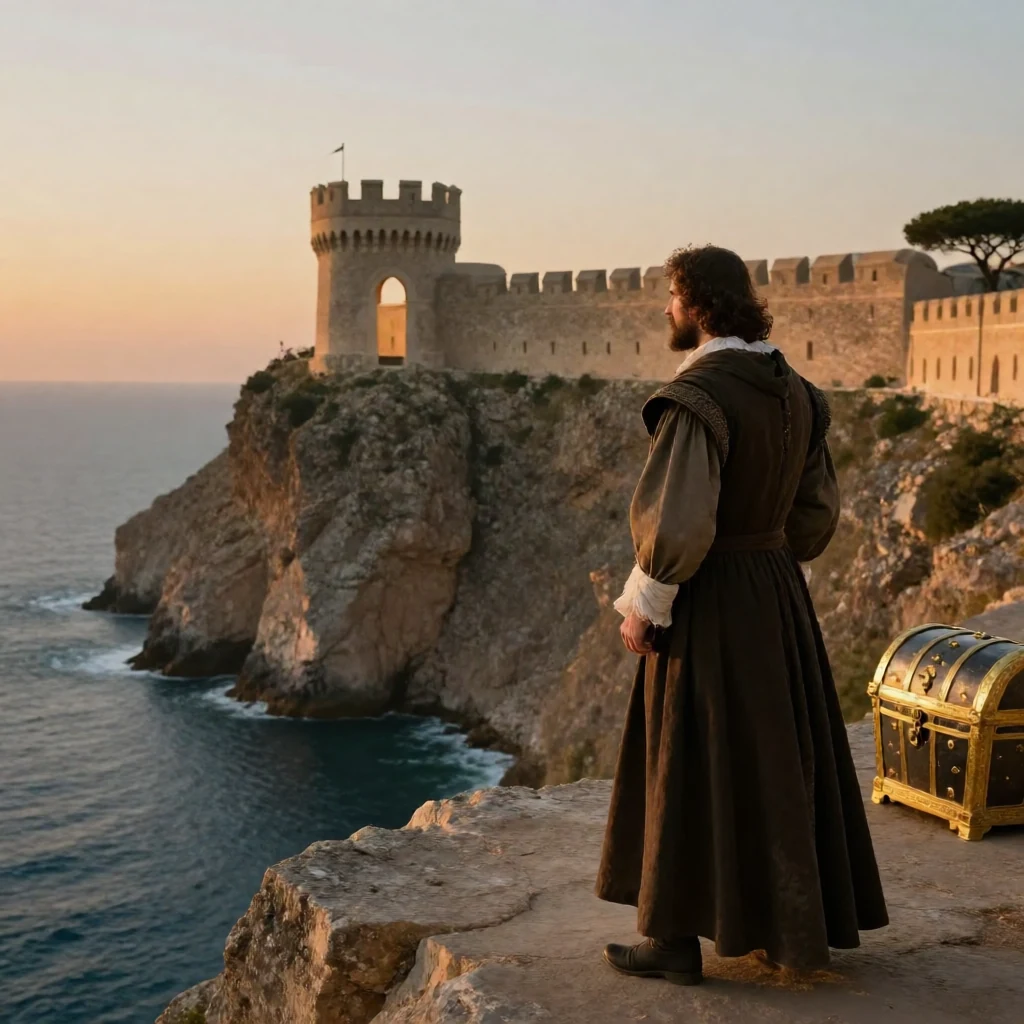
The Hidden Creek
Dantès recalls following the marks that the Abbé Faria had discovered, which led to a small creek hidden like a bath of some ancient nymph. This creek is wide enough at its mouth and deep enough in the center to admit a small lugger, perfectly concealed from observation. Dantès theorizes that Cardinal Spada, anxious to avoid surveillance, entered this creek, hid his vessel, followed the rock markings, and buried his treasure. However, one perplexing question remains: how could a rock weighing several tons have been lifted to this spot without many men?
Blasting the Rock
Edmond suddenly realizes the solution—they lowered the rock rather than raising it. Examining the base, he discovers a slope had been formed so the rock slid into position. Flints, pebbles, and earth concealed the orifice, with grass, weeds, moss, and myrtle-bushes completing the disguise. After digging for ten minutes, Dantès attacks the wall with his pickaxe. Finding the rock too heavy to move even with a lever made from an olive tree, he remembers the gunpowder left by his friend Jacopo. He digs a mine beneath the rock, fills it with powder, creates a match from a handkerchief rolled in saltpetre, lights it, and retreats. The explosion lifts the upper rock and shatters the lower one; a huge snake emerges from the aperture. Dantès then uses his lever to push the loosened rock until it tumbles into the ocean, revealing an iron ring set into a square flagstone.
The First Grotto
Overwhelmed with joy and trembling, Dantès inserts his lever and lifts the flagstone, revealing descending steps lost in darkness. Though tempted to rush forward, he pauses to reflect on his situation. He considers the possibility that Cæsar Borgia may have discovered Cardinal Spada’s secret, pursued the same trail, and already taken the treasure, leaving him nothing. Despite these doubts, he descends with a smile, murmuring “Perhaps!”—the last word of human philosophy. Rather than the darkness and foul air he expected, he finds a dim bluish light filtering through crevices in the rock, through which he can see blue sky and waving oak branches. His eyes, accustomed to darkness from his prison years, pierce even to the remotest angles of the granite cavern, which sparkles like diamonds. Remembering the will’s words about “the farthest angle of the second opening,” Dantès realizes he has only found the first grotto and must seek the second.
The Painted Wall
Dantès examines the walls of the first grotto, searching for the second cavern. His pickaxe strikes one section of the wall and produces a hollow, deeper echo. To avoid fruitless labor, he sounds all other walls before returning to the suspicious spot. Striking with greater force, he watches as stucco—similar to arabesque ground work—breaks away, exposing a white stone beneath. The opening had been sealed with stones, then covered with painted stucco imitating granite. As the evidence that Faria was not deceived grows stronger, Dantès paradoxically loses courage. He pauses, climbs the stairs to check if anyone is watching (though he is actually close to fainting), drinks rum, and returns. He discovers the stones are merely stacked, not cemented. Using his pickaxe as a lever, he makes the stones turn on an invisible hinge until the passage to the second grotto opens before him.
The Iron Casket
Dantès enters the lower, gloomier second grotto and advances toward a dark, deep corner on the left—the spot where the treasure must lie according to the will. After removing about two feet of earth, his pickaxe strikes an iron substance, producing a sound like a funeral knell or alarm bell. He strikes again and encounters wood. Believing he has found an iron-bound wooden casket, he becomes so pale he fears he might collapse. After a wild goat briefly startles him, he returns with a torch made from a resinous branch. By torchlight, he clears a space three feet long by two feet wide and uncovers an oaken coffer bound with cut steel. On the lid, a silver plate still untarnished bears the Spada family arms—a sword on an oval shield surmounted by a cardinal’s hat. Dantès recognizes them immediately from Faria’s many drawings. The treasure is here; no one would have taken such pains to conceal an empty casket.
The original text of this work is in the public domain. This page focuses on a guided summary article, reading notes, selected quotes, and visual learning materials for educational purposes.