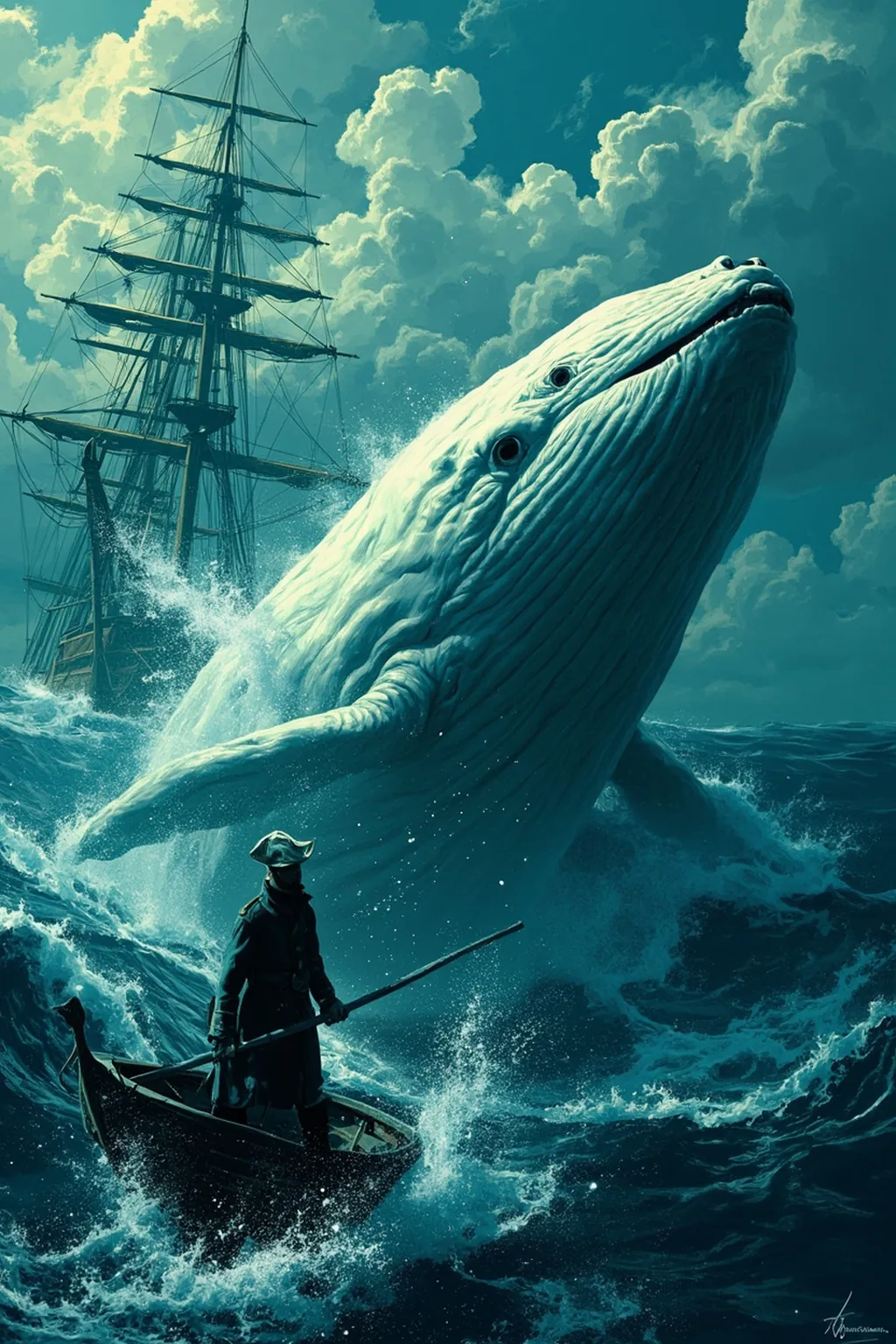
CAPÍTULO 93. The Castaway.
After Stubb’s after-oarsman injures his hand, the small Black sailor Pip is temporarily assigned to take his place in the boat. During his first hunt, Pip displays nervousness but survives the encounter without incident. On the second lowering, when the whale is struck and the line comes against Pip’s seat, he leaps from the boat in panic and becomes entangled in the whale line, being dragged through the water until Tashtego, at Stubb’s command, cuts the line and loses the whale. The crew curses Pip, and Stubb gives him stern advice to stay in the boat, threatening not to pick him up if he jumps again. Pip jumps a second time during a subsequent hunt, but Stubb keeps his word and refuses to rescue him, leaving him alone in the vast ocean. The Pequod eventually retrieves Pip from the sea, but from that hour he walks the deck an idiot, his mind broken by the experience, though his soul has been carried down to strange, profound depths where he glimpses visions that his shipmates interpret as madness.
The Significant Event
Shortly after encountering the Frenchman, a most significant and lamentable event befell the most insignificant crew member of the Pequod. This occurrence would ultimately provide the craft with a living prophecy of whatever shattered sequel might await her.
The Ship-Keepers
In the whale ship, not everyone goes in the boats. A select few called ship-keepers are reserved to work the vessel while the boats pursue whales. Typically, these ship-keepers are as hardy as the men in the crews. However, if an unduly slender, clumsy, or timorous individual exists aboard, that person is certain to be assigned as a ship-keeper. Such was the case with the little negro Pippin, nicknamed Pip.
Description of Pip
Pip made a striking pair with Dough-Boy, like a black pony and a white one in an eccentric span. While Dough-Boy was dull and torpid by nature, Pip, though over tender-hearted, possessed a bright, genial, jolly disposition characteristic of his tribe—a people who enjoy holidays and festivities with finer relish than any other race. The panic-striking business of whaling had sadly blurred his brightness, though what was temporarily subdued in him would later be luridly illuminated by strange experiences. The narrative employs a diamond metaphor to illustrate how brilliance shows most impressively against a dark background.
The Ambergris Affair
During the ambergris affair, Stubb’s after-oarsman happened to sprain his hand, rendering him maimed for a time. Consequently, Pip was temporarily put into his place.
The First Lowering
On the first occasion Stubb lowered with Pip, the young man exhibited much nervousness. Happily, he escaped close contact with the whale and came off not altogether discreditably. Stubb observed this and afterward exhorted him to cherish his courageousness to the utmost.
The Second Lowering
Upon the second lowering, the boat paddled upon the whale. When the fish received the darted iron, it gave its customary rap, which in this instance occurred directly under poor Pip’s seat, setting the tragic sequence in motion.
The Line Entanglement
The involuntary consternation of the moment caused Pip to leap, paddle in hand, out of the boat. Part of the slack whale line came against his chest, and he breasted it overboard with him, becoming entangled when he plumped into the water. Instantly the whale started on a fierce run, the line straightened, and poor Pip was dragged foaming up to the chocks of the boat, the line having taken several turns around his chest and neck.
Tashtego’s Command
Tashtego stood in the bows, full of the fire of the hunt, despising Pip as a poltroon. Snatching the boat-knife, he suspended its sharp edge over the line, turning toward Stubb and exclaiming interrogatively, “Cut?” Meantime Pip’s blue, choked face plainly looked, “Do, for God’s sake!” In less than half a minute, the entire decision was made.
Stubb’s Rebuke
Stubb roared “Damn him, cut!” and the whale was lost while Pip was saved. Afterward, the poor little negro was assailed by yells and execrations from the crew. Permitting these cursings to evaporate, Stubb then cursed Pip in a business-like but half-humorous manner, followed by unofficially giving him wholesome advice—essentially, never jump from a boat except under indefinite circumstances. Concluding with a peremptory command, Stubb declared that he would not pick Pip up if he jumped again, noting that a whale would sell for thirty times what Pip was worth. This hinted that though man loves his fellow, man is also a money-making animal.
The original text of this work is in the public domain. This page focuses on a guided summary article, reading notes, selected quotes, and visual learning materials for educational purposes.