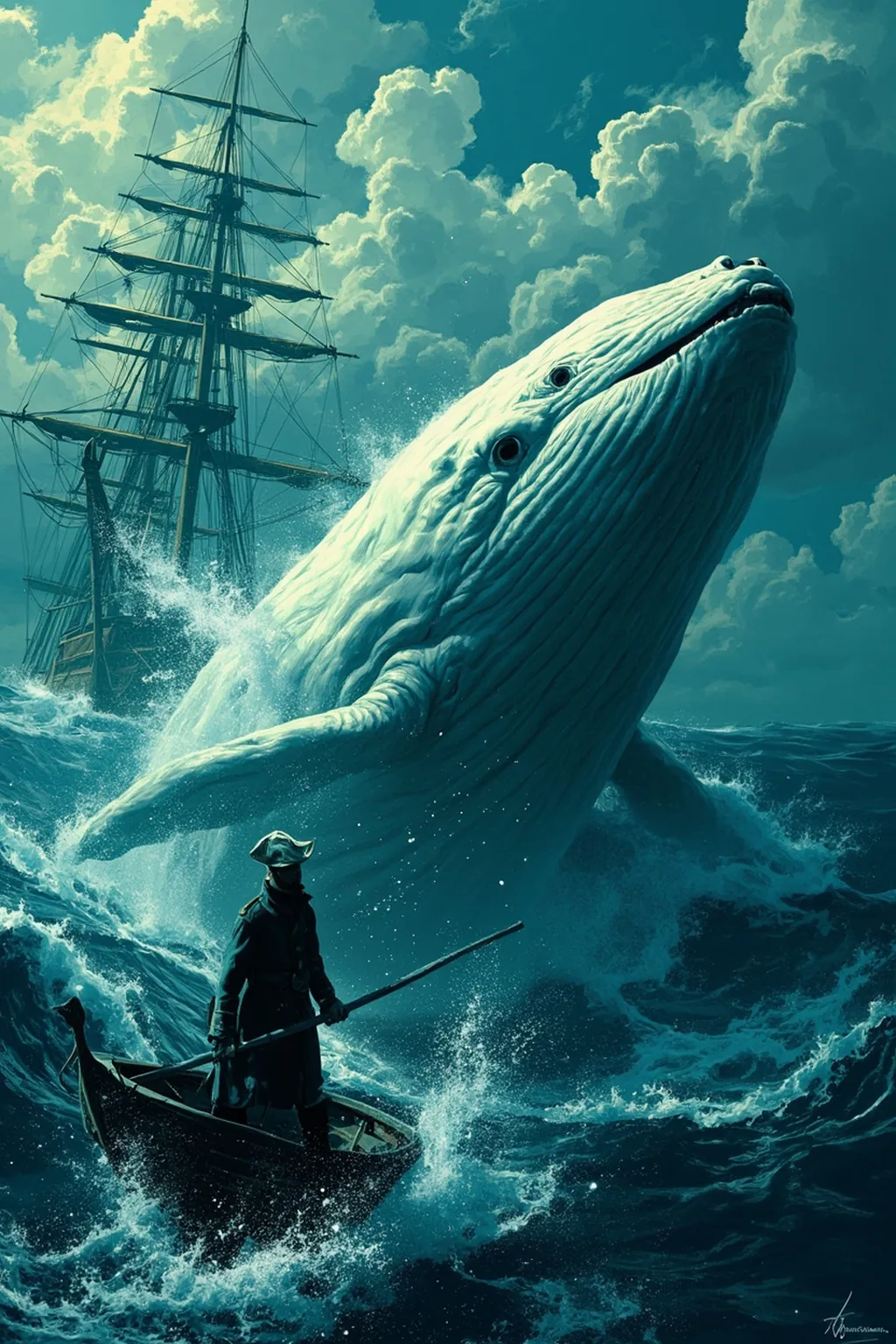
Magnitude of Fossil Whales
Contrary to what one might expect, investigation reveals that modern whales actually exceed in magnitude the fossil whales found in the Tertiary geological period. Furthermore, among Tertiary whales themselves, those from later formations are larger than those from earlier periods. The largest pre-adamite whale fossil discovered—the Alabama specimen—measures less than seventy feet in skeleton length, while modern large whales measure seventy-two feet, and sperm whales have been captured near one hundred feet long.
Degeneration Since Adam
The question arises whether, while whales have advanced in size across geological time, they may have degenerated since Adam. A whaleman’s perspective rejects this notion outright, arguing that the whale of today matches his ancestors from Pliny’s era. The narrator points to Egyptian mummies and ancient tablet sculptures of cattle as evidence that other creatures show no degeneration—only the whale cannot be conceded to have degenerated.
Ancient Naturalists’ Accounts
Pliny and ancient naturalists report whales of extraordinary size—whales embracing acres of living bulk. Aldrovandus describes whales measuring eight hundred feet. A Danish academic recorded Iceland whales (reydan-siskur, or Wrinkled Bellies) at three hundred and sixty feet. Lacépède’s 1825 natural history sets the Right Whale at three hundred and twenty-eight feet. However, whalemen dismiss these accounts as fantasy, and the narrator resolves to inform Pliny directly that whales have not degenerated.
Will Leviathan Perish?
This central inquiry considers whether omniscient lookouts and relentless harpoons penetrating even through Behring’s Straits will eventually exterminate the whale from the waters. The poignant image emerges of the last whale, like the last man, smoking his final pipe before evaporating in a concluding puff. However, the chapter argues against this conclusion through multiple considerations.
Buffalo Hunting Comparison
The extermination of buffaloes—once numbering tens of thousands on Illinois and Missouri prairies—seems to offer an analogy suggesting imminent whale extinction. Yet the nature of whale hunting differs fundamentally: forty men pursuing sperm whales for forty-eight months might capture forty fish, whereas the same number of mounted hunters could slay forty thousand buffaloes in identical timeframe. This disparity in hunting efficiency argues against comparing the two species’ fates.
Polar Citadels
Whale-bone whales possess two impregnable fortresses—their Polar citadels. When hunted from the middle seas, they retreat to polar regions, diving beneath icy barriers to emerge among floes in a “charmed circle of everlasting December” where they defy all human pursuit. These refuges will apparently remain inaccessible to hunters forever.
Whale Longevity
The probable great longevity of whales—likely exceeding a century—means that several distinct adult generations coexist at any given time. To comprehend this, one must imagine all graveyards and family vaults releasing the bodies of everyone alive seventy-five years ago, adding that countless host to the present human population.
Species Immortality
The chapter concludes that the whale is immortal in species though perishable in individuality. He swam before the continents broke water, swam over sites now occupied by the Tuileries, Windsor Castle, and the Kremlin. He despised Noah’s Ark during the Flood, and will survive any future world flood—rearing upon the topmost crest of the equatorial deluge, spouting defiance to the skies.
CAPÍTULO 106. Ahab’s Leg.
This chapter explores the damage and history of Captain Ahab’s ivory prosthetic leg, revealing both the physical deterioration of the limb and the deeper philosophical darkness of Ahab’s character concerning grief and suffering.
Ahab’s Leg Injury Departing the Samuel Enderby
When Captain Ahab departed the Samuel Enderby of London, he did so with violence to his own person. He had lighted with such energy upon a thwart of his boat that his ivory leg received a half-splintering shock. Later, when he wheeled around with an urgent command to the steersman about not steering inflexibly enough, the already shaken ivory received such an additional twist and wrench that though it still appeared entire and lusty, Ahab did not deem it entirely trustworthy.
Ahab’s Prior Severe Ivory Leg Injury
For all his pervading, mad recklessness, Ahab did at times give careful heed to the condition of that dead bone upon which he partly stood. Not very long prior to the Pequod’s sailing from Nantucket, he had been found one night lying prone upon the ground and insensible. By some inexplicable casualty, his ivory limb had been so violently displaced that it had stake-wise smitten and all but pierced his groin. The agonizing wound required extreme difficulty to cure entirely.
The original text of this work is in the public domain. This page focuses on a guided summary article, reading notes, selected quotes, and visual learning materials for educational purposes.