LIVRE V.
This is the top‑level entry for Chapter V (BOOK V), containing one child section.
The Dead Hand
The section titled The Dead Hand provides the content and focus of this part of the chapter.
CHAPITRE XLIII.
Dorothea Casaubon visits the Lydgates’ home seeking news of her husband’s health from Dr. Lydgate, only to discover Will Ladislaw there alone with Rosamond Lydgate. The encounter leaves Dorothea suddenly conscience-stricken about her private mission and the impropriety of finding Will in another man’s absence; she abruptly departs for the Hospital herself rather than wait, her newfound wariness manifesting as a coldness toward Will that he recognizes with mortification. Back at the drawing room, Will’s irritation persists through banter with Rosamond about Dorothea’s singular qualities, while later Lydgate dismisses his cousin-in-law as a “gypsy” and gently teases Rosamond about her emerging suspicions of Will’s devotion to Mrs. Casaubon, his own contentment with his wife remaining unshaken despite her growing awareness of romantic conquest as a feminine art. Lydgate ultimately reassures Rosamond of his affection and reveals that Dorothea intends to pledge two hundred pounds annually to the New Hospital, securing her as an important patron for their professional aspirations.
The Decision to Visit Lydgate
Dorothea Casaubon ventures alone to Middlemarch, defying her usual habit of never traveling without her husband. Driven by mounting anxiety about Casaubon’s health, she hopes to gather information from Lydgate without revealing her true concerns to her husband. Though she feels guilty seeking knowledge about him from another person, her fear of ignorance—imagining it might make her unjust or harsh—compels her to act. The chapter opens with a poem celebrating art of “generous womanhood” that transcends time and fashion, perhaps foreshadowing Dorothea’s own timeless dignity.
Meeting Mrs. Lydgate
Arriving at the Lydgate residence in Lowick Gate around four o’clock, Dorothea finds that Lydgate himself is not at home. When she inquires about his wife, she learns that Mrs. Lydgate is indeed present—a woman Dorothea has never personally met despite knowing of the marriage. Asking to speak with Rosamond, Dorothea waits as the servant delivers her message, during which she hears the sounds of music wafting through an open window: a man’s voice accompanied by piano roulades that suddenly break off.
Dorothea’s Simple Dress
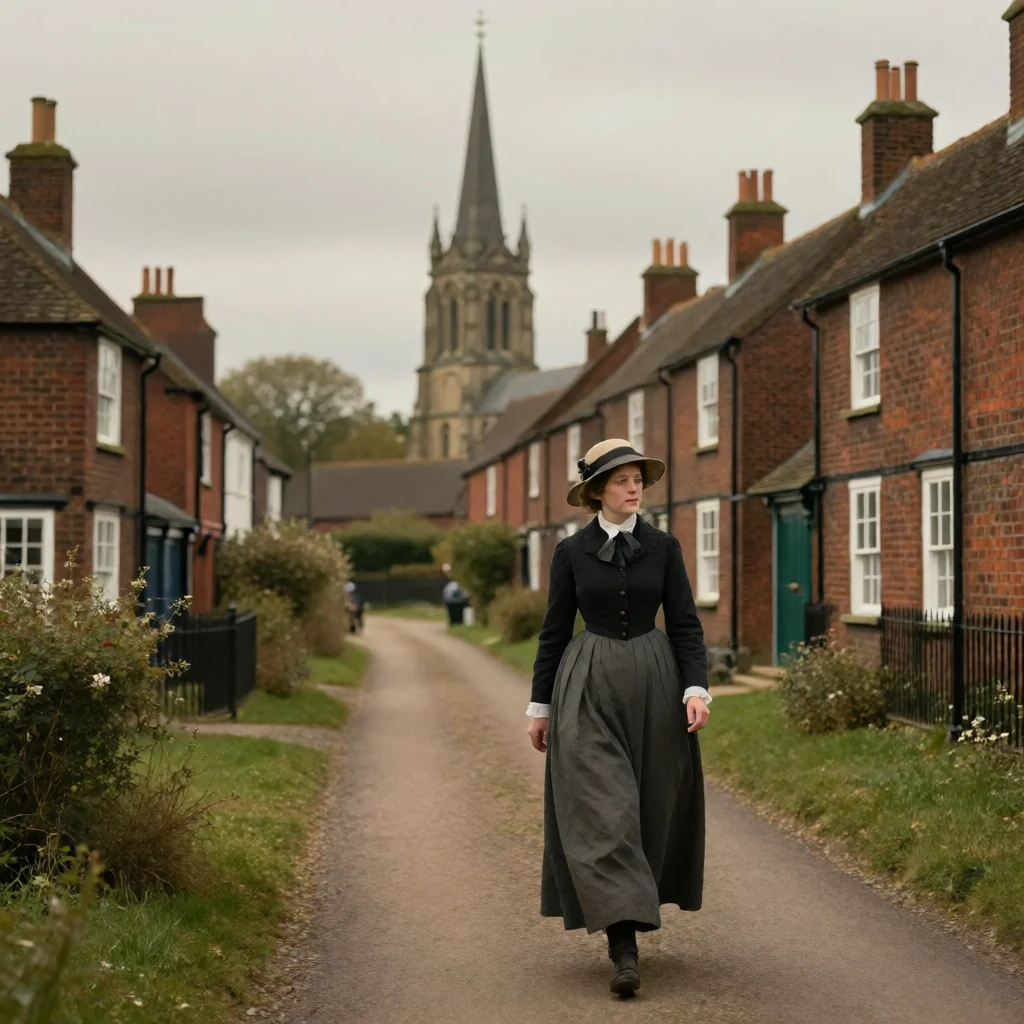
The narrative pauses to contrast the two women upon their meeting. Dorothea wears simple thin white woolen fabric, soft and modest, in the shape of an unfashionable pelisse with hanging sleeves—yet her grace and dignity transform the plain garment into something appropriate for a dramatic heroine. Her expression is candor itself, her beauty requiring no artificial ornament. Rosamond, by contrast, presents herself in pale-blue dress of perfect fashionable fit, elaborate embroidered collar, and small hands adorned with rings. Where Dorothea possesses “generous womanhood,” Rosamond displays “controlled self-consciousness of manner,” described as an “expensive substitute for simplicity.” Rosamond studies Dorothea as a county goddess, while Dorothea extends her “usual simple kindness.”
Will Ladislaw’s Presence
The mysterious gentleman at a distance proves to be Will Ladislaw, who had already taken up his hat in preparation to leave when Dorothea entered. Dorothea colors with surprise but greets him with evident pleasure, expressing that she had no thought of seeing him there. Will immediately offers to fetch Lydgate from the New Hospital, an offer that Dorothea initially accepts before dramatically changing her mind.
The Sudden Departure
In a sudden reversal, Dorothea announces she will drive to the Hospital herself rather than wait or send the carriage for Lydgate. She takes her leave of Rosamond with hurried politeness, her mind clearly arrested by some sudden thought. She is barely conscious of her surroundings as she leaves, though she accepts Will’s arm to the carriage and says nothing during their silent walk. This sudden departure from the Lydgate household represents a significant moment of social self-awareness and moral reflection.
Reflections in the Carriage
During the five-minute drive to the Hospital, Dorothea experiences new reflections that crystallize her discomfort. She realizes that allowing further voluntary intercourse with Will—interactions she could not mention to her husband—would constitute a form of deception, especially given that her current errand already involves concealment from Casaubon. The music she heard (Will singing with Rosamond) returns to her consciousness, prompting her to wonder why Will spends time with Mrs. Lydgate in her husband’s absence, just as he had once spent time with her under similar circumstances. She remembers signs suggesting Casaubon disapproved of Will’s visits during his absence, and wonders if she has been mistaken in many things. Tears come to her eyes, and the image of Will that had been so clear to her becomes “mysteriously spoiled.” The carriage stops at the Hospital gates, and she recovers her purpose upon meeting Lydgate.
The original text of this work is in the public domain. This page focuses on a guided summary article, reading notes, selected quotes, and visual learning materials for educational purposes.