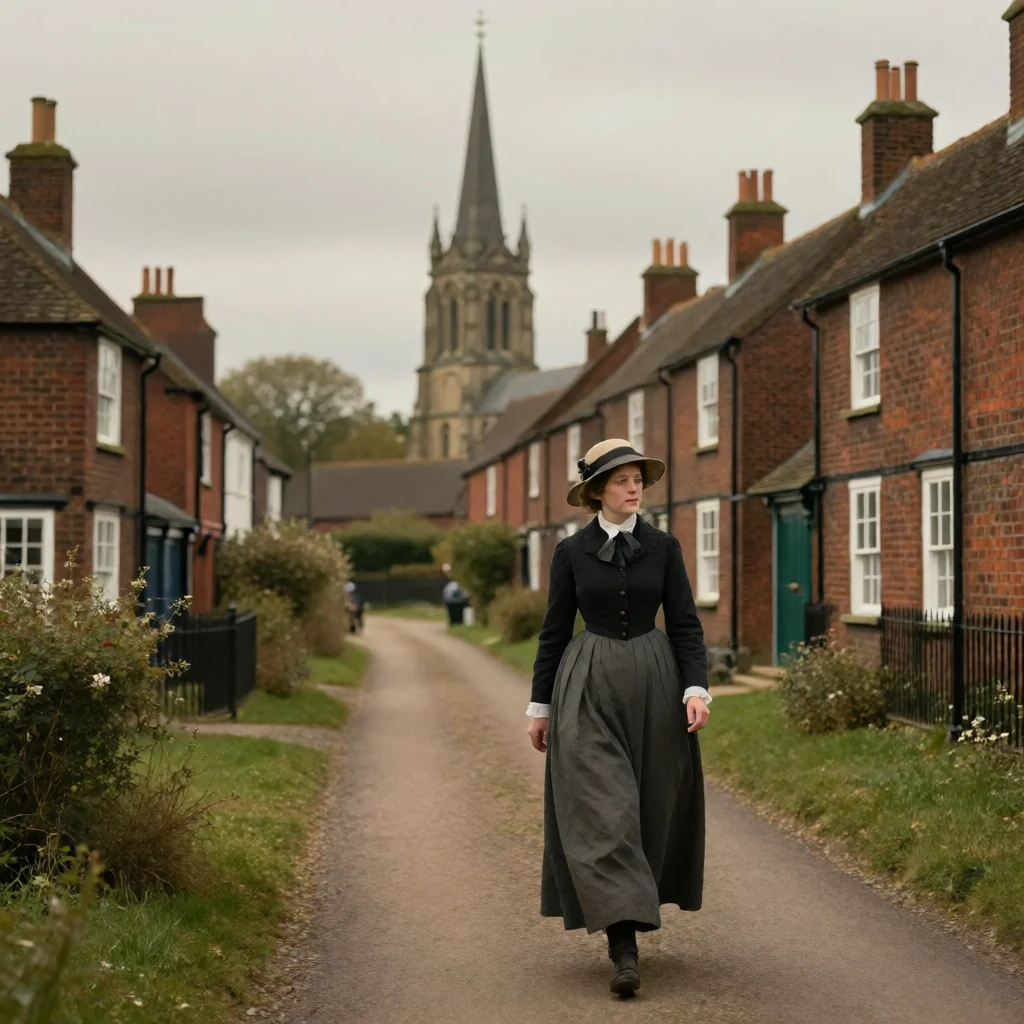
Rosamond Wishes Lydgate Was Not a Doctor
After Lydgate finishes Vesalius’s story, Rosamond admits she often wishes Lydgate had not pursued a career in medicine.
The Couple Debates the Medical Profession
Lydgate protests that Rosamond’s comment is equivalent to wishing she had married a different man, passionately defends medicine as the world’s grandest profession, and argues that loving him without embracing his work as a doctor is illogical. Rosamond teases him, calling him “Doctor Grave-face” and joking she will pretend to adore skeletons and body-snatchers, while Lydgate dismisses her Quallingham cousins’ judgment that his profession is beneath him.
Lydgate and Rosamond Reconcile
Lydgate gives up trying to argue with Rosamond, pets her affectionately, and the pair reconcile their small disagreement.
CHAPITRE XLVI.
CHAPTER XLVI. The chapter, opened by a Spanish proverb about accepting what one can have, links Lydgate’s local fight for Medical Reform with Middlemarch’s growing national engagement with political Reform. The narrative centers on Will Ladislaw’s deepening commitment to political work with Mr. Brooke, the social gossip surrounding him, and a concluding evening at the Lydgates’ home where he and Lydgate debate the merits and limits of the Reform movement.
The Approach of the Reform Bill
The Approach of the Reform Bill While Lydgate wrestles with Medical Reform at the Hospital, Middlemarch becomes increasingly aware of the national struggle for political Reform. As Lord John Russell’s measure is debated in the House of Commons, a new political animation sweeps the town and parties are redefined. Some observers already predict that a new election will be forced before the actual Parliament can carry a Reform Bill, a development Will sees as reason for celebration that he has not yet tested himself at the hustings.
Will Ladislaw and Mr. Brooke
Will Ladislaw and Mr. Brooke Will tells Brooke that the public temper will soon reach “cometary heat” now that Reform is on the table, and they should work through the “Pioneer” and political meetings. Brooke, eager to “make a new thing of opinion,” wishes to remain independent, preferring Wilberforce’s and Romilly’s causes such as Negro Emancipation and Criminal Law, while still intending to support Grey. Will warns him that supporting the principle of Reform means accepting the reforms the situation actually offers.
The “Pioneer” and Political Meetings
The “Pioneer” and Political Meetings Will argues the country wants a House of Commons that represents interests beyond the landed class, and that seeking anything less is like asking for a piece of an avalanche already thundering. Brooke, delighted by Will’s rhetoric and comparing it to Burke, urges him to commit ideas to paper in the “Pioneer,” using figures to deduce misery and the rate of political determination. Will wryly notes that pocket-boroughs would be excellent provided they were always held by the right people, including a Burke at hand.
Will’s Dedication to the Cause
Will’s Dedication to the Cause Will, long used to expressing himself better than Middlemarch notices, finds political writing surprisingly fulfilling and studies the political situation with the same ardor he once gave to metre and mediaevalism. The narrator concedes that, but for Dorothea’s presence and a lack of alternatives, he would likely have drifted into dilettante sketching and verse in Italy. He has accepted his work, warmed by its contact with life and action, and through the “Pioneer” has achieved a minor celebrity as far as Brassing, with Brooke’s occasional irritations eased by the variety between the Grange and his Middlemarch lodgings.
Middlemarch Gossip About Ladislaw
Middlemarch Gossip About Ladislaw Town opinion, rather than elevating Will as Lydgate’s high connections had elevated that doctor, tends to confirm Mr. Casaubon’s view. Mr. Hawley suggests Brooke has taken Will up precisely because no sensible man would have expected it, and that Casaubon must have excellent reasons for cold-shouldering a young man whose upbringing he paid for. Other oddities and rumors circulate about Will, undermining his standing in Middlemarch society.
The “Trumpet”’s Criticism of Will
The “Trumpet”’s Criticism of Will Mr. Keck, editor of the rival “Trumpet,” asserts that Ladislaw is not only a Polish emissary but crack-brained, which he offers as the explanation for the preternatural fluency of Will’s platform speeches. In a leading article, Keck denounces Will’s Reform speech as the violence of an “energumen,” a term Dr. Sprague pretends not to know, accusing him of using fireworks to disguise irresponsible statements and threadbare knowledge. This characterization of Will as dangerous, however, is strikingly at odds with other habits he displays.
The original text of this work is in the public domain. This page focuses on a guided summary article, reading notes, selected quotes, and visual learning materials for educational purposes.