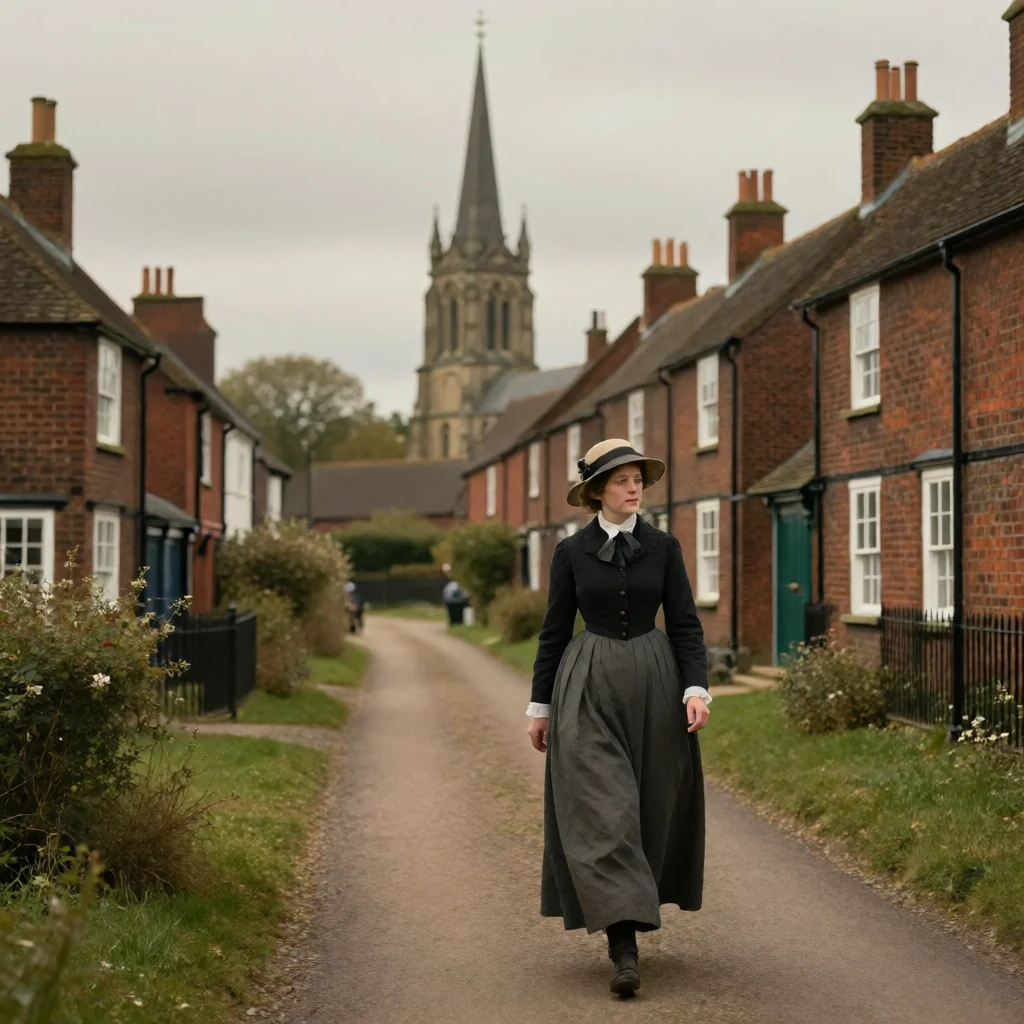
Dorothea’s Emotional Response to the Codicil
Dorothea’s first reaction is to dismiss the financial provision as of no consequence, only to be checked by Celia’s persevering clarification that the clause is directed specifically against Ladislaw. The blood rushes painfully to her face and neck. As Celia continues in her neutral, matter-of-fact tone—comparing the situation to Mrs. Cadwallader’s jest about marrying an Italian with white mice, and then tripping off to look at baby—Dorothea, turned cold, throws herself back helplessly. Her whole world convulses: her husband’s conduct, her duteous feeling toward him, every past struggle between them, and especially her entire relation to Will Ladislaw are suddenly reconceived. She is conscious of a violent shock of repulsion from Casaubon’s hidden thoughts, and simultaneously of a sudden, strange, unprecedented yearning of heart toward Ladislaw. The only certainty she can articulate is that she must wait and think anew.
Lydgate Advises on Dorothea’s Wellbeing
Lydgate arrives and, observing her agitation, takes her marble-cold hand to feel her pulse. When Celia reports that Dorothea wants to go to Lowick to look over papers, Lydgate, after a pause, advises that she should do what would give her the most repose of mind, and that such repose will not always come from being forbidden to act. He privately tells Sir James to let Mrs. Casaubon do as she likes, since she wants perfect freedom more than any prescription. From his earlier attendance upon her, Lydgate has concluded that she suffered from the strain of self-repression, and that she now feels herself only in another sort of pinfold than the one from which she has been released. His advice makes it easier for Sir James to comply with her request to be driven to Lowick the next day.
Dorothea Searches Casaubon’s Papers at Lowick
At Lowick, Dorothea asks Sir James not to linger, declaring she could not bear to stay; she will think better from a distance, and would like to be at the Grange for walks among the village people. Sir James avoids mentioning the objectionable codicil, partly to spare her, and partly out of masculine shyness, while Dorothea silently wishes he could know of Casaubon’s earlier dispute with her over Ladislaw’s moral claim to the property, both for Will’s sake and to vindicate him from being compared with an Italian carrying white mice. Once inside, Dorothea searches every desk and drawer for private writing addressed to her but finds nothing personal, only the “Synoptical Tabulation” intended as the opening of many directions. Locking the empty desks again, she returns to Freshitt with the sense that around Casaubon’s last hard demand and his last injurious assertion of power, the silence is unbroken.
Dorothea’s Reflections on Property and Duty
In long retrospective meditation, Dorothea reflects on the property as a sign of her broken tie and on the duties attached to ownership which she ought not to flinch from. Once, bound by a pledge wrung from her pity, she would have undertaken his futile toil as a supreme consecration of faithfulness; but now, with her judgment made active by the discovery that her marriage harboured hidden alienation, she recoils from her late husband, who has even defeated his own pride by shocking ordinary men of honour. Yet, even in indignation, she cannot triumphantly elude his purpose by giving half the estate to Will Ladislaw; Casaubon’s cruelly effective codicil has made such an act of justice impossible. The revelation, however, has awakened in her a strange new yearning toward Ladislaw and a wish that his true standing be acknowledged.
Lydgate Recommends Mr. Farebrother for the Rectory
Dorothea at last turns her thoughts toward immediate duties, foremost among them the appointment to the living, a subject Lydgate has caught eagerly from her earlier mention. Determined to make amends for a casting-vote once given against his conscience, Lydgate sets aside Mr. Tyke and proposes instead Mr. Farebrother, the Vicar of St. Botolph’s, whose poor living barely supports a dependent household of mother, aunt, and sister and has kept him from marrying. Lydgate praises Farebrother’s preaching as the best he has ever heard—plain, easy, original, simple, and clear upon every subject—and judges him a remarkable fellow who ought to have risen higher than he has.
The original text of this work is in the public domain. This page focuses on a guided summary article, reading notes, selected quotes, and visual learning materials for educational purposes.