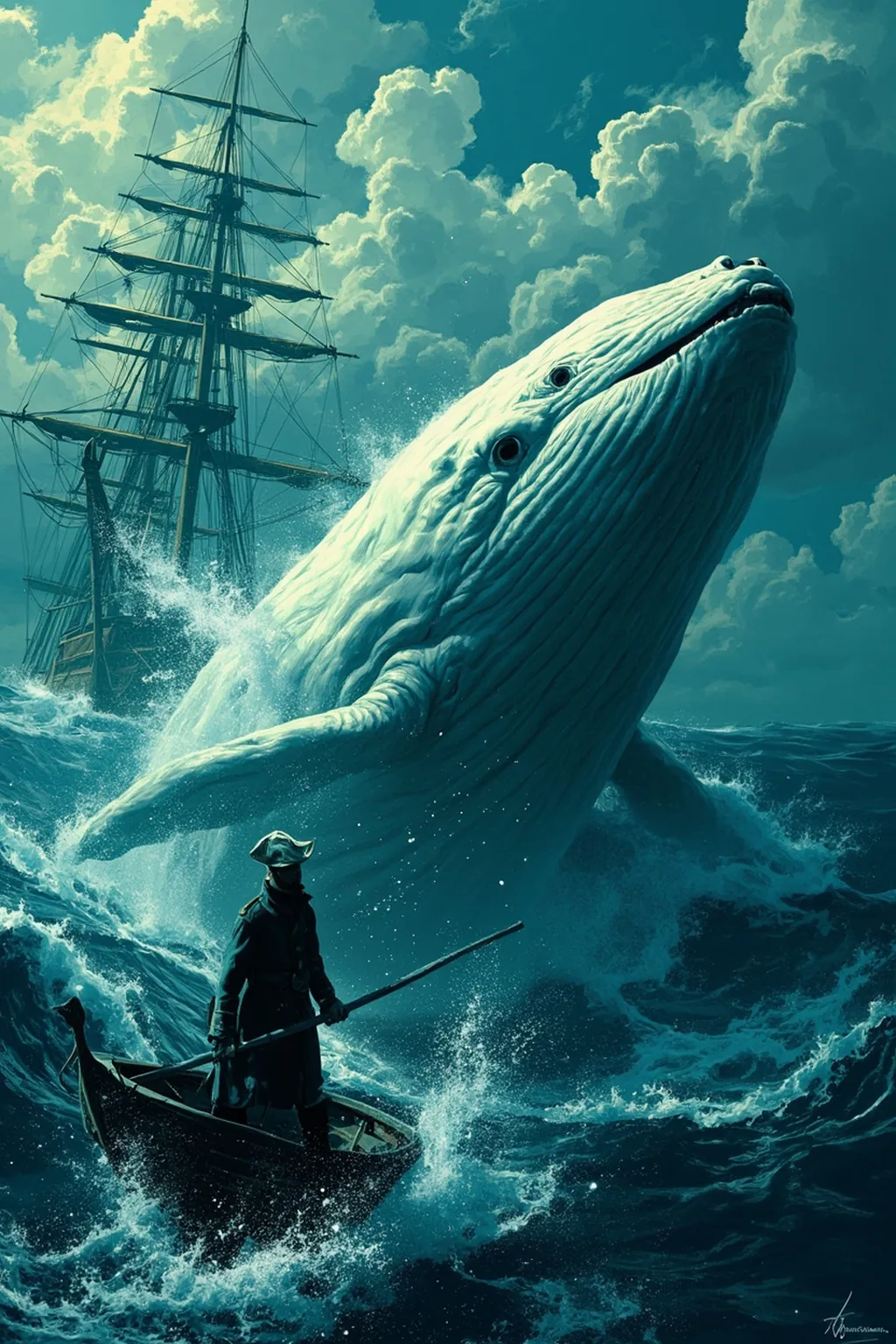
Justification for Sovereign Whale Ownership
Justification for Sovereign Whale Ownership The chapter explores why the sovereign possesses the right to claim whales in the first place. While Bracton’s law established the division, the legal commentator Plowdon provides the reasoning: whales belong to the King and Queen “because of its superior excellence.” The narrator observes that “by the soundest commentators this has ever been held a cogent argument in such matters.” However, the chapter then poses a question to lawyers: “But why should the King have the head, and the Queen the tail?” This inquiry introduces the search for deeper justification behind the specific division itself.
Error in Queen’s Whalebone Tail Claim
Error in Queen’s Whalebone Tail Claim The chapter addresses William Prynne’s explanation for the Queen’s portion. In his treatise on “Queen-Gold” (queen-pinmoney), Prynne claimed the tail belongs to the Queen so her wardrobe may be supplied with whalebone. The narrator points out this reasoning is fundamentally flawed: the black limber bone of the Greenland or Right whale, largely used in ladies’ bodices, is located in the head of the whale, not the tail. The narrator calls this “a sad mistake for a sagacious lawyer like Prynne,” though he speculates that “an allegorical meaning may lurk here” given the mermaid-like image of presenting a tail to the Queen.
Royal Fish Classification Under English Law
Royal Fish Classification Under English Law The chapter concludes by noting that two fish are classified as royal under English law: the whale and the sturgeon. Both are royal property under certain limitations and nominally supply the tenth branch of the crown’s ordinary revenue. The narrator suggests by inference that the sturgeon must be divided similarly to the whale, with the King receiving the head, which is “highly dense and elastic” in that species. This leads to a closing reflection that “there seems a reason in all things, even in law,” suggesting the chapter has thoroughly examined the logic (or apparent lack thereof) behind these royal fish regulations.
CHAPITRE 91. The Pequod Meets The Rose-Bud.
A week after their last whaling scene, the Pequod sails over a calm, vapory sea. The crew’s sense of smell detects something unusual before anyone spots it visually—a peculiar, unpleasant odor drifting across the water.
The Vapory Mid-Day Sea
Stubb comments that the smell likely comes from drugged whales they had encountered before, suggesting they would “keel up before long.” The vessel drifts through a sleepy, mid-day calm as the mysterious scent grows stronger.
The Peculiar Smell
The foul odor becomes inescapable as a dead whale’s presence reveals itself. The smell is described as more intolerable than a plague-stricken city, making the air nearly impossible to breathe without gagging.
The French Ship Rose-Bud
A French vessel appears in the distance, flying French colors and with a whale alongside. As the Pequod approaches, they see the ship is named “Bouton de Rose” (Rose-bud), with a figurehead carved to resemble a drooping green stalk with copper thorns and a red folded bulb—quite romantic for such unpleasant circumstances.
The Blasted Whale
The whale alongside the French ship is identified as a “blasted whale”—one that died unmolested and floated unclaimed. Such whales emit a terrible odor and produce inferior oil, yet some captains still pursue them despite the stench.
Stubb’s Recognition
Stubb recognizes his own cutting spade-pole entangled in the lines around the whale. He mocks the French as poor fishermen who mistake breakers for whale spouts and sail with holds full of candles and snuffers, knowing they won’t catch enough oil. Yet he notes they are content with the Pequod’s leavings—drugged whales and the bones of dried-up specimens.
The Guernsey-Man’s Complaint
The French chief mate, a Guernsey-man, speaks English and explains his predicament: his nose is slung in a bag because the stench is unbearable. He complains that his captain won’t listen to reason, insisting on working the whales despite their worthlessness. The captain, a former Cologne manufacturer on his first voyage, refuses to believe the mate’s warnings.
The original text of this work is in the public domain. This page focuses on a guided summary article, reading notes, selected quotes, and visual learning materials for educational purposes.