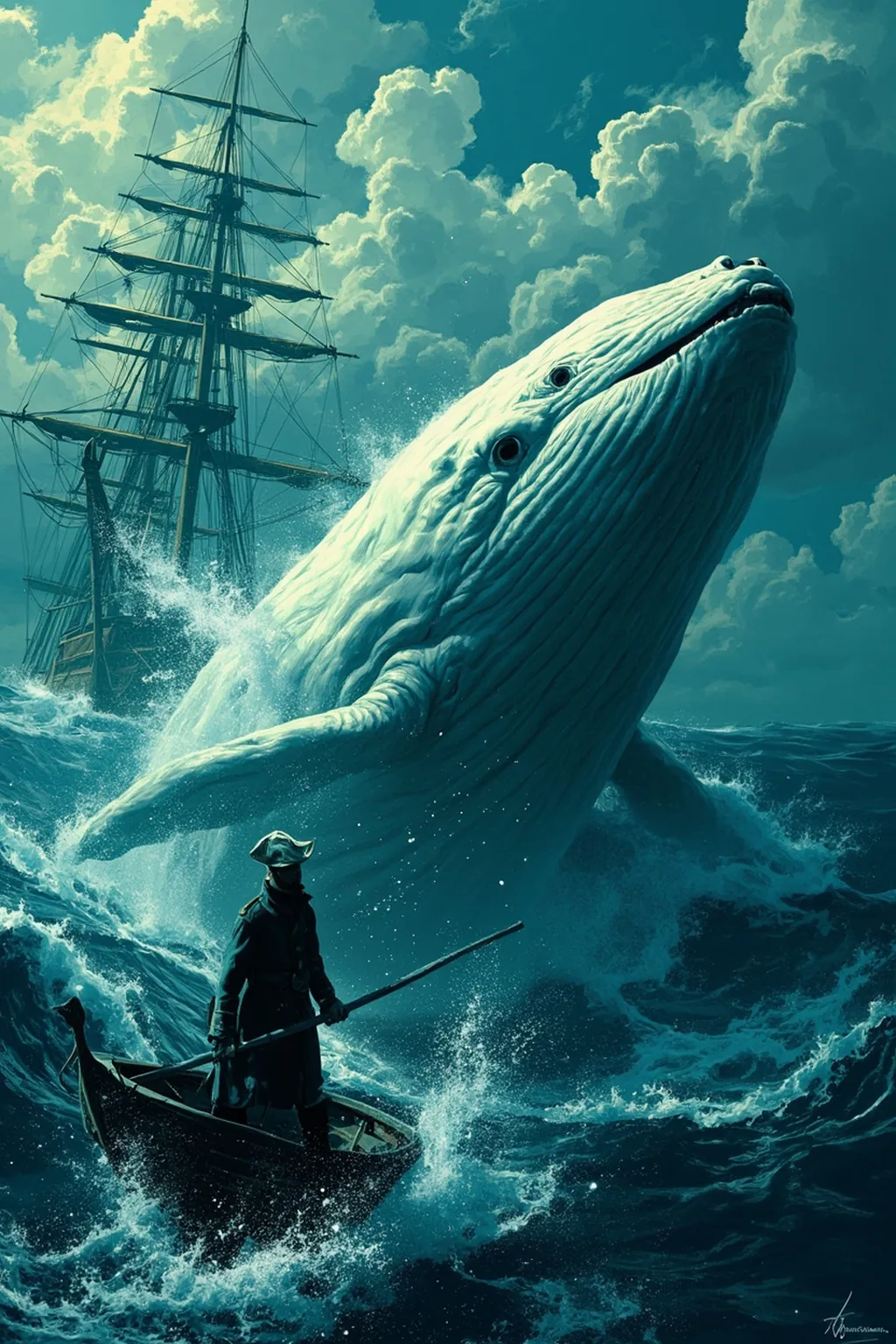
The Second Abandonment
Pip jumped again under very similar circumstances to the first time. This time he did not breast out the line, so when the whale started to run, he was left behind on the sea like a hurried traveller’s trunk. Stubb was but too true to his word. No boat-knife was lifted as Pip fell rapidly astern; Stubb’s inexorable back was turned upon him while the whale was winged. In three minutes, a whole mile of ocean lay between Pip and Stubb.
Solitude at Sea
Pip now found himself a lonely castaway in the loveliest and loftiest of loneliness. The narrative reflects on how, in calm weather, swimming in the open ocean is easy for the practiced swimmer, yet the awful lonesomeness is intolerable. The intense concentration of self in the middle of such a heartless immensity cannot be told. Sailors in a dead calm who bathe in the open sea hug their ship closely, coasting along her sides.
The Castaway’s Ordeal
Stubb had not truly intended to abandon Pip, expecting the two boats behind him would come up quickly to pick him up. However, those boats, without seeing Pip, suddenly spied whales and turned to give chase. Stubb’s boat was now so far away, and he and his crew so intent upon their fish, that Pip’s ringed horizon began to expand around him miserably. Bobbing up and down in the sea, Pip’s ebony head showed like a head of cloves against the flat, spangled expanse stretching away to the horizon.
Rescue and Madness
By the merest chance, the ship itself at last rescued him. But from that hour, the little negro went about the deck an idiot. The sea had kept his finite body up but drowned the infinite of his soul. Yet he was not entirely drowned—rather, he was carried down alive to wondrous depths where strange shapes of the unwarped primal world glided before his passive eyes. Wisdom revealed its hoarded heaps, and among the joyous, heartless eternities, Pip saw the multitudinous, God-omnipresent coral insects that heaved the colossal orbs. He saw God’s foot upon the treadle of the loom and spoke it, and his shipmates called him mad. Man’s insanity is heaven’s sense, and wandering from all mortal reason, man arrives at celestial thoughts that to reason seem absurd and frantic.
Final Reflections
The narrative advises not to blame Stubb too harshly, as the thing is common in that fishery. In the sequel of the narrative, the reader will learn what like abandonment befell the narrator himself.
CHAPITRE 94. A Squeeze of the Hand.
This chapter continues the detailed narrative of the sperm whale processing operation aboard the Pequod. Following Stubb’s successful hunt, the whale is brought alongside and various cutting and hoisting operations commence, including the emptying of the Heidelburgh Tun. The chapter focuses on the intimate sensory experience of working with sperm oil and the strange camaraderie it engenders among the crew.
Whale Brought Alongside
After Stubb’s whale is purchased at some cost, it is duly secured at the Pequod’s side. All the cutting and hoisting operations previously described are carried out systematically, including the baling of the great Heidelburgh Tun or Case. Larger tubs are dragged into position to receive the sperm as it is drawn off.
Sperm Processing
The collected sperm has cooled and crystallized into solid lumps floating in liquid. When the crew sits before large vats of this solidified sperm, they must squeeze the lumps back into fluid form. This work is described as sweet and unctuous, and the narrator reflects on how sperm was historically valued as a cosmetic and softener. After working with the sperm for only a few minutes, the narrator’s fingers begin to feel like eels, serpentining and spiraling.
Squeezing Sperm
The repetitive act of squeezing sperm becomes almost meditative for the narrator. Sitting cross-legged on deck under a tranquil blue sky, with the ship gliding serenely, the narrator experiences a sensory paradise—the smell of the sperm is literally like spring violets. The narrator describes feeling divinely free from ill-will and malice while bathing in this aromatic substance. The work becomes so consuming that a strange insanity develops, leading the narrator to squeeze co-laborers’ hands mistaking them for gentle globules. This abounding, friendly feeling prompts thoughts of universal kindness and squeezing hands all round.
The original text of this work is in the public domain. This page focuses on a guided summary article, reading notes, selected quotes, and visual learning materials for educational purposes.