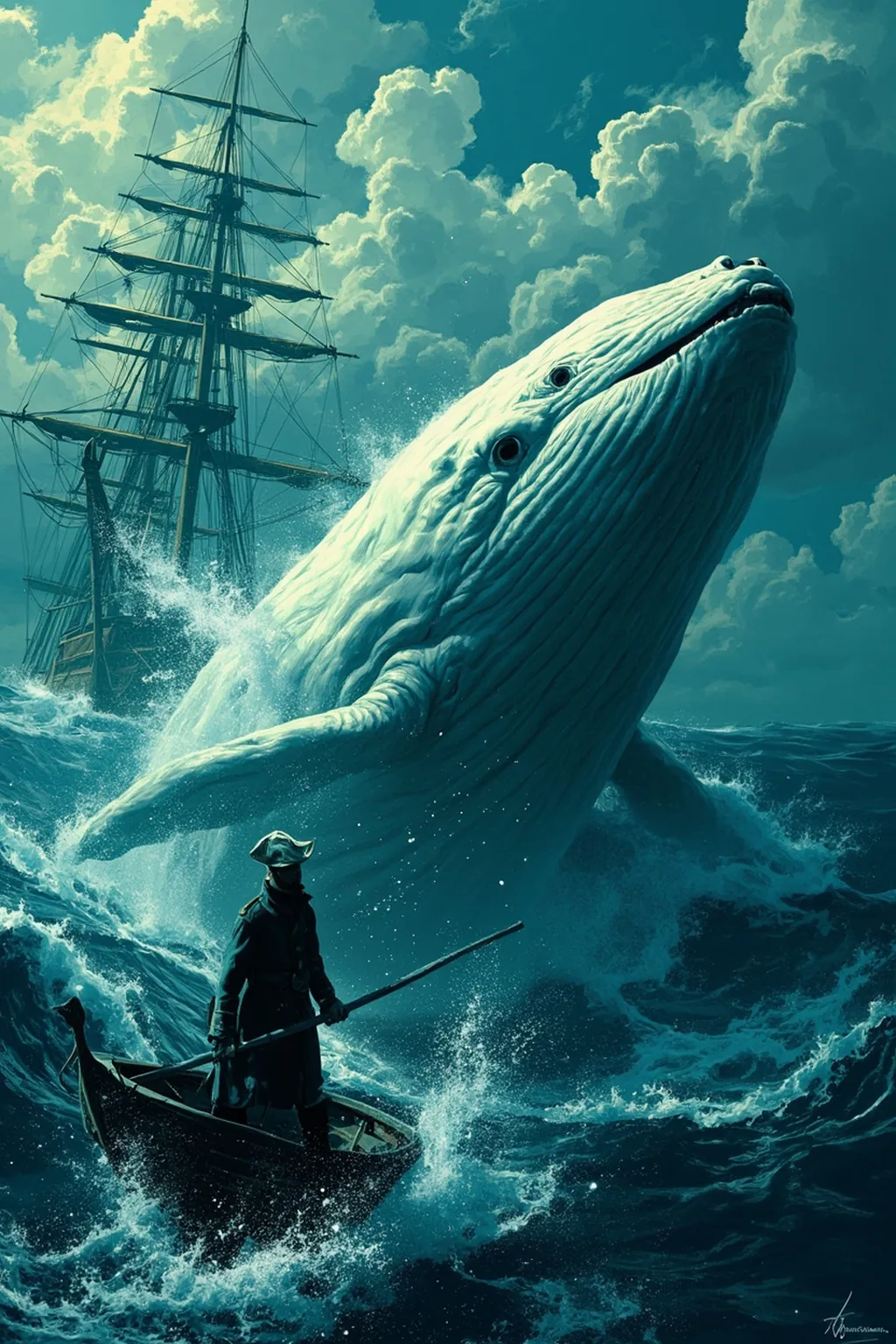
Ahab Discusses the Blacksmith
Ahab ponders the meaning of the blacksmith Prometheus creating men and animating them with fire. He suggests that what is made in fire properly belongs to fire, and therefore hell is probable. He remarks that the soot flying must be the remainder from when the Greeks made Africans. He then orders the carpenter to have the blacksmith forge a pair of steel shoulder-blades for a pedlar aboard who carries a crushing pack.
Ahab’s Mock Custom Man Order
Ahab delivers a fantastical order for a complete man to be forged by Prometheus: fifty feet tall, with a chest modeled after the Thames Tunnel, legs with roots to keep them stationary, arms three feet through the wrist, no heart, a brass forehead, a quarter acre of brains, and a skylight on top of the head instead of outward-looking eyes. The bewildered Carpenter wonders who Ahab is speaking to and whether he should continue standing there.
Ahab Teases the Carpenter About Lantern Light
Ahab notices the carpenter’s lantern and criticizes “thrusted light” as worse than presented pistols. When the carpenter assumes Ahab was addressing him, Ahab rebukes him and asks if he would prefer working in clay. The carpenter is confused, and when asked about his sneezing, he explains bone dust is the cause. Ahab cryptically advises him never to bury himself under living people’s noses, leaving the carpenter baffled.
Phantom Limb Sensation Discussion
Ahab asks if the carpenter considers himself a good workman, then poses a riddle: when he mounts the new leg, he will still feel his old lost leg—the flesh and blood one—in the same place. The carpenter admits he has heard of this phenomenon, how a dismasted man never entirely loses the feeling of his old spar. Ahab confirms this is true, demonstrating by placing his live leg where his missing one was, noting that though only one leg is visible, there are two in the soul. He feels the tingling sensation where his flesh leg once was.
Ahab’s Invisible Presence Riddle
Ahab poses a philosophical riddle: how does one know that some entire, living, thinking thing may not be invisibly standing precisely where one stands, despite one’s spite? He asks if the carpenter fears eavesdroppers in his most solitary hours. He then connects this to his phantom leg pain, asking why the carpenter might not feel the fiery pains of hell forever without a body. The carpenter replies he may need to “calculate over again” as he may have made an error.
Ahab Laments Leg Indebtedness
Ahab tells the pudding-headed carpenter he should never grant such premises, then asks how long until the leg is finished. The carpenter says perhaps an hour. As Ahab turns to leave, he delivers a soliloquy about life and indebtedness: proud as a Greek god, yet debtor to a common workman for a bone to stand on. He curses mortal inter-indebtedness that cannot do away with ledgers. Despite being rich enough to bid against the wealthiest Praetorians at Rome’s auction, he owes for the flesh in his bragging tongue. He declares he will dissolve himself down to one compendious vertebra.
Carpenter’s Soliloquy on Ahab
After Ahab leaves, the carpenter resumes his work and reflects on the Captain. He recalls Stubb’s assessment that Ahab is “queer,” and Stubb constantly dinning this into Starbuck. The carpenter meditates on Ahab’s bedfellow—a stick of whale’s jawbone—and the leg he is crafting. He muses on the riddle about one leg standing in three places, all in one hell. He reflects on the folly of short men wading into deep waters with tall captains. He observes that while most people’s legs last a lifetime because they use them mercifully, Ahab is a hard driver who has worn out multiple legs. He calls for Smut’s help to finish before the resurrection comes calling for all legs, true or false.
CHAPITRE 109. Ahab and Starbuck in the Cabin.
This chapter depicts a tense confrontation between Captain Ahab and his first mate Starbuck regarding a critical oil leak in the ship’s hold. The scene unfolds in Ahab’s cabin as the Pequod approaches the waters near Formosa and Japan. The chapter explores the conflict between practical maritime concerns and Ahab’s single-minded obsession with hunting Moby Dick, culminating in a dramatic reversal where Ahab ultimately orders the necessary repairs despite his earlier resistance.
The original text of this work is in the public domain. This page focuses on a guided summary article, reading notes, selected quotes, and visual learning materials for educational purposes.