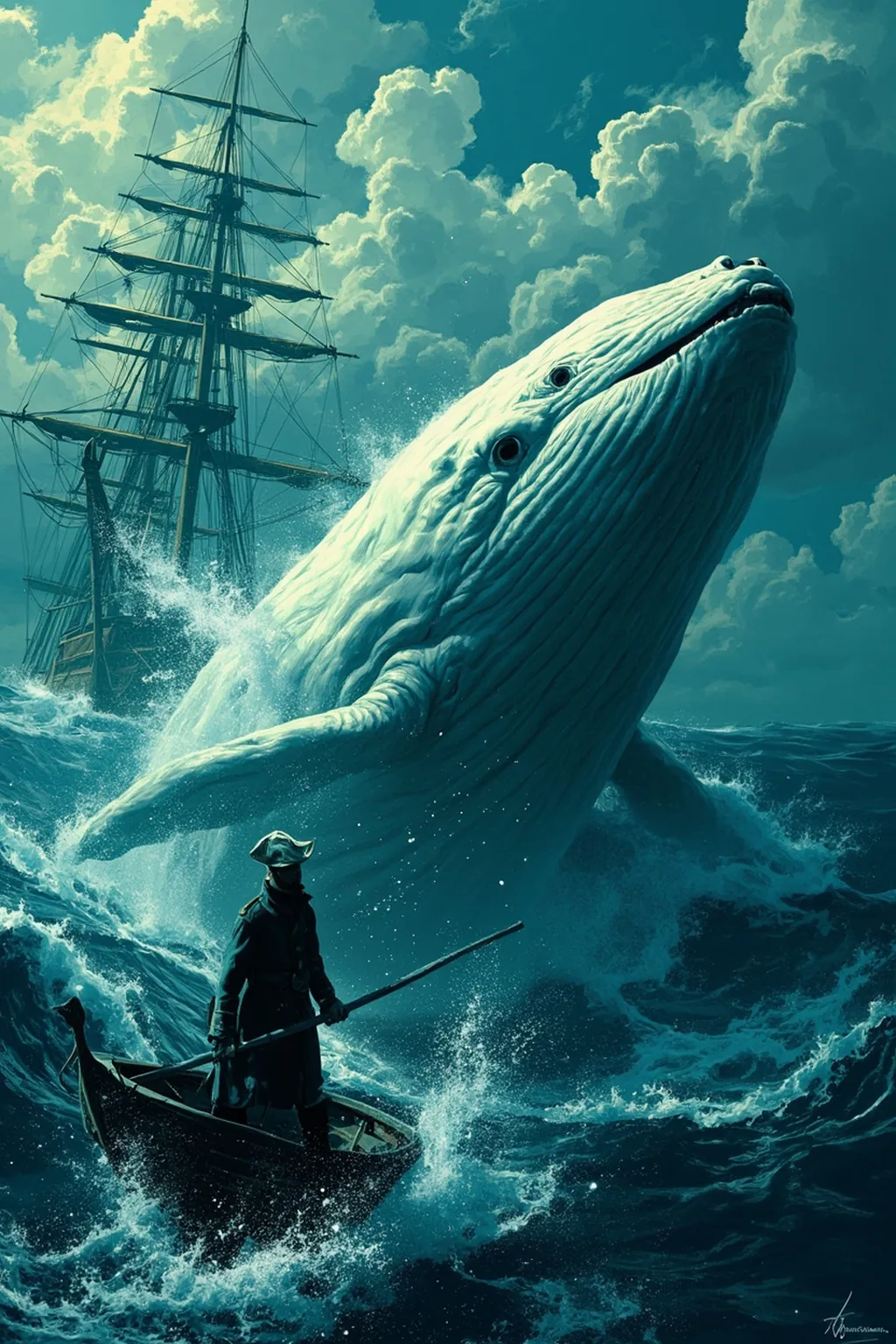
Inquiry for the White Whale
Inquiry for the White Whale Ahab eagerly demands to know the location of the white whale, exclaiming “Where was he?—not killed!—not killed!” The Rachel’s captain explains that on the previous afternoon, while three of his boats were chasing a whale shoal several miles from the ship, Moby Dick suddenly surfaced to leeward. A fourth reserved boat—the swiftest—had been immediately lowered and seemed to have fastened to the whale, but then vanished entirely, leaving only bubbling white water, leading to the conclusion that the whale had dragged off the pursuers.
The Missing Whaleboat
The Missing Whaleboat When the Rachel’s three other boats failed to return by nightfall, the ship was forced to retrieve them first, increasing distance from the missing fourth boat. Despite crowding on all sails, kindling beacon fires in the try-pots, and placing men aloft on lookout, the Rachel searched through the night and into daylight without finding any trace of the missing boat or its crew. The narrative reveals that one of the captain’s sons was among those aboard the missing vessel, adding personal stakes to the search.
The Captain’s Desperate Plea
The Captain’s Desperate Plea Stubb jokes with Flask that the captain must be seeking a lost coat or watch, but their speculation is shattered when Captain Gardiner reveals his true motive: his own boy is among the missing. The desperate father begs Ahab to unite their ships in a coordinated search, sailing parallel lines four or five miles apart to sweep a double horizon, offering to pay generously for forty-eight hours of the Pequod’s time. He appeals to Ahab’s shared paternal experience, reminding him that he too has a child waiting at home.
Ahab’s Refusal
Ahab’s Refusal Despite the captain’s pleading and Stubb’s advocacy, Ahab remains unmoved, standing like an anvil. When Gardiner refuses to leave without an affirmative answer and invokes their shared experience of fatherhood, Ahab’s face shows what might be softening, but his response is categorical refusal. He declares he cannot spare the time, tells Starbuck to warn off all strangers within three minutes, and turns away to his cabin, leaving Captain Gardiner transfixed by this complete rejection of his earnest request.
Rachel Weeping for Her Children
Rachel Weeping for Her Children The two ships diverge, their wakes separating. Throughout the time the Rachel remains in view, she is seen constantly yawing and tacking, swinging her yards at every dark spot on the water, beating against head seas and being pushed before them. Her masts remain thickly clustered with searching men. The chapter concludes with the biblical allusion that gives the chapter its meaning: the Rachel continues to weep for her children, because they were not—her desperate, sorrowful search continuing without comfort.
CHAPITRE 129. The Cabin.
This chapter depicts the emotional farewell between Captain Ahab and the cabin boy Pip in Ahab’s private quarters. The scene establishes the complex master-servant relationship and foreshadows the tragic events to come.
Ahab’s Farewell
Ahab attempts to leave for the deck but is detained by Pip, who wishes to follow him. Ahab firmly instructs the boy that he cannot accompany him, explaining that Pip possesses qualities that cure Ahab’s malady—the obsession with hunting the white whale. Ahab commands Pip to remain below, where he will be treated as if he were the captain himself.
Pip’s Protest
Pip vehemently protests Ahab’s orders, arguing that Ahab is incomplete as a person and offering himself as Ahab’s substitute leg. He asks only to be tread upon, begging to remain a part of the captain rather than being left behind. His desperation reveals his fear of abandonment and his profound attachment to Ahab.
The Screwed Chair
Ahab offers Pip a special place in his own screwed chair, promising that another screw will be added to accommodate the boy. This chair represents both authority and the obsessive nature of the quest, as additional screws suggest ongoing refinement for a singular purpose.
The original text of this work is in the public domain. This page focuses on a guided summary article, reading notes, selected quotes, and visual learning materials for educational purposes.