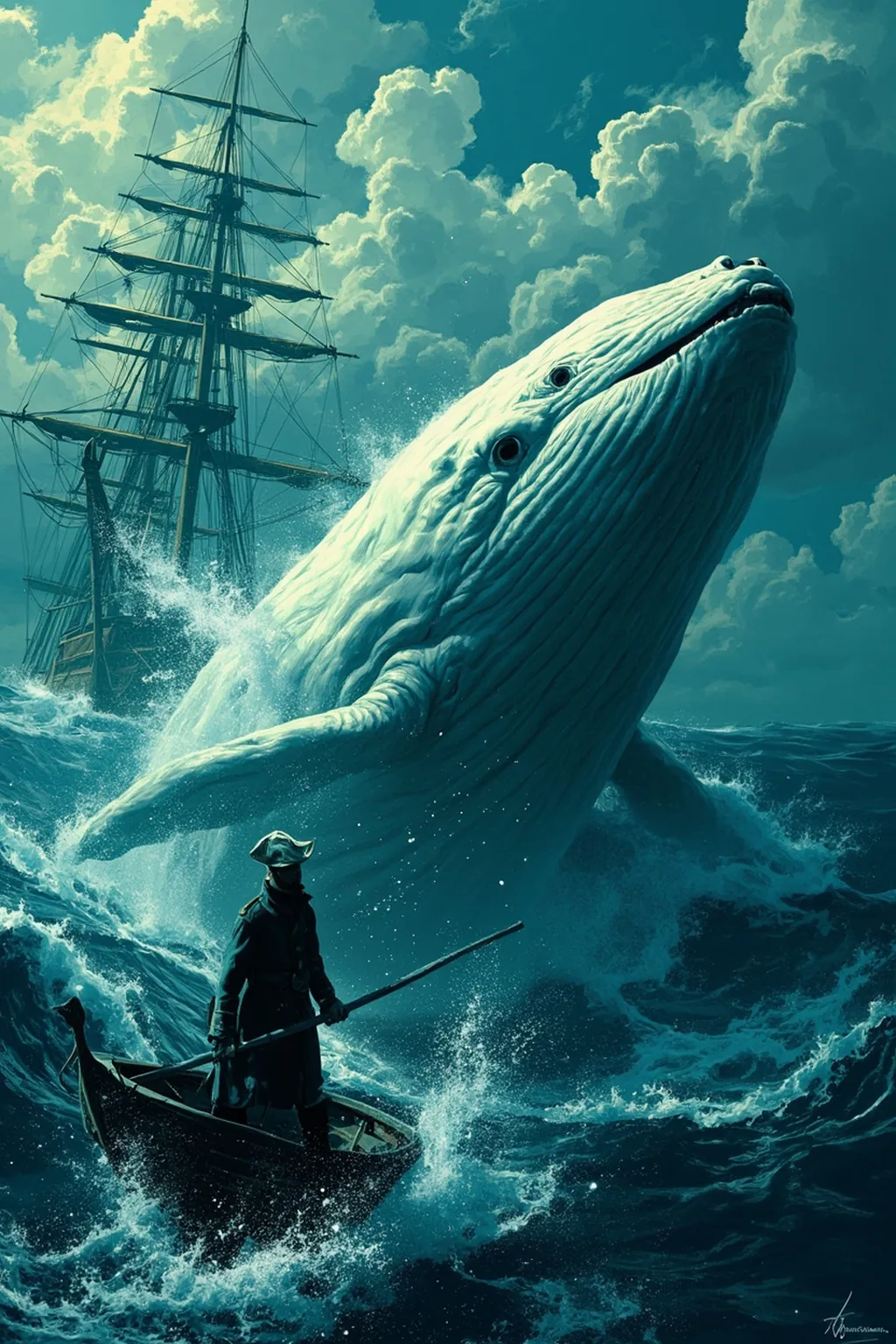
Ahab and Fedallah’s Silent Yoked Watch
Though Ahab’s life has become “one watch on deck” and Fedallah’s “mystic watch” continues “without intermission,” these two never speak except at long intervals for passing unmomentous matters. Secretly a potent spell seems to join them, yet openly they stand “pole-like asunder.” By day they may chance one word; by night both are dumb regarding the slightest verbal interchange. For longest hours without a single hail, they stand far parted—Ahab in his scuttle, the Parsee by the mainmast—yet “fixedly gazing upon each other,” as if in the Parsee Ahab sees his “forethrown shadow,” in Ahab the Parsee sees his “abandoned substance.”
Ahab’s Distrust of Most of His Crew
After several days pass without spout following the Rachel’s sighting of Moby Dick, the monomaniacal old man grows distrustful of his crew’s fidelity—except nearly for the Pagan harpooneers. He seems to doubt whether Stubb and Flask might willingly overlook the whale. Though he refrains from voicing these suspicions, his actions hint at them. He tells Starbuck to take the rope and gives it into the chief mate’s hands, freely entrusting his life to “an otherwise distrusted person.”
Ahab’s Hourly Whale Sight Demands
At the first dawn light, Ahab’s iron voice rings out “Man the mast-heads!” and every hour thereafter, at the striking of the helmsman’s bell, the same demand echoes: “What d’ye see?—sharp! sharp!” From sunrise through the day, after sunset and twilight, this relentless interrogation continues until the whale is finally spotted.
Ahab’s Self-Rigged Masthead Lookout
Determining to see the whale himself, Ahab rigs his own basket of bowlines at the main-mast head, sending a hand aloft with a block and receiving the rope ends himself. He positions the basket beside the pin and surveys his crew, fixing his firm eye upon Daggoo, Queequeg, and Tashtego, but shunning Fedallah. He entrusts the rope’s secured end to Starbuck—strangely selecting the very man whose look-out faithfulness he has doubted—to act as his watchman while he takes his position high above the deck, gazing abroad upon miles of sea in “the wide expanded circle commanded at so great a height.”
The Ominous Snatching of Ahab’s Hat
Within minutes of Ahab taking his perch, a red-billed sea-hawk begins wheeling and screaming round his head in swift circlings. Then it darts a thousand feet upward and spiralizes downward, eddying again around him—though Ahab, gaze fixed on the dim horizon, seems not to mark it. A Sicilian seaman posts at the mizen-mast-head cries out: “Your hat, your hat, sir!” But before Ahab can react, “the sable wing was before the old man’s eyes; the long hooked bill at his head”—and with a scream, the black hawk bears away Ahab’s hat. The chapter closes with the parallel to Tarquin’s cap, where a wife’s declaration of kingship depended upon the cap’s replacement. Here, Ahab’s hat is “never restored”; the hawk flies on with it, far ahead of the prow, until a minute black spot dims into the sea below.
CHAPITRE 131. The Pequod Meets The Delight.
This chapter depicts the fateful encounter between the Pequod and a battered whaling vessel tragically misnamed the Delight. The meeting reveals the destructive passage of Moby Dick through the whaling fleet, foreshadowing the Pequod’s own doom through haunting imagery and prophetic warnings. Captain Ahab’s obsessive vow to slay the White Whale intensifies, while the mysterious life-buoy-coffin at the Pequod’s stern emerges as a symbolic omen of mortality.
The Pequod Meets The Delight
As the Pequod continues its relentless pursuit across the rolling waves, another ship emerges on the horizon. This vessel is identified as the Delight, a name rendered bitterly ironic by the suffering evident upon her deck. The two ships draw near, with the Pequod’s crew fixated on the stranger’s broad beams, called shears, which in whaling vessels cross the quarter-deck at substantial height. These structural elements, designed to carry spare boats, now bear witness to the devastation wrought by the White Whale.
The original text of this work is in the public domain. This page focuses on a guided summary article, reading notes, selected quotes, and visual learning materials for educational purposes.