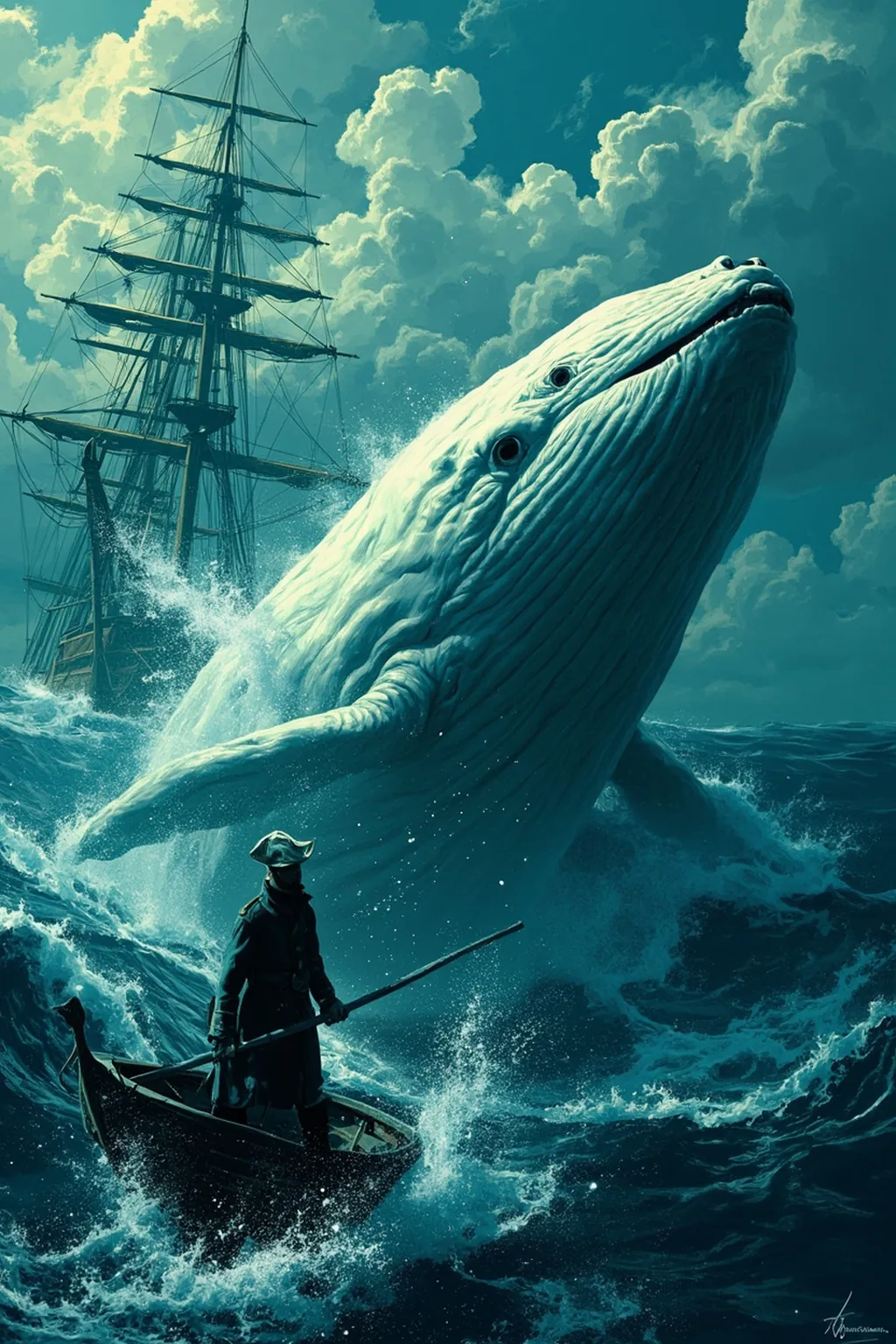
The Unpaintable Leviathan
The narrator concludes that these manifold mistakes are unsurprising when one considers the practical difficulties of whale portraiture. Scientific drawings have typically been taken from stranded fish, as inaccurate as a drawing of a wrecked ship would represent a whole vessel. The living whale cannot be hoisted from the sea, and its shape is so variable that “his precise expression the devil himself could not catch.” The skeleton provides little idea of the general shape—Hunter compared the skeleton to the insect while the living whale is the chrysalis. Therefore, accurate knowledge of the whale’s form requires going whaling personally, risking being “eternally stove and sunk.”
第五十六章 Of the Less Erroneous Pictures of Whales, and the True
The narrator briefly mentions monstrous pictures and stories of whales found in ancient and modern texts such as Pliny, Purchas, Hackluyt, Harris, and Cuvier, but chooses to pass over this matter. He has knowledge of only four published outlines of the great Sperm Whale.
Pictures of Whaling Scenes
The narrator acknowledges only four published outlines of the great Sperm Whale: Colnett’s, Huggins’s, Frederick Cuvier’s, and Beale’s. Of these, Huggins’s is far better than Colnett and Cuvier’s, but Beale’s is by far the best. The narrator notes that J. Ross Browne’s Sperm Whale drawings are pretty correct in contour but wretchedly engraved, though he clarifies this is not Browne’s fault.
Sperm Whale Outlines
Among the four known outlines of the great Sperm Whale, Beale’s drawings are the finest, with all of them being good except the middle figure in a picture of three whales in various attitudes from his second chapter. Beale’s frontispiece depicting boats attacking Sperm Whales is described as admirably correct and life-like in its general effect.
The original text of this work is in the public domain. This page focuses on a guided summary article, reading notes, selected quotes, and visual learning materials for educational purposes.