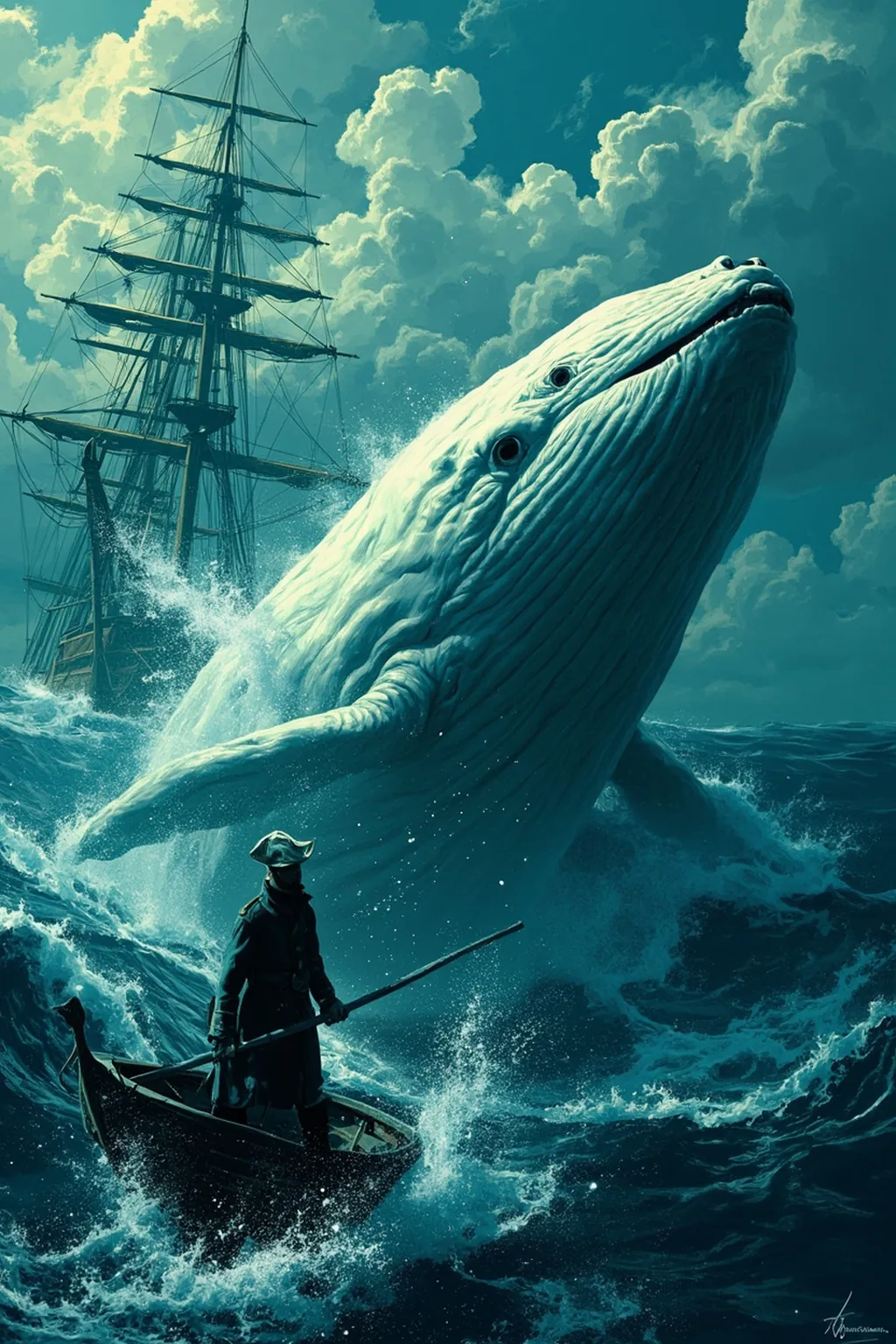
The ‘Sail Ho!’ Sighting
The contemplative scene was broken by a triumphant cry from the main-mast-head: “Sail ho!” Ahab responded with unexpected warmth, declaring the cry cheering upon the deadly calm and suggesting it might convert a better man. Upon learning the vessel was three points on the starboard bow and approaching with its breeze, Ahab’s whole demeanor shifted as thunder-clouds seemed to sweep aside from his brow. He expressed hope that St. Paul might arrive that way to bring breezes to his windless situation, and reflected on how far beyond utterance the linked analogies of Nature and the soul of man extended—not the smallest atom stirs or lives in matter but has its cunning duplicate in mind.
第七十一章 The Jeroboam’s Story.
The chapter opens with the Pequod sailing in concert with a brisk wind, soon sighting a distant unknown whale ship. After exchanging private signals of the American Whale Fleet to confirm the stranger’s identity, the vessel is identified as the Jeroboam of Nantucket, which squares its yards and bears down alongside the Pequod.
Approach of the Jeroboam
The Pequod’s crew raises its private whale ship signal to hail the distant unknown vessel, and after the stranger returns a matching signal, they confirm the ship is the Jeroboam of Nantucket. The Jeroboam adjusts its rigging to bear down, ranges alongside the Pequod’s lee, and lowers a boat toward the Pequod, though its captain waves off the Pequod’s offer of a side ladder for boarding.
Epidemic Quarantine
The Jeroboam’s captain, Mayhew, refuses all direct contact with the Pequod, as the Jeroboam is carrying a malignant epidemic on board. Despite Mayhew and his boat crew being uninfected, and a half-rifle-shot distance and open sea and air between the two vessels, he adheres strictly to maritime quarantine protocols to avoid infecting the Pequod’s crew. The Jeroboam’s boat maintains a small buffer of a few yards between itself and the Pequod, using occasional oar strokes to stay parallel to the Pequod as it cuts through fresh wind and heavy seas, with only rare interruptions from large rolling waves during their sustained long-distance conversation.
The original text of this work is in the public domain. This page focuses on a guided summary article, reading notes, selected quotes, and visual learning materials for educational purposes.