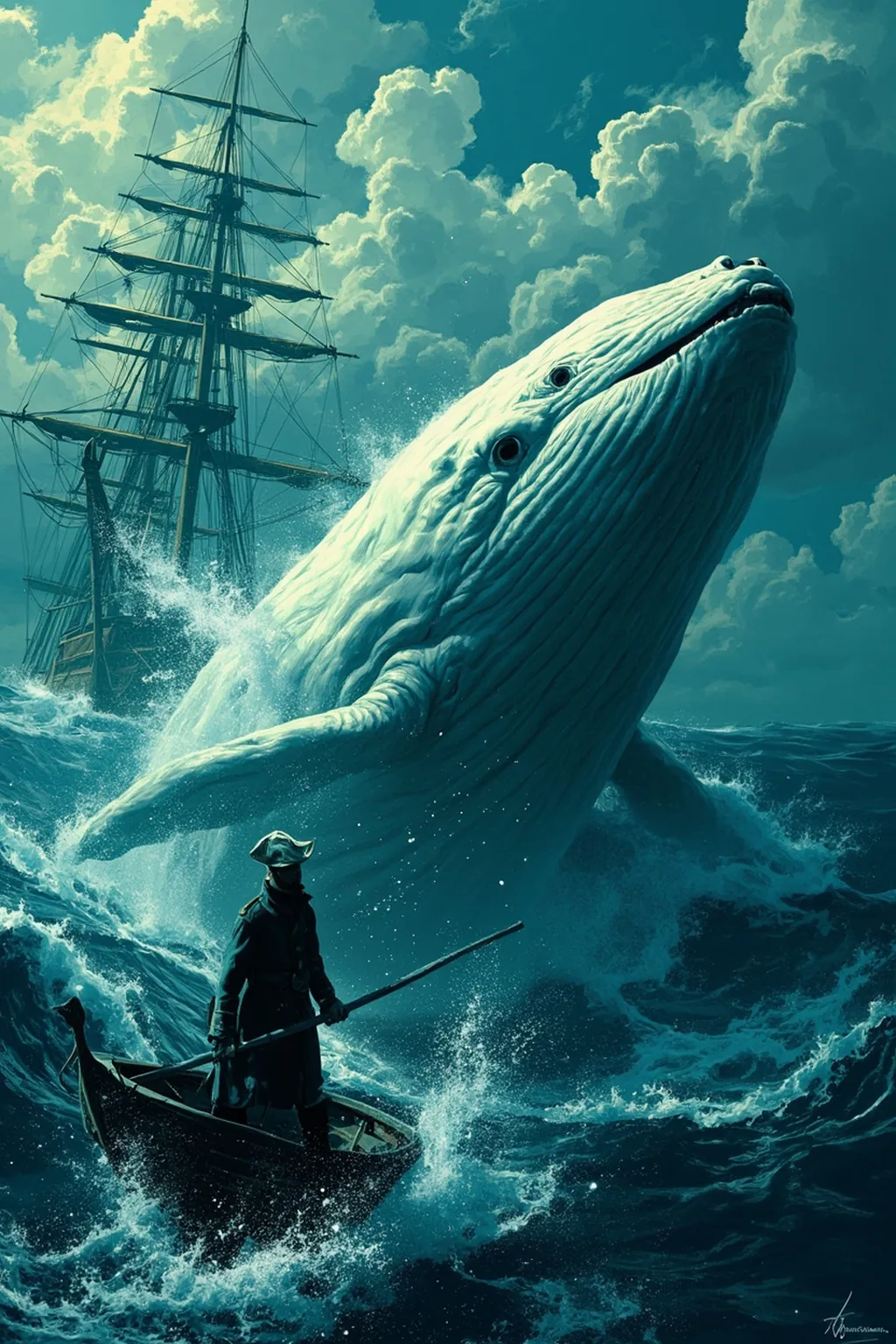
Queequeg on the Whale
The harpooneer often must remain on the whale throughout the entire flensing operation. The whale lies mostly submerged, with only the parts being worked on visible above water. Queequeg scrambles about ten feet below deck level, caught between the massive revolving carcass and the water. On this particular occasion, he wears Highland costume—shirt and socks—which the narrator finds unusually becoming.
The Monkey-Rope
The narrator, serving as Queequeg’s bowsman, holds his position by a monkey-rope, a line attached to a strip of canvas belted around Queequeg’s waist. Just as Italian organ-boys hold dancing-apes by long cords, the narrator holds Queequeg steady from the ship’s steep side. This arrangement proves both humorous and perilous for both parties involved.
The Siamese Connexion
The monkey-rope is fastened at both ends—to Queequeg’s broad canvas belt and to the narrator’s narrow leather belt. This creates what the narrator describes as an elongated Siamese ligature, wedging them together for better or worse. Honor and custom demand that if Queequeg sinks, the narrator should be dragged down rather than cutting the cord. Queequeg becomes the narrator’s inseparable twin brother.
Metaphysical Reflections
The narrator contemplates the metaphysical implications of this bond. His individuality seems merged into a joint stock company of two, his free will wounded, and another’s misfortune threatening his own welfare. He perceives this as an interregnum in Providence, yet ponders further that every mortal shares such Siamese connexions with others—if a banker breaks, you break; if an apothecary poisons you, you die.
The original text of this work is in the public domain. This page focuses on a guided summary article, reading notes, selected quotes, and visual learning materials for educational purposes.