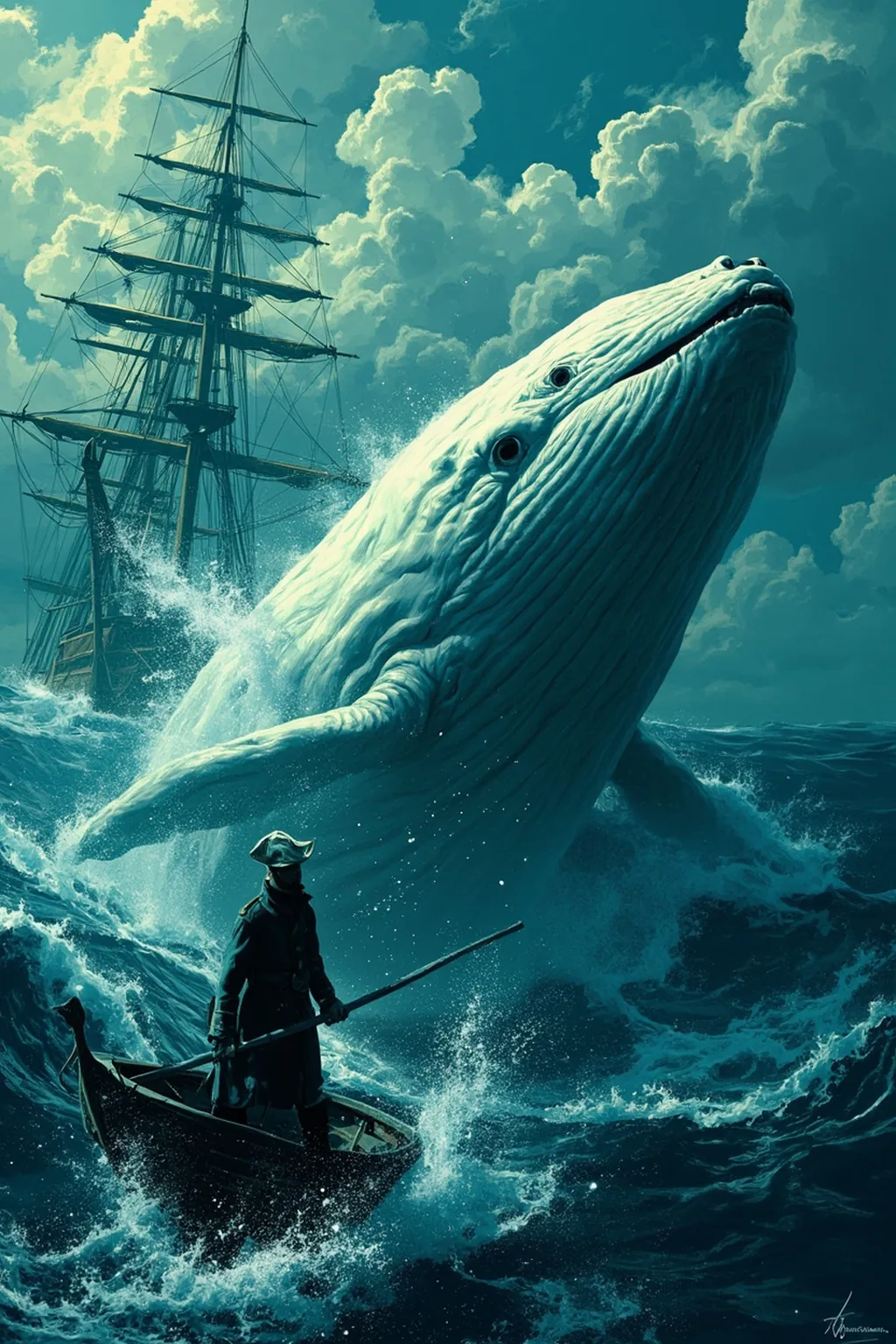
Pupella’s Stranded Sperm Whale Skeleton
King Tranquo, devoted to barbarian vertu, collected rare carved woods, chiselled shells, inlaid spears, costly paddles, and aromatic canos. Among his treasures was a great Sperm Whale found dead and stranded after a long raging gale, its head against a cocoa-nut tree. After the body was stripped and bones dried in the sun, the skeleton was transported to a grand palm temple. The ribs hung with trophies, vertebrae bore Arsacidean hieroglyphics, an aromatic flame burned in the skull recreating the jet, and the terrifying lower jaw vibrated from a bough like Damocles’ sword.
Arsacidean Wood and Verdant Loom Metaphor
The scene is described as a wondrous display where green wood, tall trees, and earth as a weaver’s loom create a living carpet. The sun appears as a flying shuttle weaving verdure, leading Ishmael into an extended philosophical meditation on the cosmic weaver-god who weaves yet remains deaf to mortal voices. He suggests that in the din of the great world’s loom, subtlest thoughts may be overheard afar, and mortals must be heedful. Within this verdant loom, the great white skeleton lounges—Life folds Death, Death trellises Life, and the grim god weds with youthful Life.
Measurement of the Royal Whale Skeleton
Ishmael explored the skeleton with a ball of Arsacidean twine, wandering through its colonnades and arbours. When he began measuring the skeleton with a green rod, taking the altitude of the final rib, the priests challenged him, crying “Dar’st thou measure this our god!” A fierce contest arose among the priests concerning feet and inches, during which Ishmael quickly concluded his own admeasurements.
The original text of this work is in the public domain. This page focuses on a guided summary article, reading notes, selected quotes, and visual learning materials for educational purposes.