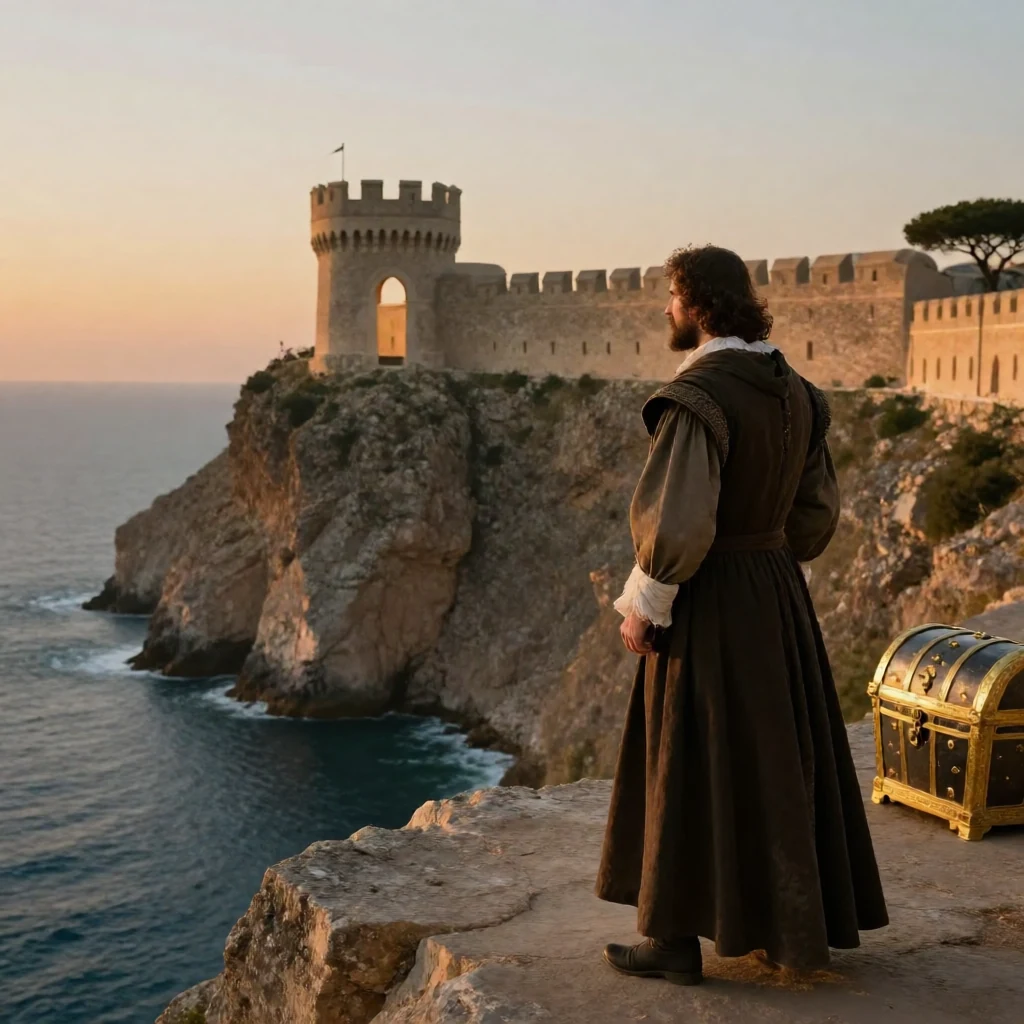
Faria’s Encyclopedic Self-Education
Faria describes his scholarly life. He offers to show Dantès a major work conceived during meditations at Rome’s Colosseum, Venice’s St. Mark’s column, and the banks of Florence’s Arno — A Treatise on the Possibility of a General Monarchy in Italy, which will fill one large quarto volume. Though he once owned nearly five thousand volumes at Rome, he reduced his essential library to 150 well-chosen books, committing them nearly to memory over three years; in prison, a slight memory effort lets him recall their contents as if the pages were open. He can recite the works of Thucydides, Xenophon, Plutarch, Livy, Tacitus, Strada, Jornandes, Dante, Montaigne, Shakespeare, Spinoza, Machiavelli, and Bossuet. He speaks five modern tongues — German, French, Italian, English, and Spanish — and uses ancient Greek to study modern Greek, which he continues to practice by rearranging a working vocabulary of nearly one thousand words.
Faria Invites Dantès to View His Treatise
Dantès asks when he may see Faria’s work, and the abbé replies “whenever you please.” Dantès eagerly insists on going immediately, and Faria leads him back into the subterranean passage, with Dantès following as the old man disappears into its depths.
第十七章 The Abbé’s Chamber
Dantès reaches the Abbé Faria’s chamber through a narrow subterranean passage and is shown the remarkable tools, writings, and resources the Abbé has created during his long imprisonment. After examining these hidden treasures, Dantès recounts his own story of unjust arrest, prompting the Abbé to begin investigating the true motives behind his imprisonment through systematic questioning. Chapter 17, “The Abbé’s Chamber,” centers on the deepening collaboration between Edmond Dantès and Abbé Faria. Their conversation identifies Danglars as the letter’s author and exposes Villefort’s chilling duplicity: the deputy prosecutor destroyed the letter not out of compassion but to conceal his father’s revolutionary past. Stunned by this revelation, Dantès vows vengeance, but channels his energy into the abbé’s tutelage, rapidly mastering multiple languages and subjects over many months. While studying, Faria devises an elaborate escape plan involving a mine-like tunnel beneath the sentry’s post. After fifteen months of grueling labor with primitive tools, the excavation is complete—but the chapter ends on a cliffhanger as Faria suddenly collapses in agony. Chapter 17, “The Abbé’s Chamber,” depicts the catastrophic interruption of Dantès and Abbé Faria’s escape plan when the abbé is struck by a sudden, violent illness. The chapter traces the emergency response—Dantès’s administering of the prescribed remedy, the abbé’s grim revelation of permanent paralysis, Dantès’s solemn vow to remain with his friend, and the abbés order to conceal their excavation work.
The original text of this work is in the public domain. This page focuses on a guided summary article, reading notes, selected quotes, and visual learning materials for educational purposes.