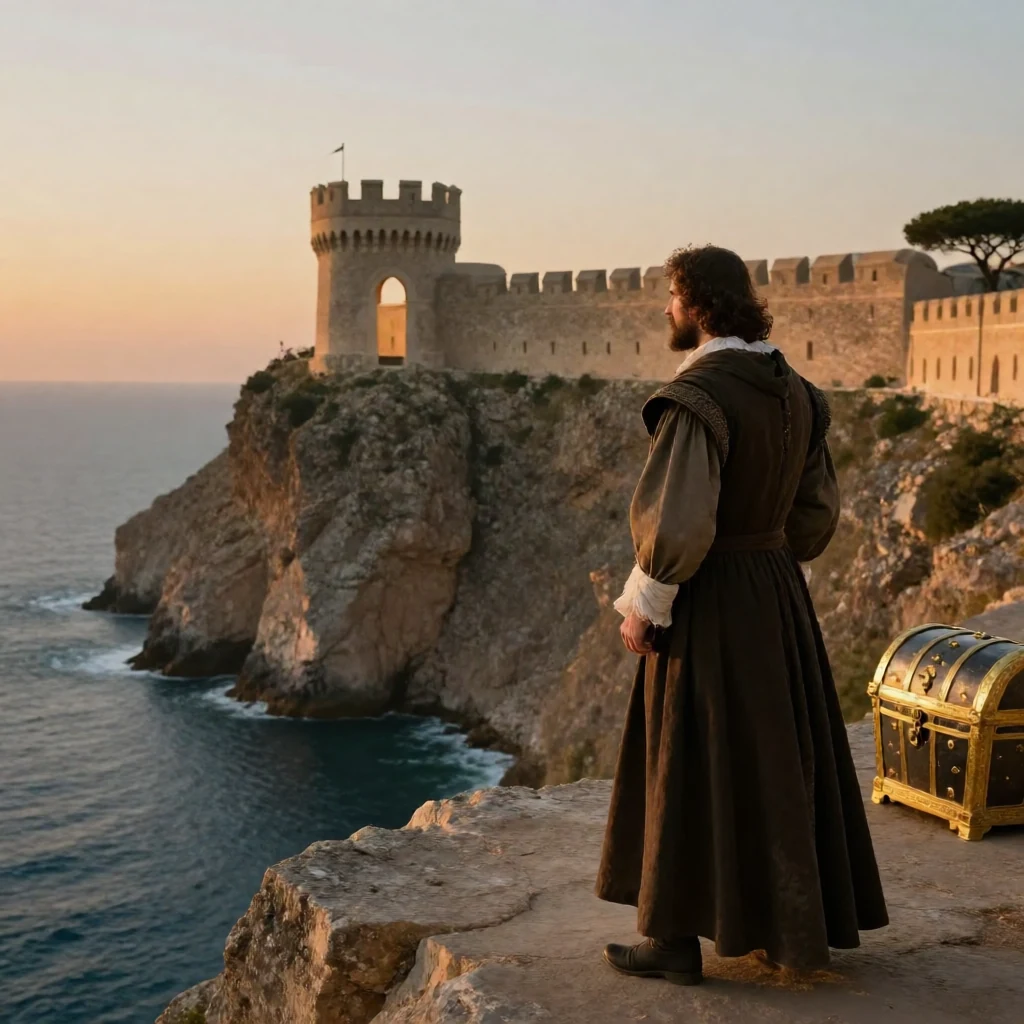
Touring the Abandoned Château d’If
Stepping onto the same rock where he had once been dragged by guards at bayonet-point, Monte Cristo finds the ascent shorter than he remembered, though each stroke of the oar had awakened a new throng of ideas. The Château d’If has held no prisoners since the July Revolution and is now inhabited only by a guard tasked with preventing smuggling. A concierge waits at the door to exhibit this monument of curiosity, once a scene of terror. Upon inquiring about the ancient jailers, Monte Cristo learns that they have all been pensioned or reassigned; the current concierge has only been there since 1830.
Hearing the Tale of Prisoner No. 34
Visiting his own dungeon, Monte Cristo beholds the dull light struggling through the narrow opening and fixes his eyes on the spot where his bed had stood and on the new stones marking the breach made by Abbé Faria. His limbs tremble and he seats himself on a log of wood. When he asks whether any traditions are attached to the prison beyond the story of Mirabeau’s poisoning, the concierge mentions a tale told by his predecessor Antoine—none other than Monte Cristo’s former jailer. At the name, the Count recalls the bearded face, brown jacket, and jingling keys, and, pressing his hand to his heart to still its beatings, he asks to hear the story of prisoner No. 34, fearing to hear his own history.
Recognizing Personal Prison Marks
As the concierge recounts the tale of prisoner No. 34—a dangerous yet resourceful young man who tunneled into the cell of a mad priest, Abbé Faria, who offered millions for his liberty and whose name was given as No. 27—Monte Cristo is overcome. He raises his eyes but finds only a stone veil where the sky should be, just as Faria’s millions had been hidden from his fellow prisoners. He murmurs that the guards were blind fools. When the concierge reveals how the young prisoner hid in the burial sack and was thrown into the sea, Monte Cristo relives the cold dampness of the canvas on his face. He mutters that the doubt he felt was only the beginning of forgetfulness, and that his wound has now reopened, making his heart thirst for vengeance once more.
The original text of this work is in the public domain. This page focuses on a guided summary article, reading notes, selected quotes, and visual learning materials for educational purposes.