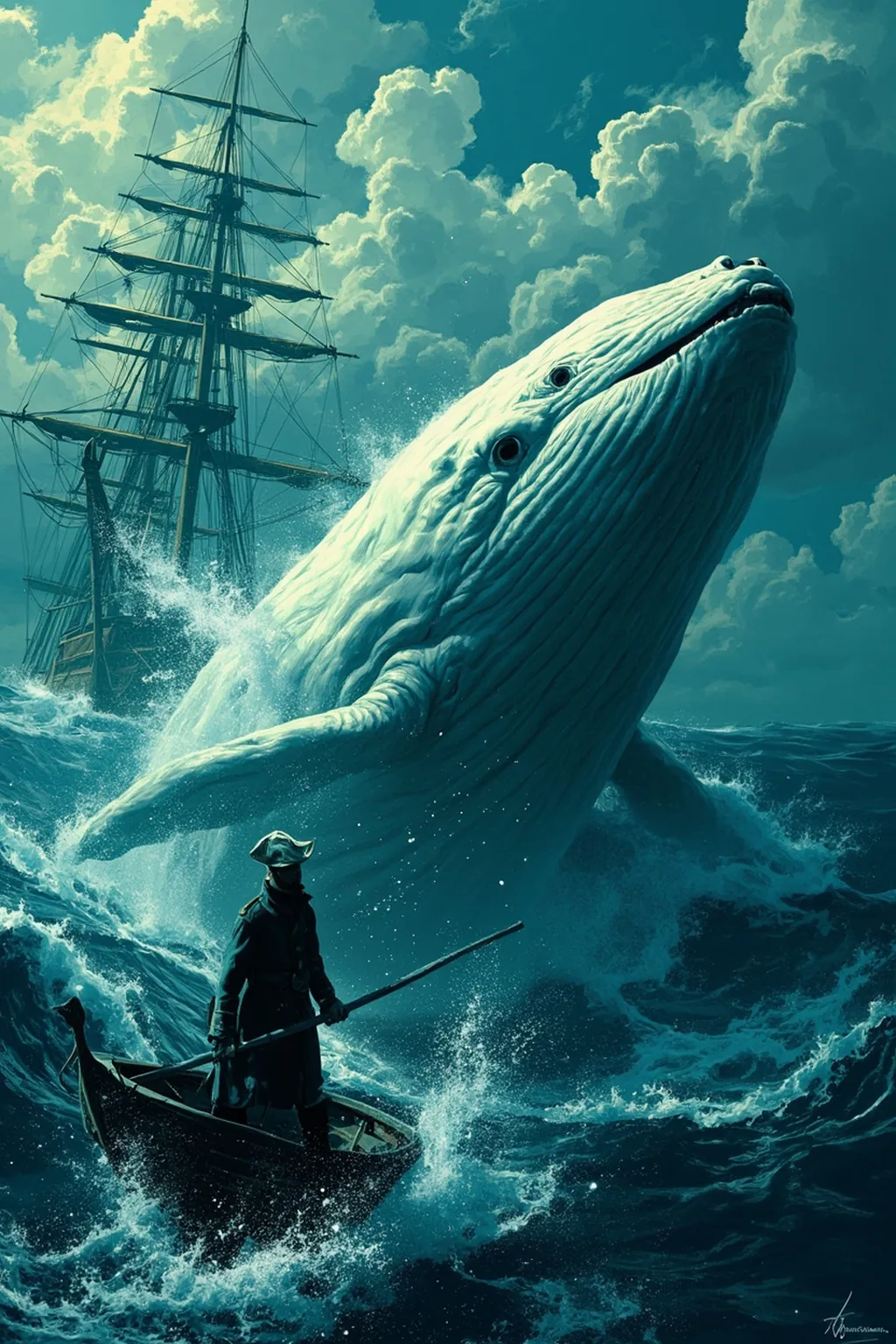
Moby Dick’s Malicious Attacks on Whalers
Moby Dick’s attacks were marked by an intelligent, deliberate malignity that distinguished him from other whales, as he often feigned alarm to lure pursuers before turning suddenly to smash boats and kill or maim crew members. In one such attack, he targeted Captain Ahab specifically, shearing off Ahab’s leg with his lower jaw in an act that seemed driven by personal malice rather than animal instinct, cementing his reputation as a uniquely vengeful adversary.
Ahab’s Monomaniacal Obsession With Moby Dick
The loss of his leg transformed Ahab’s anger at Moby Dick into a consuming monomania. During the long, painful voyage back to port after the attack, his physical agony and mental distress merged, driving him to brief bouts of raving madness. Though he appeared to recover his composure as the ship sailed through warmer waters, his obsession only deepened and contracted, focusing all his vast intellect and strength on the single goal of destroying Moby Dick, whom he came to see as the physical embodiment of all evil and suffering in the world.
第四十一章 Moby Dick.
This chapter details Captain Ahab’s hidden monomaniacal obsession with hunting the white whale Moby Dick, his carefully constructed public performance of grief over his lost leg, the Nantucket community’s widespread misperception of his fitness to lead the Pequod, the moral weakness of the ship’s crew that leaves them open to aligning with his rage, and Ishmael’s own capitulation to the hunt’s momentum.
Ahab’s Concealed Madness and Public Grief
Ahab internally acknowledges that while his methods and resources are rational, his core motive and target are mad, and he is powerless to change or escape this obsession. He successfully hides his inner torment from the public, so when he returns to Nantucket with his ivory prosthetic leg, islanders believe he is only experiencing natural, intense grief over his severe injury. His reported delirium at sea and the brooding moodiness that plagued him in the lead-up to the Pequod’s departure are also popularly attributed to his physical trauma rather than his hidden vengeful fixation.
The original text of this work is in the public domain. This page focuses on a guided summary article, reading notes, selected quotes, and visual learning materials for educational purposes.