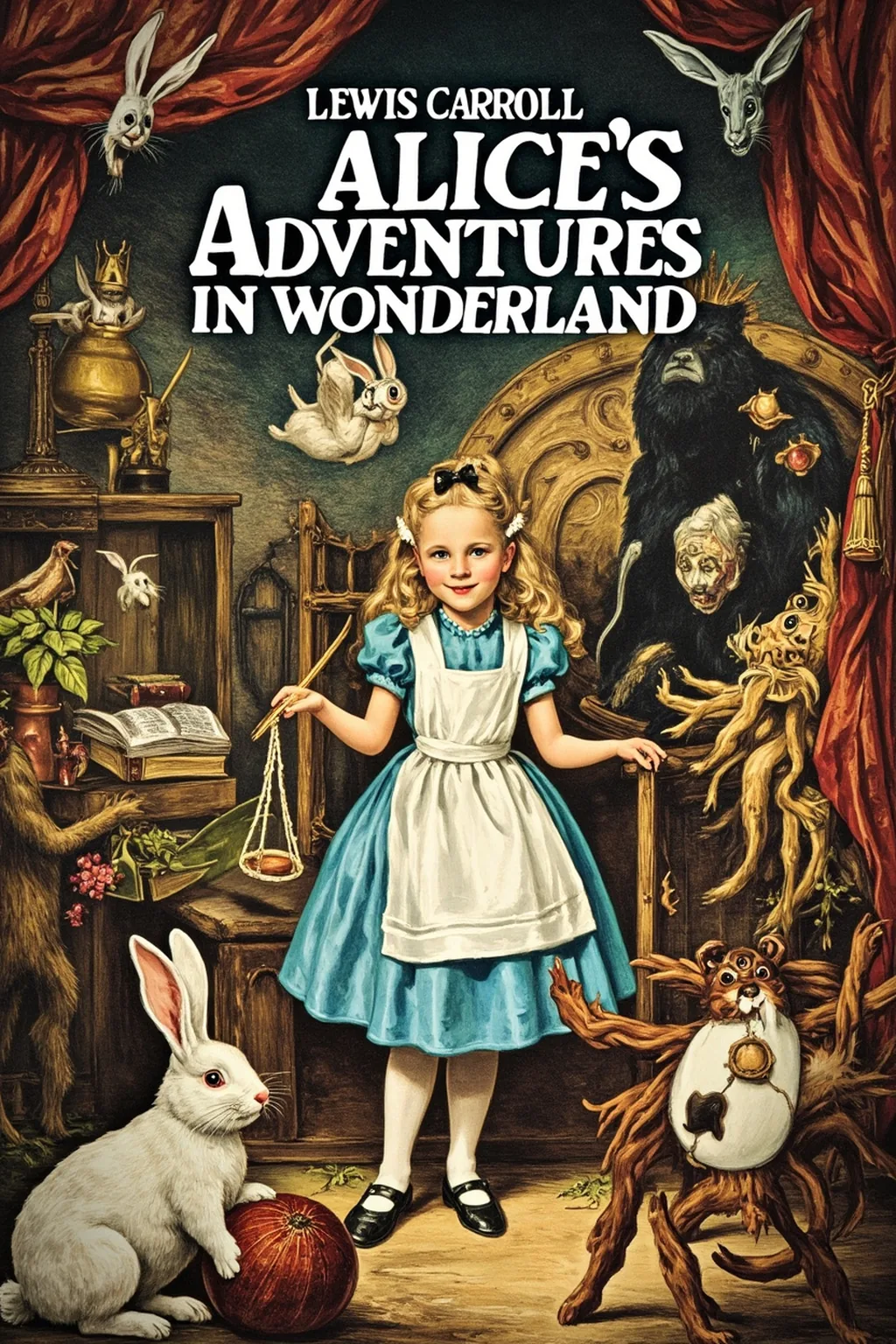
Chasing a White Rabbit leads Alice into a fantastical world where logic dissolves. She fluctuates wildly in size, encounters rude and eccentric inhabitants, and survives a terrifying royal trial, ultimately realizing the absurdity of the fantasy is nothing more than a pack of cards.
And so our story finds itself suspended at the precise moment when young Alice’s name is bellowed across the crowded courtroom—a threshold between one chapter of absurdity and another. The Queen of Hearts, with her crimson lips and impatient temperament, has demanded the witness stand, and our bewildered protagonist must now navigate the increasingly surreal landscape of Wonderland’s legal system, where verdicts seem mere afterthoughts and sentences are pronounced before any crime is fully established. What follows is perhaps the most theatrical and bewildering spectacle of Alice’s entire dream: a trial that spirals magnificently out of control, punctuated by impossible rules, disputed measurements, and the ever-present threat of decapitation. The White Rabbit’s shrill announcements, the jury’s frantic scribbling, and the King’s increasingly desperate attempts at judicial procedure will all converge upon this singular moment when Alice finally declares, with all the indignation a seven-year-old can muster, that such proceedings are nothing more than the ravings of a common pack of cards. And indeed, as the dream dissolves into waking and the cards flutter down like autumn leaves, we are reminded that Wonderland itself is as insubstantial as the imagination of a child resting by the riverbank—real only while the dreamer sleeps, and gone forever with the opening of eyes.
Alice jumps up in a hurry to answer the summons, forgetting her recent growth, and accidentally tips the jury-box over the edge of her skirt. The jurors tumble onto the heads of the crowd below, sprawling about like goldfish. Alice hastily picks them up, though she places Bill the Lizard head downwards, reasoning it makes little difference to the trial. Once the jury recovers and resumes writing, the King demands to know what Alice knows about the business. She admits to knowing nothing whatever, leading to a confused debate over whether this is important or unimportant.
Suddenly, the King reads from his notebook “Rule Forty-two,” stating that all persons more than a mile high must leave the court. Alice refuses to go, arguing she is not a mile high and that he invented the rule just now. Flustered by her logic, the King shuts his book and asks the jury for a verdict, but the White Rabbit interrupts with new evidence: a set of unsigned verses found in the Knave’s possession. The King argues the lack of a signature proves the Knave’s guilt, but when the Rabbit reads the nonsensical poem, Alice loudly declares it has no meaning and offers a reward to anyone who can explain it. The King attempts to interpret the verses as a confession regarding the tarts, but Alice points out the text does not fit the facts.
The original text of this work is in the public domain. This page focuses on a guided summary article, reading notes, selected quotes, and visual learning materials for educational purposes.