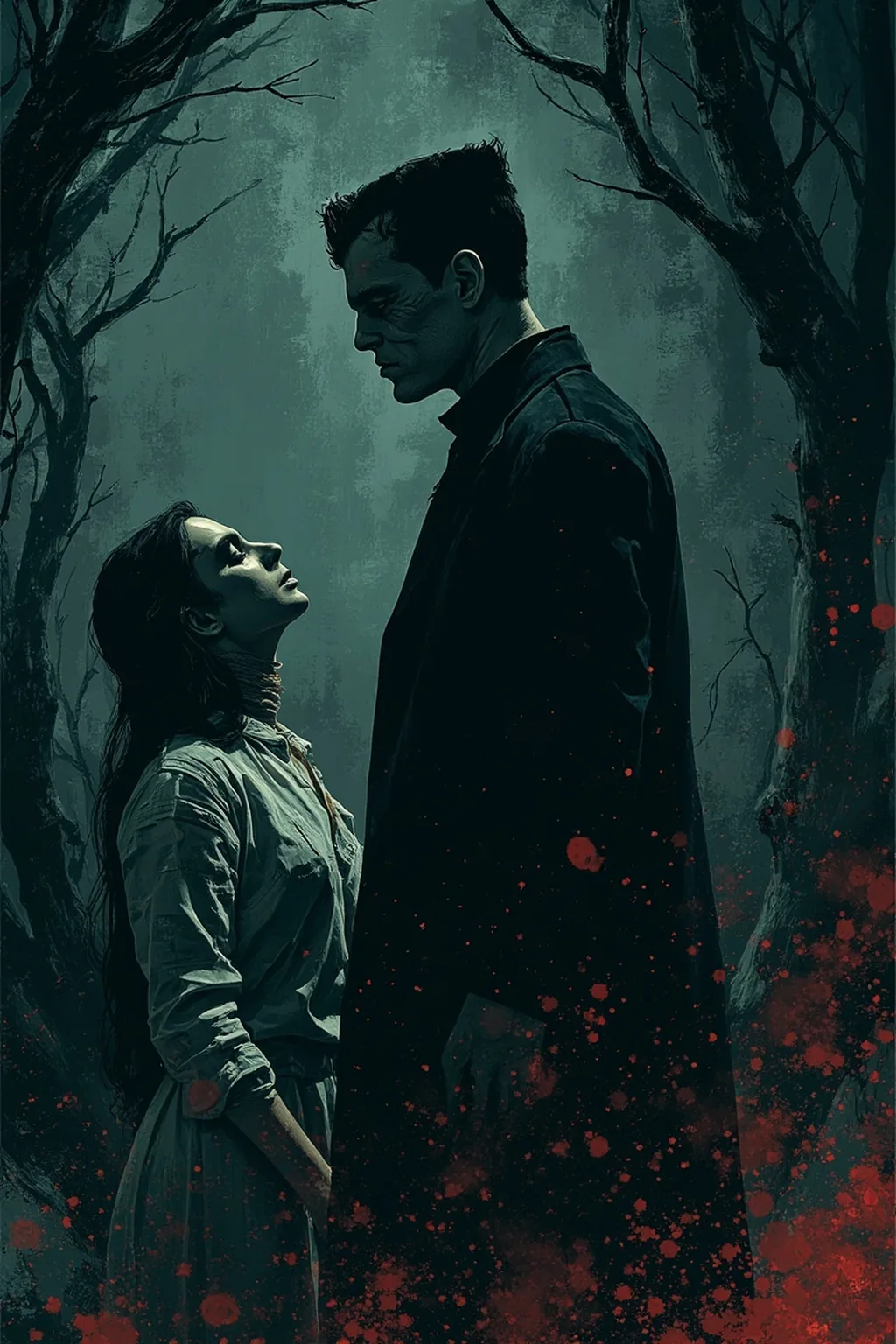
Frankenstein
I sat one evening in my laboratory, the sun set, the moon rising from the sea. With too little light to work, I paused to consider whether to continue. As I deliberated, a train of reflection overcame me. Three years earlier I had created a fiend whose barbarity had desolated my heart. Now I was about to form another being, a female whose dispositions were equally unknown. She might become ten thousand times more malignant than her mate, delighting in murder and wretchedness. He had sworn to hide himself in deserts, but she had not. She, who was likely to become a reasoning creature, might refuse any compact made before her existence. They might even hate each other. The creature already loathed his own deformity; might he not conceive a greater abhorrence for it in female form?
Even if they left Europe for the wilds of the new world, the sympathies for which the dæmon thirsted would produce children, and a race of devils would be propagated. Had I the right, for my own benefit, to inflict this curse on everlasting generations? Future ages might curse me as their pest, whose selfishness had purchased its own peace at the price of the whole human race.
I trembled, and my heart failed within me, when on looking up I saw by the moonlight the dæmon at the casement. A ghastly grin wrinkled his lips. He had followed me in my travels, loitered in forests, hidden in caves; now he came to mark my progress and claim my promise.
Madness seized me at the thought of my promise. Trembling with passion, I tore to pieces the thing on which I was engaged. The wretch saw me destroy the creature on whose future existence his happiness depended, and with a howl of devilish despair withdrew.
I locked the door and made a solemn vow never to resume my labours. Hours passed as I gazed on the motionless sea beneath the quiet moon. At last my ear was arrested by the paddling of oars near the shore. Footsteps approached. The door opened, and the wretch I dreaded appeared.
“You have destroyed the work which you began,” he said in a smothered voice. “Do you dare to break your promise? I have endured toil and misery; I left Switzerland with you; I crept along the shores of the Rhine. I have dwelt many months in the heaths of England and among the deserts of Scotland. I have endured incalculable fatigue, and cold, and hunger; do you dare destroy my hopes?”
“Begone! I do break my promise; never will I create another like yourself.”
“Slave, I before reasoned with you, but you have proved yourself unworthy of my condescension. You believe yourself miserable, but I can make you so wretched that the light of day will be hateful to you. You are my creator, but I am your master; obey!”
“The hour of my irresolution is past. Shall I set loose upon the earth a dæmon whose delight is in death? Begone! I am firm.”
The monster gnashed his teeth. “Shall each man find a wife for his bosom, and each beast his mate, and I be alone? Man, you may hate, but beware. Your hours will pass in dread and misery. I may die, but first you, my tyrant, shall curse the sun that gazes on your misery. I am fearless and therefore powerful.”
“It is well. I go; but remember, I shall be with you on your wedding-night.”
I started forward. “Villain! Before you sign my death-warrant, be sure that you are yourself safe.” He eluded me and quitted the house.
His words rang in my ears. I shuddered to think who might be the next victim. Then I recalled his words—I shall be with you on your wedding-night. When I thought of my beloved Elizabeth, tears—the first I had shed for many months—streamed from my eyes.
A fishing-boat landed near me and brought a packet: letters from Geneva, and one from Clerval entreating me to join him. This letter recalled me in a degree to life, and I determined to quit my island at the expiration of two days.
Yet there was a task to perform. At daybreak I unlocked the door of the room that had been the scene of my odious work. The remains of the half-finished creature lay scattered on the floor. With trembling hand I conveyed the relics into a basket with stones, determined to throw them into the sea that very night.
Between two and three in the morning I put my basket aboard a little skiff and sailed about four miles from shore. A moment of darkness came when the moon was overspread by a thick cloud, and I cast my basket into the sea.
I know not how long I remained, but when I awoke the sun had mounted considerably. The wind was high, the waves threatened my little skiff, and I had been driven far from the coast. “Fiend,” I exclaimed, “your task is already fulfilled!” I thought of Elizabeth, of my father, and of Clerval—all left behind, on whom the monster might satisfy his sanguinary passions.
By degrees the wind died. Sick and hardly able to hold the rudder, I suddenly saw a line of high land towards the south. Almost spent by fatigue, this sudden certainty of life rushed like a flood of warm joy to my heart.
I constructed another sail with a part of my dress and steered towards the land. I saw vessels near the shore and found myself transported back to the neighbourhood of civilised man.
As I was arranging the sails, several people crowded towards the spot. “My good friends, will you tell me the name of this town?”
“You will know that soon enough,” replied a man with a hoarse voice. “Maybe you are come to a place that will not prove much to your taste.”
“I do not know what the custom of the English may be, but it is the custom of the Irish to hate villains.”
Then an ill-looking man tapped me on the shoulder. “Come, sir, you must follow me to Mr. Kirwin’s to give an account of yourself.”
“Mr. Kirwin is a magistrate, and you are to give an account of the death of a gentleman who was found murdered here last night.”
Witnesses deposed that they had found a handsome young man, apparently strangled, with a black mark of fingers on his neck. When the mark of the fingers was mentioned I remembered the murder of my brother. Daniel Nugent swore that just before the fall of his companion he had seen a boat with a single man in it at a short distance from the shore.
The original text of this work is in the public domain. This page offers a compressed quick-read summary for educational purposes.