Mr. Kirwin desired that I should be taken into the room where the body lay. I entered and was led up to the coffin. How can I describe my sensations? I saw the lifeless form of Henry Clerval stretched before me. I threw myself on the body and exclaimed, “Have my murderous machinations deprived you also, my dearest Henry, of life?” The human frame could no longer support the agonies I endured, and I was carried out of the room in strong convulsions.
A fever succeeded. I lay for two months on the point of death; my ravings were frightful; I called myself the murderer of William, of Justine, and of Clerval. Mr. Kirwin alone understood me.
When I awoke to understanding I found myself in a prison. An old nurse sat beside me. “For that matter, if you mean about the gentleman you murdered, I believe that it were better for you if you were dead!”
Mr. Kirwin had shown me extreme kindness. “Your family is perfectly well,” said Mr. Kirwin, “and someone, a friend, is come to visit you.”
I cried out, “Oh! Take him away! I cannot see him.”
“My father!” cried I, while every feature was relaxed from anguish to pleasure. “Is my father indeed come?”
In a moment my father entered. I gradually recovered my health, though absorbed by a gloomy and black melancholy. The image of Clerval was for ever before me, ghastly and murdered.
The season of the assizes approached. Mr. Kirwin charged himself with every care of collecting witnesses. The grand jury rejected the bill, on its being proved that I was on the Orkney Islands at the hour the body of my friend was found; and a fortnight after my removal I was liberated from prison.
My father was enraptured. We took our passage on board a vessel bound for Havre-de-Grace. I hailed the darkness that shut Ireland from my sight, and my pulse beat with a feverish joy when I reflected that I should soon see Geneva. The past appeared to me in the light of a frightful dream; yet Clerval, my friend and dearest companion, had fallen a victim to me and the monster of my creation.
Summary
The voyage ended in Paris. Victor, exhausted and broken, confessed to his father, crying out that he had murdered William, Justine, and Henry. His father, suspecting madness, sought to distract him with society and argument, but Victor clung to a guilty silence, unable to reveal the creature he had unleashed.
Some days before they left for Switzerland, Elizabeth’s letter arrived. She wrote that she expected him within a fortnight, then asked, with tender courage, if he loved another. “Our union had been the favourite plan of your parents,” she reminded him, “but as brother and sister often love without desiring a more intimate union, may not such also be our case?” She confessed her love, yet declared that she would not make him miserable by clinging to what he did not freely choose. “Be happy, my friend,” she wrote, signing at Geneva, May 18th.
The letter revived the fiend’s threat: “I will be with you on your wedding-night!” Victor realized that on that night the creature would strike. Death seemed certain, yet he resolved not to postpone the marriage, fearing the monster’s worse revenge if he did. He wrote to Elizabeth, calm and affectionate, promising to reveal his dread secret the day after their union.
In a week they returned to Geneva. Elizabeth, thinner and paler, wept at his emaciated frame. His father pressed for the wedding. Victor, holding a pistol even then, agreed: in ten days, with Elizabeth’s consent, the ceremony would be held.
Preparations moved swiftly. Elizabeth’s inheritance had been restored by the Austrian government; they would honeymoon at Villa Lavenza on Lake Como. Victor carried pistols and a dagger, ever watchful, and as the day approached, the threat seemed almost a delusion against the certainty of his happiness.
The wedding morning came. Elizabeth was melancholy, a presentiment of evil oppressing her. After the ceremony, the couple embarked by water, intending to sleep at Evian. The day was fair, the wind favorable; they glided past Mont Salêve and Montalègre, the great Mont Blanc towering above, the dark Jura opposing its barrier to the shore. Elizabeth, trying to lift their spirits, pointed out the fish in the clear waters, the shifting clouds over the dome of Mont Blanc. “What a divine day!” she cried. Joy flickered in her eyes, then faded into reverie.
The sun sank as they passed the river Drance, the Alps closing in toward the eastern shore. The spire of Evian shone beneath the woods. The wind fell; the air carried the scent of flowers and hay. They landed at eight o’clock, walked a short while on the shore, then retired to the inn as darkness veiled the mountains.
The wind shifted to the west with sudden violence. The moon rose and was chased by clouds; the lake heaved; a heavy storm broke. Victor’s thousand fears returned. He gripped his hidden pistol and walked the passages, searching every corner. Elizabeth, sensing his terror, asked what he feared. “This night, and all will be safe,” he whispered, “but this night is dreadful.”
He urged her to retire while he sought the enemy. She left him. Suddenly, from her room, came a shrill and dreadful scream. The whole truth rushed upon him; his arms dropped, every muscle suspended. He rushed in.
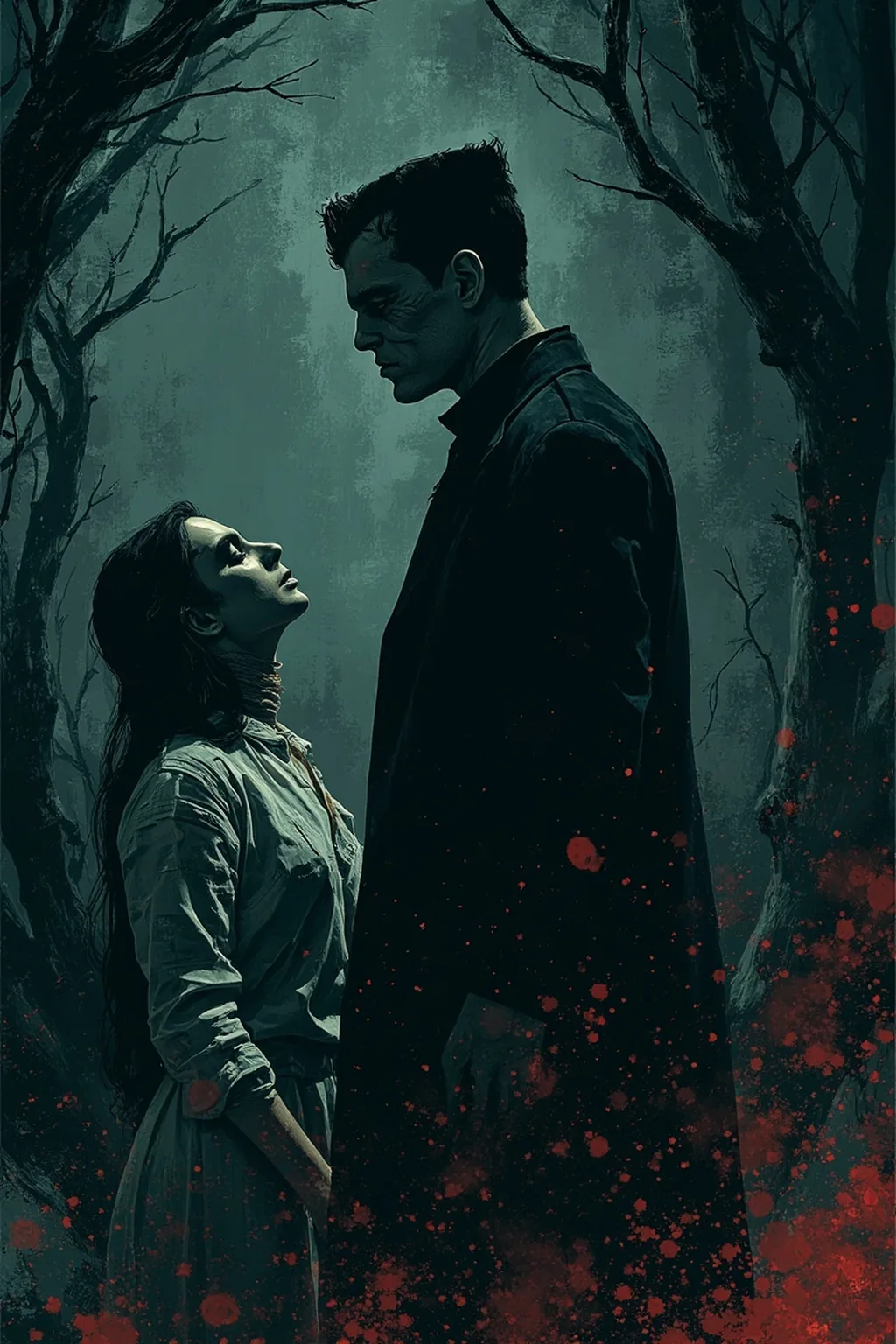
Elizabeth lay lifeless across the bed, her head hanging, her pale features half hidden by her hair, the mark of the fiend’s grip upon her neck. At the open window stood the monster, grinning, pointing toward the corpse. Victor fired, but the creature leaped into the lake and vanished.
Victor fell senseless. When he recovered, he crawled to her body, embracing her cold limbs, weeping with the women around him. He thought of his father and Ernest, possibly in the monster’s grasp, and forced himself to return to Geneva. They rowed through the storm; he could not lift the oar. Nothing was as it had been a day before.
At Geneva, his father, learning Elizabeth’s fate, withered. The old man, who had clung to her as his more than daughter, died in Victor’s arms within days. Victor sank into madness, a prisoner in a dungeon for months.
On his release, he went to a magistrate and confessed the whole tale, accusing the creature of every crime. The magistrate listened with astonishment, then with incredulity, declaring the monster beyond capture. Victor, blazing with rage, swore to pursue the fiend himself across the world. He broke from the house, bent on a vengeance that would end only with death.
The original text of this work is in the public domain. This page offers a compressed quick-read summary for educational purposes.