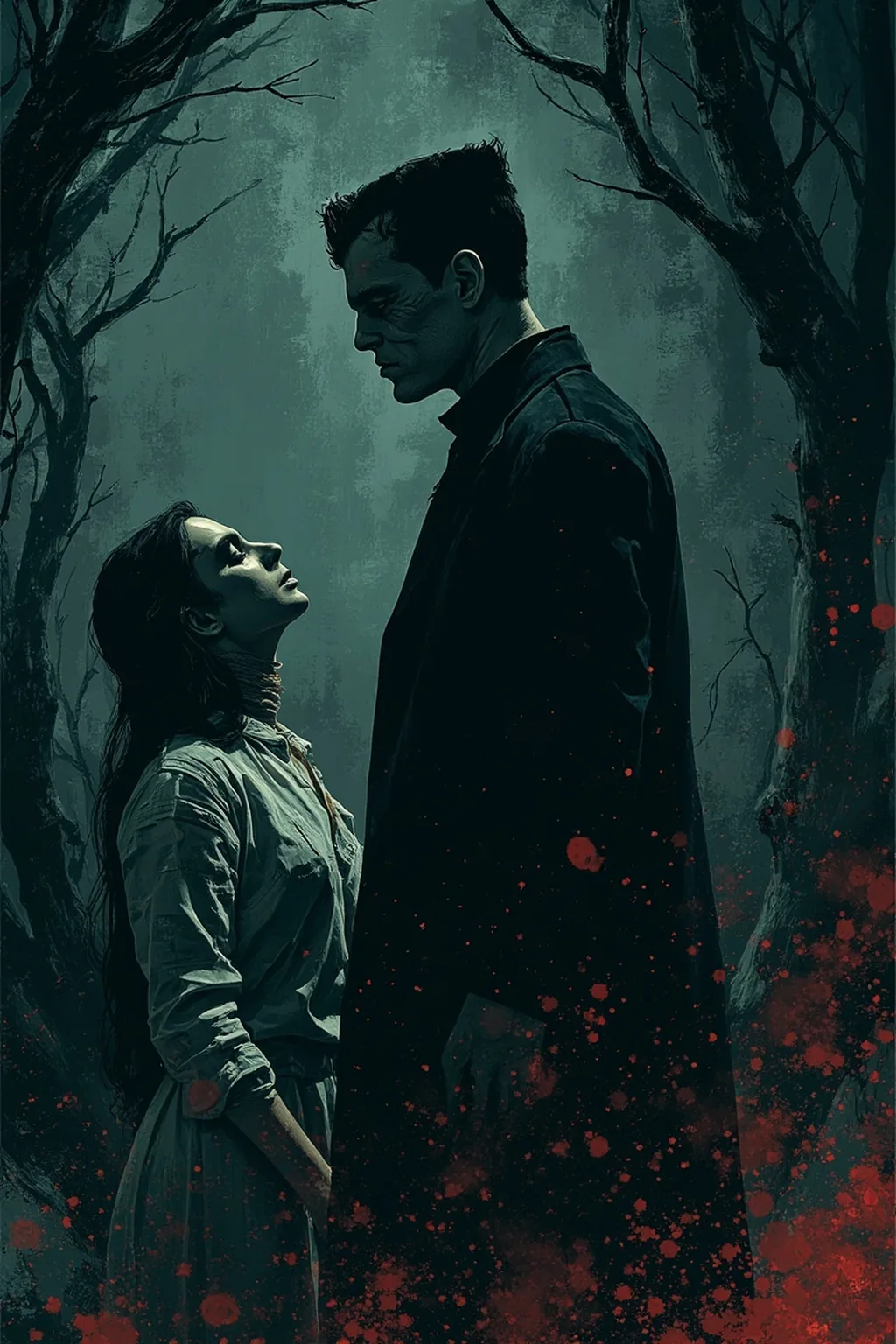
But when he awoke the next morning, dark melancholy clouded every thought. The rain poured in torrents and thick mists hid the summits of the mountains. He resolved to ascend to the summit of Montanvert without a guide. It was a scene terrifically desolate, where the traces of winter avalanches lay broken and strewed upon the ground. At the top he sat upon a rock overlooking the sea of ice; a breeze dissipated the cloud, and he descended upon the glacier.
Suddenly he beheld the figure of a man advancing toward him with superhuman speed, bounding over the crevices in the ice. His stature, as he approached, seemed to exceed that of man. Victor trembled with rage and horror, resolving to close with him in mortal combat. “Devil,” he exclaimed, “do you dare approach me? Begone, vile insect! Or rather, stay, that I may trample you to dust!”
“I expected this reception,” said the dæmon. “All men hate the wretched; how, then, must I be hated, who am miserable beyond all living things! Yet you, my creator, detest and spurn me, thy creature, to whom thou art bound by ties only dissoluble by the annihilation of one of us. You purpose to kill me. How dare you sport thus with life?” Victor’s rage was without bounds; he sprang upon the creature, impelled by all the feelings which can arm one being against the existence of another.
The monster easily eluded him. “Be calm,” he said, “and hear me before you give vent to your hatred. Have I not suffered enough, that you seek to increase my misery? Remember, thou hast made me more powerful than thyself; but I will not be tempted to set myself in opposition to thee. I am thy creature, and I will be even mild and docile to my natural lord and king if thou wilt also perform thy part. Oh, Frankenstein, be not equitable to every other and trample upon me alone, to whom thy justice, and even thy clemency and affection, is most due. Remember that I am thy creature; I ought to be thy Adam, but I am rather the fallen angel, whom thou drivest from joy for no misdeed. I was benevolent and good; misery made me a fiend. Make me happy, and I shall again be virtuous.”
“Begone! There can be no community between you and me; we are enemies.”
“How can I move thee?” replied the creature. “Believe me, Frankenstein, I was benevolent; my soul glowed with love and humanity; but am I not alone, miserably alone? You, my creator, abhor me; what hope can I gather from your fellow creatures? They spurn and hate me. The desert mountains and dreary glaciers are my refuge. Yet it is in your power to recompense me, and deliver them from an evil which it only remains for you to make so great. Listen to my tale; when you have heard that, abandon or commiserate me, as you shall judge that I deserve.”
Victor weighed the arguments and determined at least to listen. He was partly urged by curiosity, and compassion confirmed his resolution. They crossed the ice and ascended the opposite rock, entering a hut upon the mountain—the fiend with an air of exultation, Victor with a heavy heart.
The creature’s tale began with confusion: a strange multiplicity of sensations had seized him upon awakening, all events of that period appearing confused and indistinct. He saw, felt, heard, and smelt at the same time. By degrees a stronger light pressed upon his nerves; he opened and shut his eyes, wandered and descended, until he found himself in a forest near Ingolstadt, where he lay by a brook until tormented by hunger and thirst. He ate berries and drank, then lay down overcome by sleep.
When he awoke it was dark, and he felt cold and helpless. He covered himself with clothes taken from Victor’s apartment, but they were insufficient against the dews of night. Soon a gentle light stole over the heavens—the moon—giving him a sensation of pleasure. He found a huge cloak beneath a tree and sat down upon the ground, all still confused within him.
Several changes of day and night passed before he began to distinguish his sensations from each other. He observed the forms that surrounded him, tried to imitate the songs of the birds, but was frightened by his own uncouth sounds. He discovered a fire left by wandering beggars; in his joy he thrust his hand into the live embers and cried out in pain. By touching the wet wood he learned how to feed the flame. When night came he feared its extinction and covered it carefully.
The next morning he was pleased to find that fire gave light as well as heat, and he began to roast the offals the travellers had left. Soon food grew scarce, and he resolved to quit the place. Lamenting the loss of his fire, he struck across the wood toward the setting sun, and after three days discovered the open country under a great fall of snow.
He perceived a small hut and entered it, frightening an old man who fled into the fields. He devoured the shepherd’s breakfast of bread, cheese, milk, and wine, then lay down among the straw and slept. At noon he recommenced his travels, and at sunset arrived at a village. No sooner had he entered one of the better cottages than the children shrieked and a woman fainted. Grievously bruised by stones, he escaped to a low hovel bare of all but a dry floor, and there took refuge from the inclemency of the season and the barbarity of man.
He carpeted the hovel with clean straw and lived on purloined bread and water. Soon, through a small chink where a window had been filled up with wood, he beheld a small whitewashed room. An old man sat near a fire in a disconsolate attitude, and a young girl, meanly dressed but of gentle demeanour, took something from a drawer and sat beside him. The old man took up an instrument and began to play, producing sounds sweeter than the voice of the thrush or the nightingale. Tears came to the girl’s eyes; she knelt at his feet, and he raised her with such kindness that the watching creature felt sensations of a peculiar and overpowering nature—a mixture of pain and pleasure he had never before experienced—and withdrew, unable to bear these emotions.
In the evening the old man again played, and the youth began to utter sounds that were monotonous—not resembling harmony but, as the creature later learned, reading aloud. The family soon extinguished their lights and retired to rest, leaving him to wonder at the means by which they prolonged the light, and at the mysterious sounds that poured from the old man’s instrument and the young man’s voice into the night.
The original text of this work is in the public domain. This page offers a compressed quick-read summary for educational purposes.