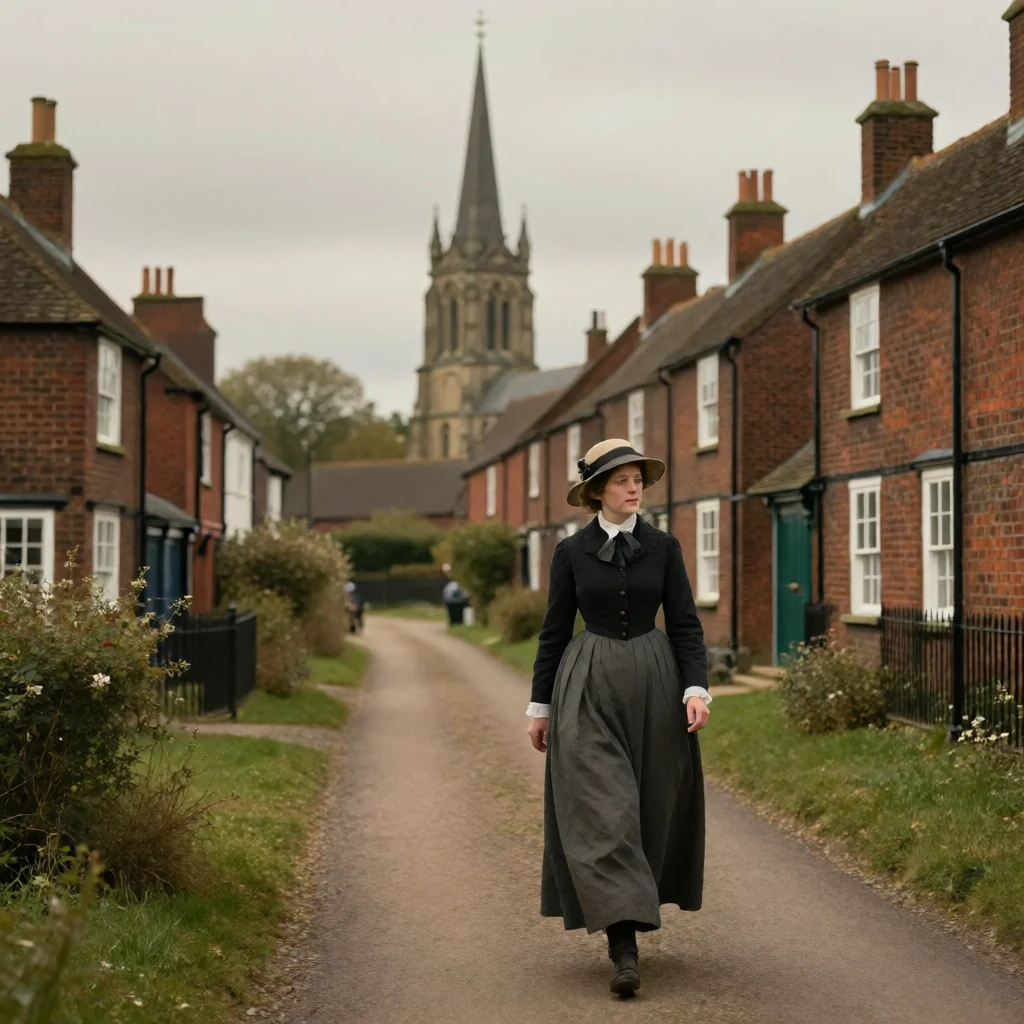
Mrs. Cadwallader Breaks Engagement News to Sir James Chettam
Mrs. Cadwallader departs quickly to break the engagement news to Sir James Chettam at Freshitt Hall, stopping first to arrange for her young cook to train with the Brookes’ pastry cook, Mrs. Carter. At Freshitt Hall, she asks Sir James to walk with her to the conservatory to avoid being overheard by staff. She first teases him about Mr. Brooke’s suspected political ambitions to ease into the news, then reveals Dorothea is engaged to Mr. Casaubon. Sir James is horrified, calling Casaubon “no better than a mummy” and complaining Dorothea is throwing her life away. Mrs. Cadwallader mocks Casaubon’s scholarly, pallid nature, notes that Sir James is well rid of Dorothea’s high-flown, strict ways, and suggests Celia would have made him a far better wife. Sir James is left reeling, and rides away quickly in a direction away from Tipton Grange to process the news.
CHAPTER VI.
Chapter VI traces Mrs. Cadwallader’s reaction to Dorothea Brooke’s rejection of Sir James Chettam, her pivot to arranging a new match between Sir James and Celia Brooke, and the psychological workings of pride and disappointment among the gentry of Tipton and Freshitt.
Mrs. Cadwallader’s Matchmaking
The narrator opens by asking why Mrs. Cadwallader should be so invested in Miss Brooke’s marriage and, when one match fails, immediately scheme for another. No overt plot would be visible to a telescopic watcher of her rural rounds; the causes of her behavior must be examined at a finer scale.
The Diplomatist of Tipton and Freshitt
Mrs. Cadwallader’s simple rural life is enriched by letters from aristocratic relatives detailing the scandals, follies, and gouty humors of high-born families. She believes fervently in birth and no-birth, would sympathize with a fallen nobleman, but harbors a near-religious hatred of vulgar wealth and high retail prices.
A Play of Minute Causes
Using a microscope metaphor applied to a water-drop, the narrator argues that small, almost invisible pressures shape Mrs. Cadwallader’s matchmaking, producing vortices of thought and speech that feed her active, phosphorus-like mind. Her self-conception as a vital social force makes the Brookes’ matrimonial prospects naturally her concern.
An Offensive Irregularity
Mrs. Cadwallader had prearranged Dorothea’s marriage to Sir James and is irritated that Dorothea instead chose the elderly Mr. Casaubon. She registers this as an “offensive irregularity” against her diplomacy and revises her opinion of Dorothea, now judging her religious eccentricities as a constitutional disease rather than mere whim.
Joy of Her Hair Shirt
Concluding that Dorothea is lost to her influence, Mrs. Cadwallader declares she “throws her over” and wishes her “joy of her hair shirt,” reasoning that a husband who never contradicted her was the only hope of curing her absurdities.
A New Match for Sir James
Mrs. Cadwallader resolves on Celia as the next match for Sir James and skillfully hints to him that he has made an impression on Celia’s heart. Sir James, who is no languishing romantic but has an amiable vanity that responds to being liked, finds this hint agreeable rather than wounding.
Sir James’s Resolve
After riding hard away from Tipton Grange, Sir James slackens his pace, turns back, and resolves to visit as though nothing new has happened. The knowledge that Dorothea chose Casaubon has bruised but not destroyed his attachment, and he welcomes the chance to call on polite pretexts while secretly paying Celia more attention.
Pride and Disappointment
The chapter closes with a generalization about mortal endurance: between breakfast and dinner people swallow many disappointments, suppressing tears and replying “Oh, nothing!” to inquiries. Pride, the narrator allows, is not a bad thing when it only urges concealment of one’s own hurts.
CHAPTER VII.
The chapter opens with an Italian proverb about pleasure and seasons, establishing the theme of timing and natural progression in romantic relationships. Mr. Casaubon, as expected, spends considerable time at the Grange during the courtship period, and the interruption to his work on the Key to all Mythologies makes him eager for the relationship to conclude successfully.
The original text of this work is in the public domain. This page offers a compressed quick-read summary for educational purposes.