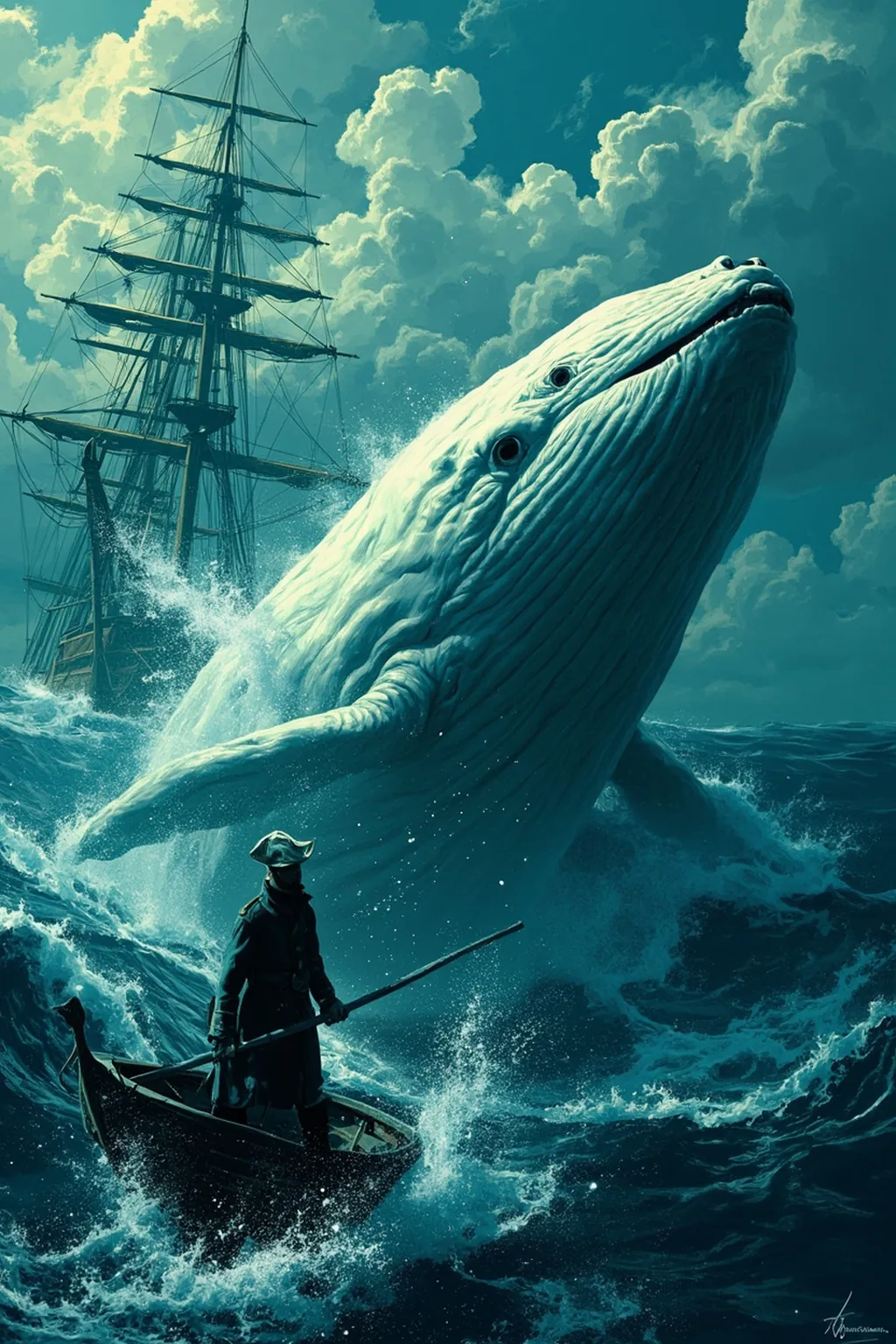
“Well, then,” Bunger interrupted, “give him your left arm for bait to get the right. Do you know, gentlemen”—bowing gravely to both captains—“Do you know, gentlemen, that the digestive organs of the whale are so inscrutably constructed by Divine Providence, that it is quite impossible for him to completely digest even a man’s arm? And he knows it too. So that what you take for the White Whale’s malice is only his awkwardness. For he never means to swallow a single limb; he only thinks to terrify by feints. But sometimes he is like the old juggling fellow, formerly a patient of mine in Ceylon, that making believe swallow jack-knives, once upon a time let one drop into him in good earnest, and there it stayed for a twelvemonth or more; when I gave him an emetic, and he heaved it up in small tacks, d’ye see. No possible way for him to digest that jack-knife, and fully incorporate it into his general bodily system. Yes, Captain Boomer, if you are quick enough about it, and have a mind to pawn one arm for the sake of the privilege of giving decent burial to the other, why in that case the arm is yours; only let the whale have another chance at you shortly, that’s all.”
“No, thank ye, Bunger,” Boomer said. “he’s welcome to the arm he has, since I can’t help it, and didn’t know him then; but not to another one. No more White Whales for me; I’ve lowered for him once, and that has satisfied me. There would be great glory in killing him, I know that; and there is a ship-load of precious sperm in him, but, hark ye, he’s best let alone; don’t you think so, Captain?”—glancing at Ahab’s ivory leg.
“He is. But he will still be hunted, for all that. What is best let alone, that accursed thing is not always what least allures. He’s all a magnet! How long since thou saw’st him last? Which way heading?”
“Bless my soul, and curse the foul fiend’s,” Bunger cried, stooping to sniff at Ahab’s arm like a dog, “this man’s blood—bring the thermometer!—it’s at the boiling point!—his pulse makes these planks beat!—sir!”—taking a lancet from his pocket and stepping toward Ahab’s arm.
“Avast!” Ahab roared, dashing him against the bulwarks. “Man the boat! Which way heading?”
“Good God!” Boomer cried, to whom the question was addressed. “What’s the matter? He was heading east, I think.—Is your Captain crazy?” he whispered to Fedallah. But Fedallah only put a finger to his lip, slid over the bulwarks to take the boat’s steering oar, and Ahab, swinging the cutting-tackle toward him, commanded his sailors to stand by to lower. In a moment he was standing in the boat’s stern, the Manilla men springing to their oars, his back to the stranger ship, face set like a flint to his own.
CHAPTER 101. The Decanter.
Before the English Samuel Enderby fades from sight, it is worth recording that she hailed from London, named for the late Samuel Enderby, merchant of that city, the founder of the famous whaling house Enderby & Sons—a house which, in Ishmael’s poor whaleman’s opinion, comes not far behind the united royal houses of the Tudors and Bourbons in real historical interest. How long the house existed before 1775 Ishmael’s documents do not say, but that year it fitted out the first English ships ever to regularly hunt the sperm whale; though Nantucketers and Vineyard men had pursued the leviathan in the North and South Atlantic for fifty years prior, they were the first to harpoon the sperm whale with civilized steel, and for half a century the only people on earth to do so. In 1778, the Enderbys fitted out the Amelia at their own expense, which boldly rounded Cape Horn and was the first of any nation to lower a whale-boat in the great South Sea; the successful voyage, returning with a hold full of sperm oil, was soon followed by other English and American ships, throwing open the vast Pacific sperm whale grounds. Not content with that, the indefatigable house bestirred itself again: Samuel and all his sons, under their auspices and partly at their expense, convinced the British government to send the sloop-of-war Rattler on a whaling discovery voyage to the South Sea, which made a rattling voyage of it and did some unrecorded service. In 1819, the same house fitted out a discovery whale ship, the Syren, for a tasting cruise to the remote waters of Japan, opening the great Japanese whaling grounds for the first time; the Syren was commanded by Captain Coffin, a Nantucketer.
All honor to the Enderbies, then, whose house Ishmael believes still exists to this day, though the original Samuel must long ago have slipped his cable for the great South Sea of the other world. The ship named for him was worthy of the honor: a fast sailer, a noble craft in every way. Ishmael boarded her once at midnight off the Patagonian coast, drinking good flip down in the forecastle, and the gam that followed was one for the books: every soul on board was a trump, a short life to them and a jolly death. That night, long after Ahab touched her planks with his ivory heel, stays in Ishmael’s mind as the perfect example of Saxon hospitality: they drank flip at a rate of ten gallons an hour, until a squall blew up off Patagonia and all hands—visitors included—were called to reef topsails. So top-heavy with flip that they had to swing each other aloft in bowlines, they ignorantly furled the skirts of their jackets into the sails, hanging there reefed fast in the howling gale as a warning to all drunken tars. The masts held, they scrambled down sober enough that they had to pass the flip again, though the savage salt spray bursting down the forecastle scuttle pickled and diluted it more than Ishmael liked. The beef was fine—tough, but with body in it, whether bull or dromedary they never confirmed. The dumplings were small but substantial, symmetrically globular, indestructible: Ishmael fancied you could feel them rolling around inside you after swallowing, and if you stooped too far forward, they might pitch out of you like billiard balls. The bread was the only fresh fare they had, an anti-scorbutic, dark as the forecastle where they ate it. All in all, from truck to helm, the Samuel Enderby was a jolly ship, good fare and plenty, fine flip and strong, crack fellows from boot heels to hat-band.
The original text of this work is in the public domain. This page focuses on a guided summary article, reading notes, selected quotes, and visual learning materials for educational purposes.