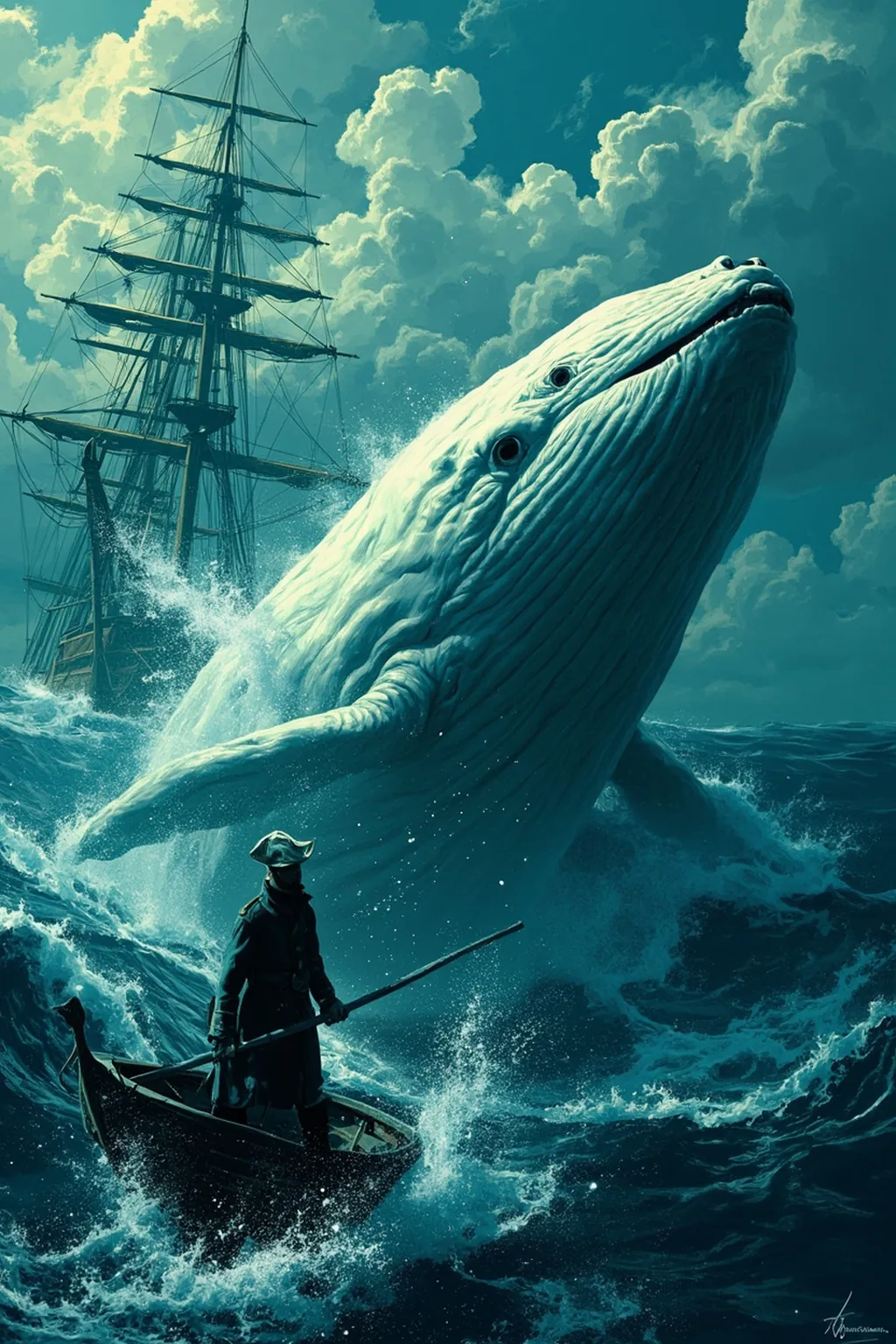
The Spirit-Spout
The Spirit-Spout On a serene moonlight night, a silver jet is sighted far ahead of the ship by Fedallah, who maintains his vigil at the main-mast head. The ethereal spout, illuminated by the moon, resembles a plumed and glittering god rising from the sea. When Fedallah breaks his customary silence to announce the sighting, every sailor rises instinctively, drawn by the deliriously exciting cry. Though whales are visible by night, most whalemen would not risk lowering for them at such unwonted hours.
Ahab’s Command
Ahab’s Command Ahab responds to the sighting with immediate, commanding action. He orders all sails set, including stunsails, and commands the best helmsman to take the wheel. The ship surges forward through the wind with every mast-head manned. Ahab walks the deck with fierce determination, his ivory leg striking the deck in contrast to his living leg, embodying the war between life and death that consumes him. Despite the ship’s swift pursuit, the silvery jet vanishes and is not seen again that night.
The Midnight Spout
The Midnight Spout The mysterious spout reappears several nights later at the same silent hour, is sighted by all, but disappears whenever the ship makes sail to pursue it. This pattern repeats night after night—the jet mysteriously jetted into the moonlight, vanishing for days at a time, yet somehow appearing progressively further ahead each time. The crew grows accustomed to the phenomenon, no longer heeding it except to wonder at its persistent, alluring presence that seems to beckon them onward.
The Moby Dick Superstition
The Moby Dick Superstition Among the crew, a superstitious belief takes hold that this solitary spout belongs to none other than Moby Dick himself. They swear that regardless of time or location, the same self-same whale is responsible for this unattainable jet. This belief instills a peculiar sense of dread, as if the apparition is treacherously beckoning them onward toward some inevitable confrontation in the remotest, most savage seas.
Cape Tormentoso
Cape Tormentoso The ship rounds the Cape of Good Hope, renamed Cape Tormentoso (Tormentous Cape), where fierce winds and troubled seas assault the vessel. The ivory-tusked Pequod cuts through crashing waves, sending foam cascading over the bulwarks. Strange sea creatures dart alongside the ship while ravens and other birds follow persistently. Despite the harsh conditions, the mysterious spout continues to appear, still beckoning them onward through the desolate waters.
Ahab in the Gale
Ahab in the Gale During the storm, Ahab assumes continuous command of the dangerous deck, rarely speaking to his mates. For hours he stands gripping a shroud, gazing fixedly to windward while sleet and snow nearly freeze his eyelashes. The crew, driven from the forward decks, stands in bowlines along the bulwarks, swinging with the waves. Wordless and grim, the men endure the shrieking ocean while Ahab remains unmoved, refusing rest even when exhausted, demonstrating his unyielding resolve against nature’s fury.
The Tell-Tale Compass
The Tell-Tale Compass Starbuck discovers Ahab one night in the cabin, eyes closed but sitting upright in his chair, rain still dripping from his clothes. His lantern swings from his clenched hand as he grips the tell-tale compass—a cabin compass that allows him to monitor the ship’s course from below. A chart of tides and currents lies unrolled beside him. Moved by the sight, Starbuck reflects on this terrible old man who, even in apparent sleep during the gale, steadfastly fixes his purpose upon the hunt ahead.
CHAPITRE 52. The Albatross.
As the Pequod approaches another whaling vessel called the Goney, or Albatross, Ishmael observes from his perch atop the fore-mast how the stranger ship appears bleached and weathered after nearly four years at sea, its crew looking forlorn in tattered clothing and resembling wild men standing in iron hoops nailed to the masts. When the Pequod hails the vessel to ask about the White Whale, the strange captain accidentally drops his speaking trumpet into the sea, and despite Ahab’s efforts to shout his message across the widening gap between the ships, the two vessels separate without meaningful communication. As the ships pass, a school of small fish that had been peacefully swimming alongside the Pequod suddenly darts away with shuddering fins, an omen that seems to affect Ahab with a rare moment of deep helpless sadness as he murmurs to himself. He then commands the helmsman to keep the ship off course to sail round the world, prompting his meditation on how such circumnavigation leads only through countless perils back to where one started, concluding that while this earth is indeed round, pursuit of far mysteries or the demon phantom swimming before all human hearts often leads only to barren mazes or abandonment mid-journey.
The original text of this work is in the public domain. This page focuses on a guided summary article, reading notes, selected quotes, and visual learning materials for educational purposes.