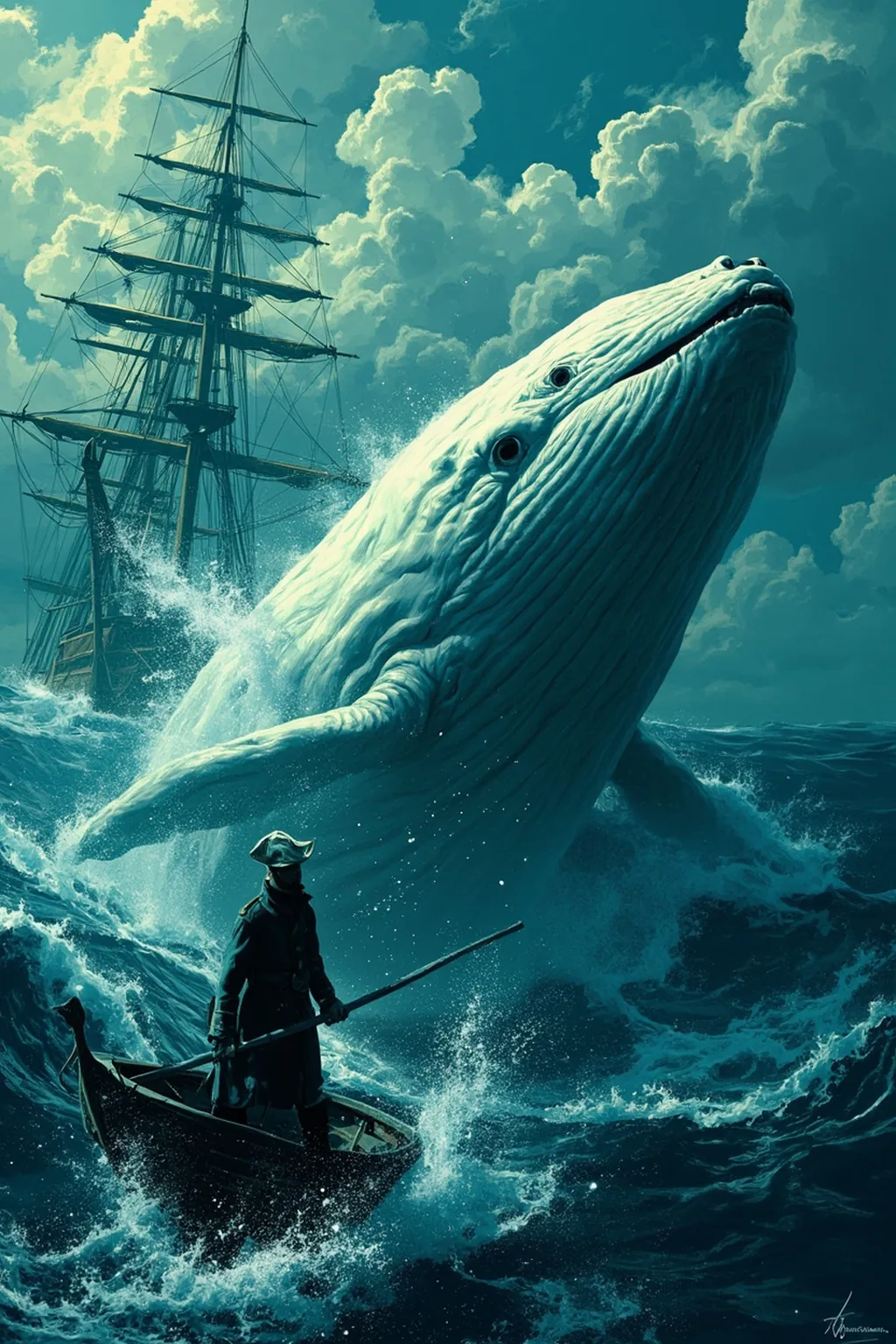
CHAPTER 111. The Pacific.
When the Pequod slipped past the Bashee isles and emerged at last onto the great South Sea, the narrator could have fallen to his knees in gratitude: his long youth supplication for the serene Pacific was answered, a thousand leagues of blue rolling eastwards before him. There is a sweet, unknowable mystery to that sea, whose gentle, awful stirrings seem to speak of a hidden soul beneath, like the fabled undulations of Ephesian sod over the buried Evangelist St. John. It is fit that its waves rise and fall unceasingly over the Potter’s Fields of all four continents: here, millions of drowned dreams, somnambulisms, half-lived lives lie dreaming, tossing in their sleep, the ever-rolling waves made only by their restlessness. To any meditative rover, the Pacific is the sea of adoption: it rolls the midmost waters of the world, the Indian Ocean and Atlantic its outstretched arms. The same waves wash the moles of new Californian towns planted yesterday, and lave the faded, gorgeous skirts of Asiatic lands older than Abraham; between them float milky-ways of coral isles, endless unknown archipelagoes, impenetrable Japans. It zones the whole world’s bulk, makes all coasts one bay to it, the tide-beating heart of the earth; lifted by its eternal swells, you must bow your head to the seductive god Pan. But few thoughts of Pan stirred Ahab’s brain as he stood like an iron statue at his post by the mizen rigging, one nostril snuffing the sugary musk of the Bashee isles, the other inhaling the salt breath of the new-found sea where Moby Dick even then swam. Launched at last onto these final waters, gliding toward the Japanese cruising-ground, Ahab’s purpose burned hotter than ever. His firm lips pressed together like a vice; the veins on his Delta forehead swelled like overladen brooks; in his very sleep, his ringing cry split the vaulted hull: “Stern all! the White Whale spouts thick blood!”
CHAPTER 112. The Blacksmith.
The old blacksmith Perth, his face matted with beard, swathed in a bristling shark-skin apron, kept his portable forge lashed to the ringbolts by the foremast long after he’d finished the fittings for Ahab’s leg, taking advantage of the mild summer weather to repair the crew’s weapons and boat gear. He was a silent, patient man, his hammer beating as slow and steady as his heart, no murmur of impatience ever passing his lips, his chronically broken back bowed further over his work as if toil were the only thing that kept him alive. Most miserable was his lot, and the crew soon learned why: one bitter winter midnight, half-stupid with drink, he’d taken refuge in a dilapidated barn, and lost the extremities of both his feet to frost. That was the final act of a life’s tragedy that had begun when a desperate burglar, the Bottle Conjuror, had slipped into his home in the dark and robbed him of everything while he was in the basement forge, his hammer’s muffled ring lulling his wife and children upstairs. The house was sold, his wife died of grief, his children ended up in the churchyard, and the old blacksmith, houseless and familyless, staggered off a vagabond in crape, his grey head a scorn to the flaxen curls of the young men who’d once respected him. Death seemed the only worthy end to such a life, but Death was only a passage into the unknown, the wild, the watery unshored; so when the ocean called to him, singing of a new life without the guilt of suicide, of wonders supernatural that required no dying to attain, he’d answered at once, and gone a-whaling. Now he toiled on, patient as a stone, his hammer ringing out the beat of his ruined, unending life.
CHAPTER 113. The Forge.
Midday found Perth standing between his forge and anvil, a pike-head held in the coals, his bellows pumping, when Ahab approached carrying a small, rusty leathern bag full of nail-stubbs from the steel shoes of racing horses. He paused a few feet from the forge, watching the sparks fly, until Perth withdrew his iron and began hammering it, the red mass sending up thick, hovering flights of sparks that burned close to Ahab’s face. “Are these thy Mother Carey’s chickens, Perth?” Ahab called. “They are always flying in thy wake; birds of good omen, too, but not to all—look here, they burn; but thou livest among them without a scorch.” “Because I am scorched all over, Captain Ahab,” Perth answered, resting his hammer for a moment. “I am past scorching; not easily canst thou scorch a scar.” “Well, well; no more. Thy shrunk voice sounds too calmly, sanely woeful to me. In no Paradise myself, I am impatient of all misery in others that is not mad. Thou should’st go mad, blacksmith; say, why dost thou not go mad? How canst thou endure without being mad? Do the heavens yet hate thee, that thou canst not go mad? What wert thou making there?” “Welding an old pike-head, sir; there were seams and dents in it.” “And canst thou make it all smooth again, after such hard usage?” “I think so, sir.” “And I suppose thou canst smoothe almost any seams and dents; never mind how hard the metal?” “Aye, sir, I think I can; all seams and dents but one.” “Look ye here, then!” Ahab cried, passionately advancing, leaning both hands on Perth’s shoulders. He swept one hand across his ribbed, seamed brow. “Here—can ye smoothe out a seam like this, blacksmith? If thou couldst, glad enough would I lay my head upon thy anvil, and feel thy heaviest hammer between my eyes. Answer! Canst thou smoothe this seam?” “Oh! that is the one, sir! Said I not all seams and dents but one?” “Aye, blacksmith, it is the one; it is unsmoothable. For though thou only seest it here in my flesh, it has worked down into the bone of my skull—that is all wrinkles! But away with child’s play; no more gaffs and pikes to-day. Look ye here!” He jingled the leather bag, as if it were full of gold. “I, too, want a harpoon made; one that a thousand yoke of fiends could not part, Perth; something that will stick in a whale like his own fin-bone. There’s the stuff.” He flung the pouch onto the anvil. “Look ye, blacksmith, these are the gathered nail-stubbs of the steel shoes of racing horses.” “Horse-shoe stubbs, sir? Why, Captain Ahab, thou hast here the best and stubbornest stuff we blacksmiths ever work.” “I know it, old man; these stubbs will weld together like glue from the melted bones of murderers. Quick! forge me the harpoon. And forge me first twelve rods for its shank; then wind, and twist, and hammer these twelve together like the yarns and strands of a tow-line. Quick! I’ll blow the fire.” Perth heated the rods one by one, and Ahab tested each by spiralling it round a long iron bolt. “A flaw!” he rejected the last one. “Work that over again, Perth.” When the twelve rods were remade and perfect, Perth was about to begin welding them into one, when Ahab stayed his hand. “I will weld my own iron,” he said. As Ahab hammered the glowing rods with regular, gasping hems, Perth passing him each rod in turn, the forge shooting up its intense straight flame, the Parsee Fedallah passed silently, bowing over his head towards the fire as if invoking some curse or blessing on the toil. He slid aside when Ahab looked up. “What’s that bunch of lucifers dodging about there for?” Stubb muttered from the forecastle. “That Parsee smells fire like a fusee; and smells of it himself, like a hot musket’s powder-pan.” At last the shank was a single, complete rod, glowing with final heat. Perth plunged it hissing into the nearby water cask to temper it, and scalding steam shot up into Ahab’s bent face. “Wouldst thou brand me, Perth?” Ahab winced. “Have I been but forging my own branding-iron, then?” “Pray God, not that; yet I fear something, Captain Ahab. Is not this harpoon for the White Whale?” “For the white fiend! But now for the barbs; thou must make them thyself, man. Here are my razors—the best of steel; make the barbs sharp as the needle-sleet of the Icy Sea.” For a moment Perth eyed the razors as if he fain would not use them. “Take them, man; I have no need for them. For I now neither shave, sup, nor pray till—” He cut himself off, tossing the razors to the anvil. “To work!” The razors were fashioned into arrowy barbs, welded to the shank, and heated for their final temper. Perth called for the water cask, but Ahab stopped him. “No, no—no water for that. I want it of the true death-temper. Ahoy, there! Tashtego, Queequeg, Daggoo! What say ye, pagans! Will ye give me as much blood as will cover this barb?” He held the barb high. A cluster of dark nods replied yes. Three punctures were made in the heathen flesh of the three harpooneers, and the White Whale’s barbs were tempered in their blood. “Ego non baptizo te in nomine patris, sed in nomine diaboli!” Ahab howled deliriously as the malignant iron scorchingly devoured the baptismal blood. When the barbs were cool, Ahab selected a hickory pole with the bark still on, fitted it to the iron’s socket, then unwound a coil of new tow-line, stretched fathoms of it to the windlass till it hummed like a harp-string, no strandings to be found. He pressed his foot on it till it sang, then had the rope unstranded at one end, the yarns braided and woven round the harpoon’s socket, the pole driven hard up into the socket, the rope secured half-way along the pole’s length with twine. Pole, iron, and rope were now inseparable, like the Three Fates. Ahab moodily stalked away with the weapon, the sound of his ivory leg and the hollow hickory pole ringing along every plank. But ere he entered his cabin, a light, unnatural, half-bantering, yet most piteous sound rang out: Pip’s wretched laugh, his idle but unresting eye, all his strange mummeries not unmeaningly blended with the black tragedy of the melancholy ship, mocking it.
The original text of this work is in the public domain. This page focuses on a guided summary article, reading notes, selected quotes, and visual learning materials for educational purposes.