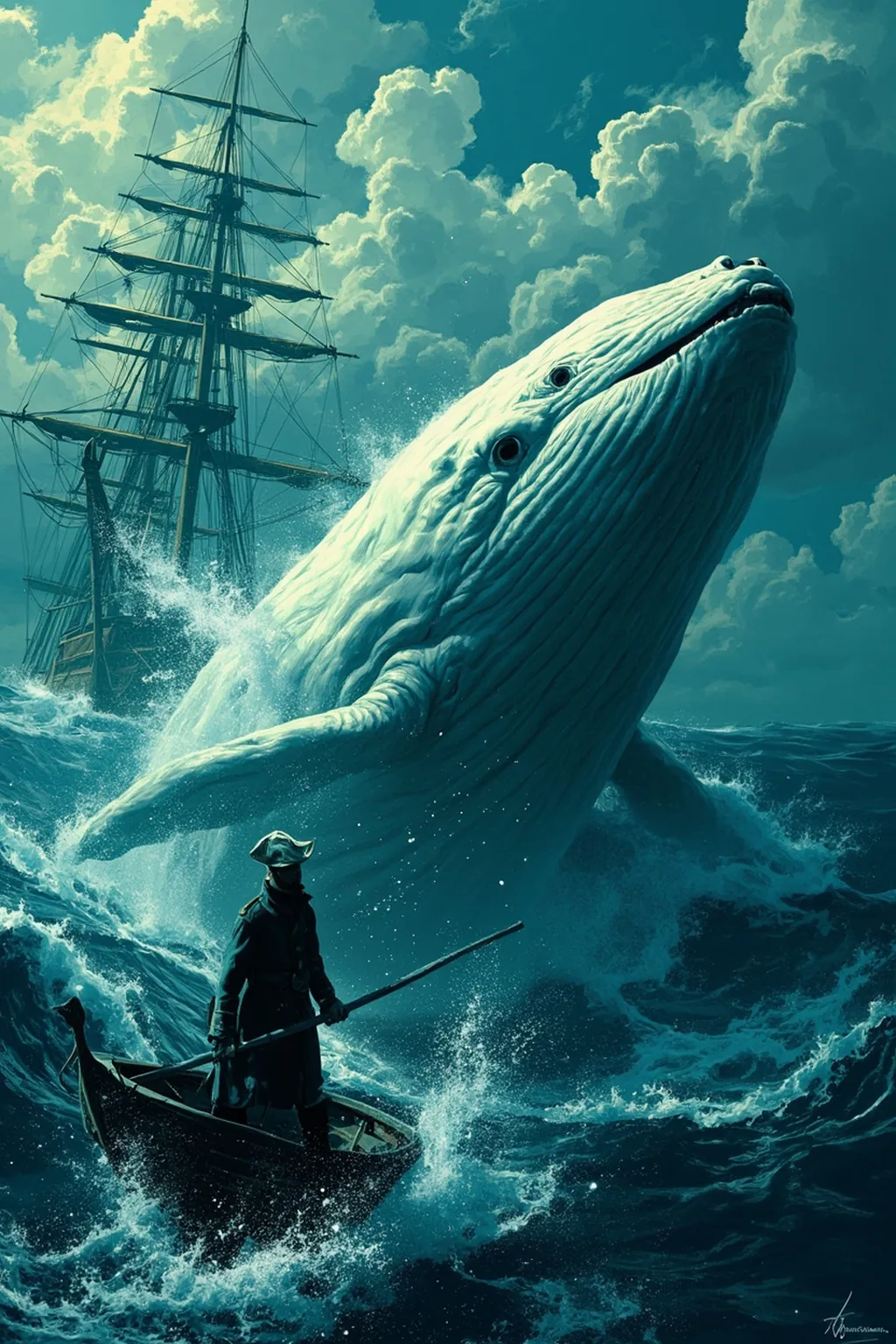
CHAPTER 114. The Gilder.
As the Pequod cruised deeper into the Japanese hunting grounds, the days stretched long and quiet, the crew pulling or sailing in their boats for twelve, fifteen, even twenty hours at a stretch, waiting for the whales to rise. In those calm, mild hours, afloat all day on slow, heaving swells, the boat rocking like a birch canoe, the waves purring against the gunwale like hearth-stone cats, it was easy to forget the tiger heart panting beneath the ocean’s velvet paw. The sea felt like flowery earth, the distant ship just a tip of masts wading through tall prairie grass, the long empty vales and blue hill-sides seeming to hold sleeping children, the hush and hum of the waves mixing with the most mystic mood until fact and fancy met halfway, interpenetrating into one seamless whole. Even Ahab seemed soothed for a moment by these secret golden keys to his own buried treasuries—though his breath upon them only tarnished them, leaving him darker than before. The narrator, too, felt the seductive pull of that endless, vernal soul-landscape, where men could roll like young horses in morning clover, feeling the cool dew of immortal life on their skin, if only the calm would last. But life is woven of warp and woof: every calm is crossed by a storm, every storm by a calm, no steady progress but an eternal tracing of the circle from infancy to boyhood to manhood to the endless “If” of pondering repose. Starbuck, gazing down into the golden sea from his boat one day, murmured low: “Loveliness unfathomable, as ever lover saw in his young bride’s eye! Tell me not of thy teeth-tiered sharks, and thy kidnapping cannibal ways. Let faith oust fact; let fancy oust memory; I look deep down and do believe.” And Stubb, fish-like with sparkling scales, leaped up in the same golden light to swear: “I am Stubb, and Stubb has his history; but here Stubb takes oaths that he has always been jolly!” The calm would not last, of course—but for a moment, it was theirs.
CHAPTER 115. The Pequod Meets The Bachelor.
A few weeks after Ahab’s harpoon was forged, the Pequod met a Nantucket ship called the Bachelor, which had just wedged its last cask of oil into the hold, bolted down its hatches, and was sailing round the cruising ground in gay holiday apparel, bound for home. She was a sight to cheer any heart: three men at her mast-head wore long red bunting streamers in their hats, a whale-boat hung bottom down from her stern, the long lower jaw of her last kill nailed to her bowsprit, signals and ensigns of every colour flying from her rigging, two barrels of sperm oil lashed in each of her basketed tops, slender breakers of oil in her cross-trees, a brazen lamp nailed to her main truck. She’d had unprecedented success, while other ships in the same seas had gone months without a single fish; she’d bartered extra casks from every ship she met, even knocked her cabin table into kindling to make room for more oil, filled every spare container she had—even the cook had clapped a head on his largest boiler and filled it, the steward plugged his spare coffee-pot, the harpooneers headed the sockets of their irons and filled them, only the captain’s pantaloons pockets left empty for him to thrust his hands in in self-satisfaction. Drums rolled from her forecastle, her crew danced with olive-hued Polynesian girls on the quarter-deck, three Long Island negroes with whale-ivory fiddle-bows played jigs from a boat suspended between the masts, and the crew hurled the useless try-works bricks into the sea with wild cries, like they were pulling down the Bastille. Her captain stood erect on the quarter-deck, lord of all this joy, as the two ships crossed wakes. “Come aboard, come aboard!” he called, lifting a glass and a bottle in the air. Ahab stood shaggy and black with stubborn gloom on his own deck. “Hast seen the White Whale?” he gritted out. “No; only heard of him; but don’t believe in him at all,” the other captain laughed. “Come aboard!” “Thou art too damned jolly. Sail on. Hast lost any men?” “Not enough to speak of—two islanders, that’s all. Come aboard, old hearty, I’ll soon take that black from your brow. Come along—merry’s the play; a full ship and homeward-bound.” “How wondrous familiar is a fool!” Ahab muttered. Then aloud: “Thou art a full ship and homeward bound, thou sayst; well then, call me an empty ship, outward-bound. So go thy ways, and I will mine. Forward there! Set all sail, keep her to the wind!” The Bachelor flew off before the breeze, her crew cheering, while the Pequod fought stubbornly against it. The Pequod’s crew watched the happy ship recede with grave, lingering glances, but the Bachelor’s men never looked back, caught up in their revelry. Ahab leaned over the taffrail, watching her go, and pulled a small vial of Nantucket sand from his pocket, holding it up to compare to the receding ship, the two remote associations—home and his quest—colliding in his mind for a single, unspoken moment.
The original text of this work is in the public domain. This page focuses on a guided summary article, reading notes, selected quotes, and visual learning materials for educational purposes.