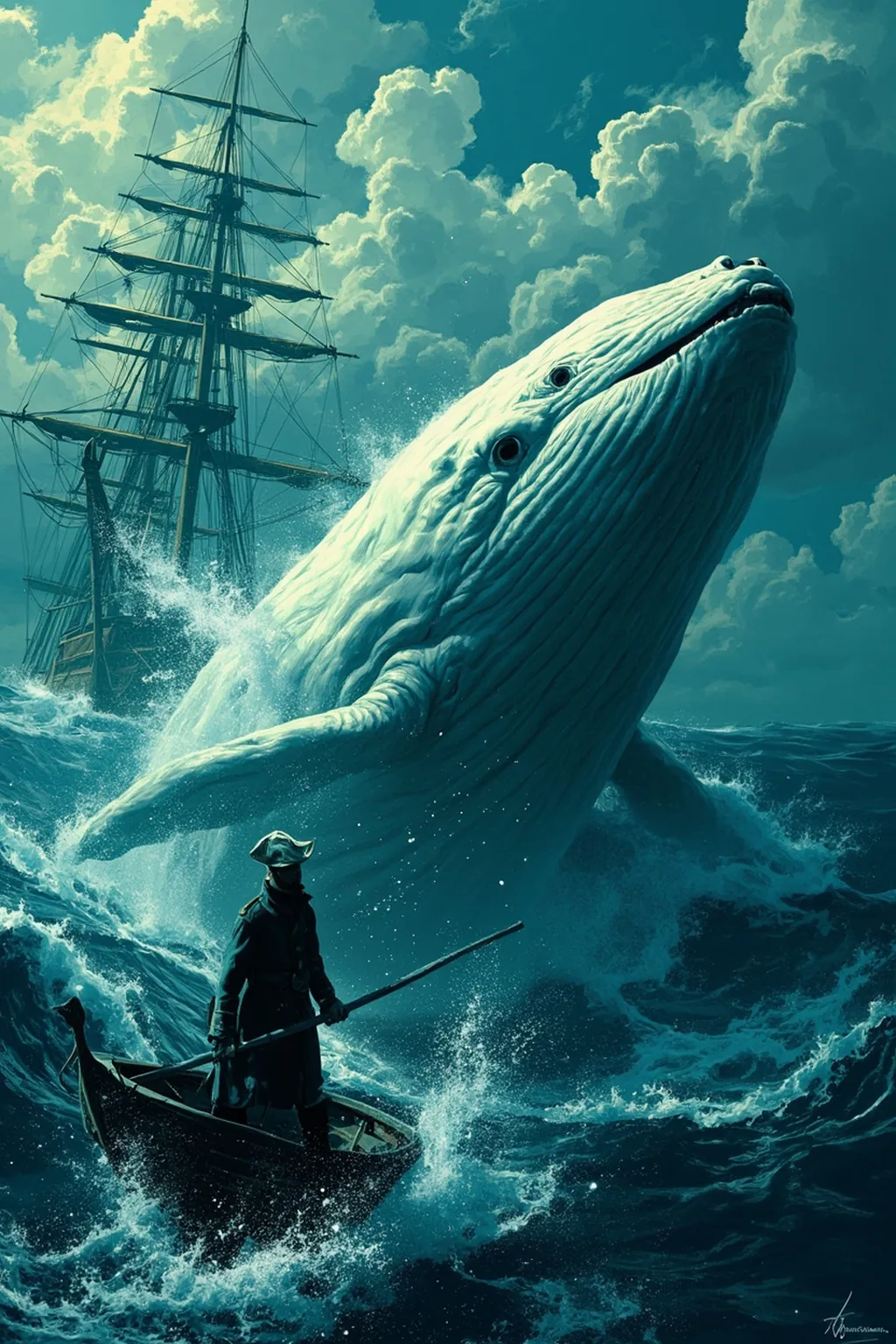
Harris’s Voyage Collection
The narrator examines old Harris’s collection of voyages, specifically plates from a Dutch book of 1671 entitled “A Whaling Voyage to Spitzbergen in the ship Jonas in the Whale.” These illustrations show whales lying among ice-islands like “great rafts of logs” with white bears running over their backs. The narrator identifies the “prodigious blunder” of depicting whale flukes as perpendicular rather than horizontal, a fundamental anatomical error that persists even in seemingly authoritative sources.
Captain Colnett’s Sperm Whale
The narrator critiques Captain Colnett’s “Voyage round Cape Horn” (1793), which purports to show a scientifically drawn “Physeter or Spermaceti whale, drawn by scale from one killed on the coast of Mexico.” He doubts the captain’s veracity and mockingly suggests the illustration’s eye, when scaled to a real sperm whale, would be a “bow-window some five feet long.” He quips that the captain should have included Jonah looking out of that enormous eye, highlighting the absurdity of the proportional errors.
Goldsmith’s Animated Nature
The narrator turns to popular natural history works, examining the 1807 abridged London edition of “Goldsmith’s Animated Nature.” He finds the plates depicting an alleged “whale” and “narwhale” deplorable. The whale “looks much like an amputated sow,” while the narwhale resembles a “hippogriff”—a mythical creature utterly unlike the actual animal. He expresses amazement that such gross inaccuracies could be accepted by the intelligent public of schoolboys in the nineteenth century.
Lacépède’s Whale System
In 1825, Count de Lacépède, a prominent naturalist, published a scientific systemized work on whales containing numerous pictures of Leviathan species. The narrator observes that all these illustrations are “not only incorrect” but that even the picture of the Mysticetus or Greenland whale (the Right whale) lacks any “counterpart in nature,” as confirmed by Scoresby, an experienced authority on that species. This demonstrates that even serious scientific efforts fell short of accurate representation.
Frederick Cuvier’s Sperm Whale
The narrator reserves his harshest criticism for Frederick Cuvier’s 1836 “Natural History of Whales,” in which Cuvier presents his picture of the Sperm Whale. The narrator warns that showing this illustration to any Nantucketer requires arranging a “summary retreat.” He declares that Cuvier’s Sperm Whale is “not a Sperm Whale, but a squash.” He speculates that Cuvier derived the picture from a Chinese drawing, like his predecessor Desmarest, noting the Chinese are “queer cups and saucers” informants about their artistic style.
Sign-Painters’ Whales
The narrator turns to popular street imagery, describing the whales painted on signs above oil-dealers’ shops. These depictions are “generally Richard III. whales, with dromedary humps, and very savage,” breakfasting on “three or four sailor tarts” (whaleboats full of mariners). Their “deformities flounder in seas of blood and blue paint,” presenting a monstrous, aggressive image far removed from the living animal.
The Unpaintable Leviathan
The narrator concludes that these manifold mistakes are unsurprising when one considers the practical difficulties of whale portraiture. Scientific drawings have typically been taken from stranded fish, as inaccurate as a drawing of a wrecked ship would represent a whole vessel. The living whale cannot be hoisted from the sea, and its shape is so variable that “his precise expression the devil himself could not catch.” The skeleton provides little idea of the general shape—Hunter compared the skeleton to the insect while the living whale is the chrysalis. Therefore, accurate knowledge of the whale’s form requires going whaling personally, risking being “eternally stove and sunk.”
CAPÍTULO 56. Of the Less Erroneous Pictures of Whales, and the True
The narrator briefly mentions monstrous pictures and stories of whales found in ancient and modern texts such as Pliny, Purchas, Hackluyt, Harris, and Cuvier, but chooses to pass over this matter. He has knowledge of only four published outlines of the great Sperm Whale.
Pictures of Whaling Scenes
The narrator acknowledges only four published outlines of the great Sperm Whale: Colnett’s, Huggins’s, Frederick Cuvier’s, and Beale’s. Of these, Huggins’s is far better than Colnett and Cuvier’s, but Beale’s is by far the best. The narrator notes that J. Ross Browne’s Sperm Whale drawings are pretty correct in contour but wretchedly engraved, though he clarifies this is not Browne’s fault.
The original text of this work is in the public domain. This page focuses on a guided summary article, reading notes, selected quotes, and visual learning materials for educational purposes.