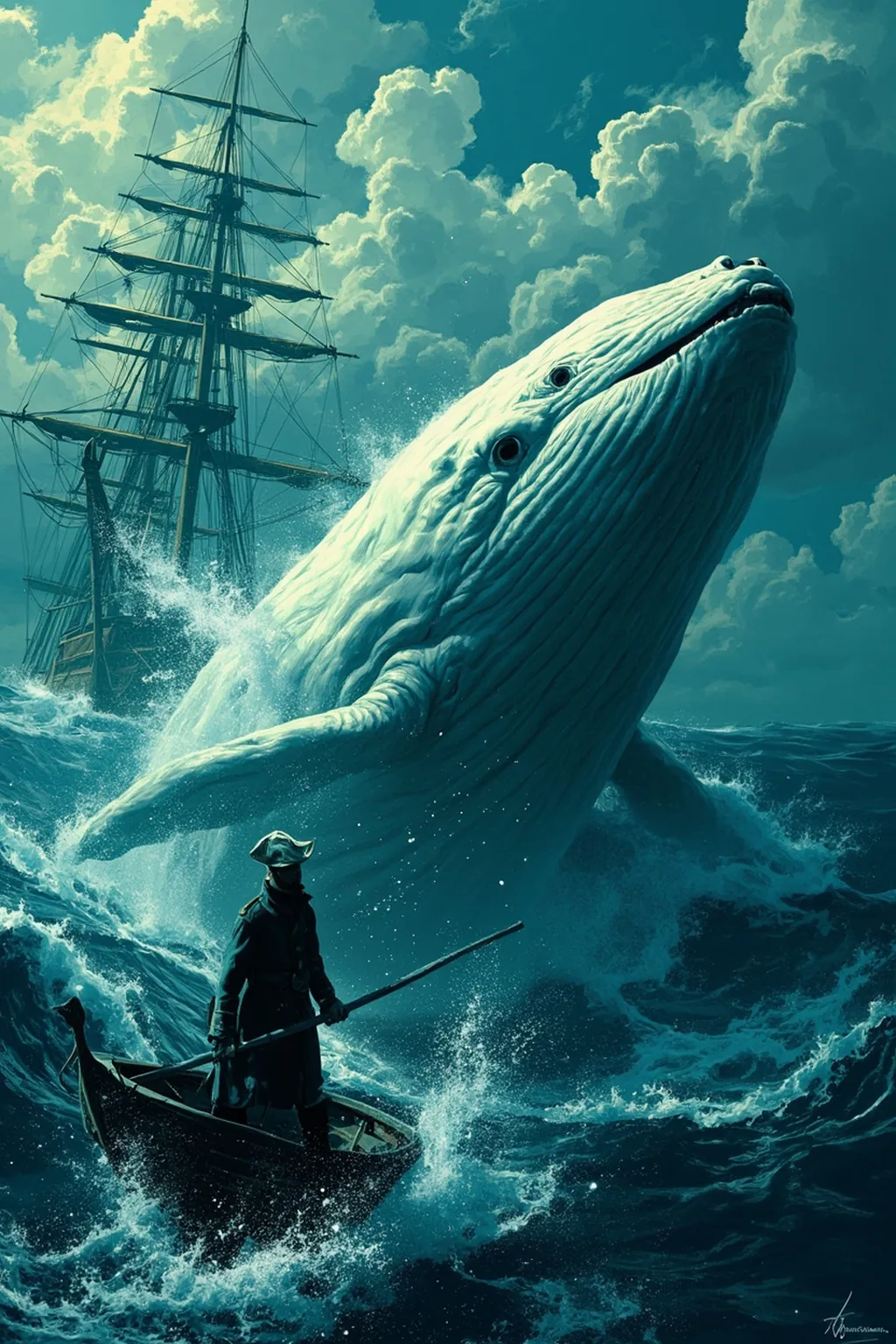
CHAPTER 118. The Quadrant.
As the Pequod drew near the Line, every day Ahab would emerge from his cabin to find the helmsman ostentatiously handling his spokes, the crew clustering around the nailed doubloon on the mainmast, impatient for the order to point for the equator. It came at last, high noon on a day so bright the Japanese sun seemed the blazing focus of a glassy burning-glass, the sky lacquered, clouds absent, the horizon floating in unrelieved radiance. Ahab had his quadrant fitted with coloured glasses to shield his eyes from the glare, and sat in his hoisted boat, swinging with the ship’s roll, to take his daily solar observation. The Parsee knelt on the deck beneath him, face thrown up to the sun, eyes half-hooded, his wild face subdued to earthly passionlessness. When Ahab had calculated his latitude on his ivory leg, he fell into a revery, staring up at the sun, and murmured to himself: “Thou sea-mark! thou high and mighty Pilot! thou tellest me truly where I am—but canst thou cast the least hint where I shall be? Or canst thou tell where some other thing besides me is this moment living? Where is Moby Dick? This instant thou must be eyeing him. These eyes of mine look into the very eye that is even now beholding him; aye, and into the eye that is even now equally beholding the objects on the unknown, thither side of thee, thou sun!” He turned the quadrant over in his hands, muttering at its cabalistical contrivances: “Foolish toy! babies’ plaything of haughty Admirals, and Commodores, and Captains; the world brags of thee, of thy cunning and might; but what after all canst thou do, but tell the poor, pitiful point where thou thyself happenest to be on this wide planet, and the hand that holds thee: no! not one jot more! Thou canst not tell where one drop of water or one grain of sand will be to-morrow noon; and yet with thy impotence thou insultest the sun! Science! Curse thee, thou vain toy; and cursed be all the things that cast man’s eyes aloft to that heaven, whose live vividness but scorches him, as these old eyes are even now scorched with thy light, O sun! Level by nature to this earth’s horizon are the glances of man’s eyes; not shot from the crown of his head, as if God had meant him to gaze on his firmament. Curse thee, thou quadrant!” He dashed it to the deck. “No longer will I guide my earthly way by thee; the level ship’s compass, and the level dead-reckoning, by log and by line; these shall conduct me, and show me my place on the sea. Aye!” He leaped from the boat to the deck, trampling the quadrant underfoot. “Thus I trample on thee, thou paltry thing that feebly pointest on high; thus I split and destroy thee!” As he raged, a sneering triumph meant for Ahab, and a fatalistic despair meant for himself, passed over the mute, motionless Parsee’s face. He rose and glided away unobserved, while the awestruck crew clustered on the forecastle. Ahab, troubledly pacing the deck, shouted: “To the braces! Up helm!—square in!” The yards swung round in an instant, the three masts standing erect on the hull like the three Horatii pirouetting on one steed. Starbuck watched from between the knight-heads, his thoughts sombre. “I have sat before the dense coal fire and watched it all aglow, full of its tormented flaming life; and I have seen it wane at last, down, down, to dumbest dust. Old man of oceans! of all this fiery life of thine, what will at length remain but one little heap of ashes!” “Aye,” Stubb called, “but sea-coal ashes—mind ye that, Mr. Starbuck. Well, well; I heard Ahab mutter, ‘Here some one thrusts these cards into these old hands of mine; swears that I must play them, and no others.’ And damn me, Ahab, but thou actest right; live in the game, and die in it!”
The original text of this work is in the public domain. This page focuses on a guided summary article, reading notes, selected quotes, and visual learning materials for educational purposes.