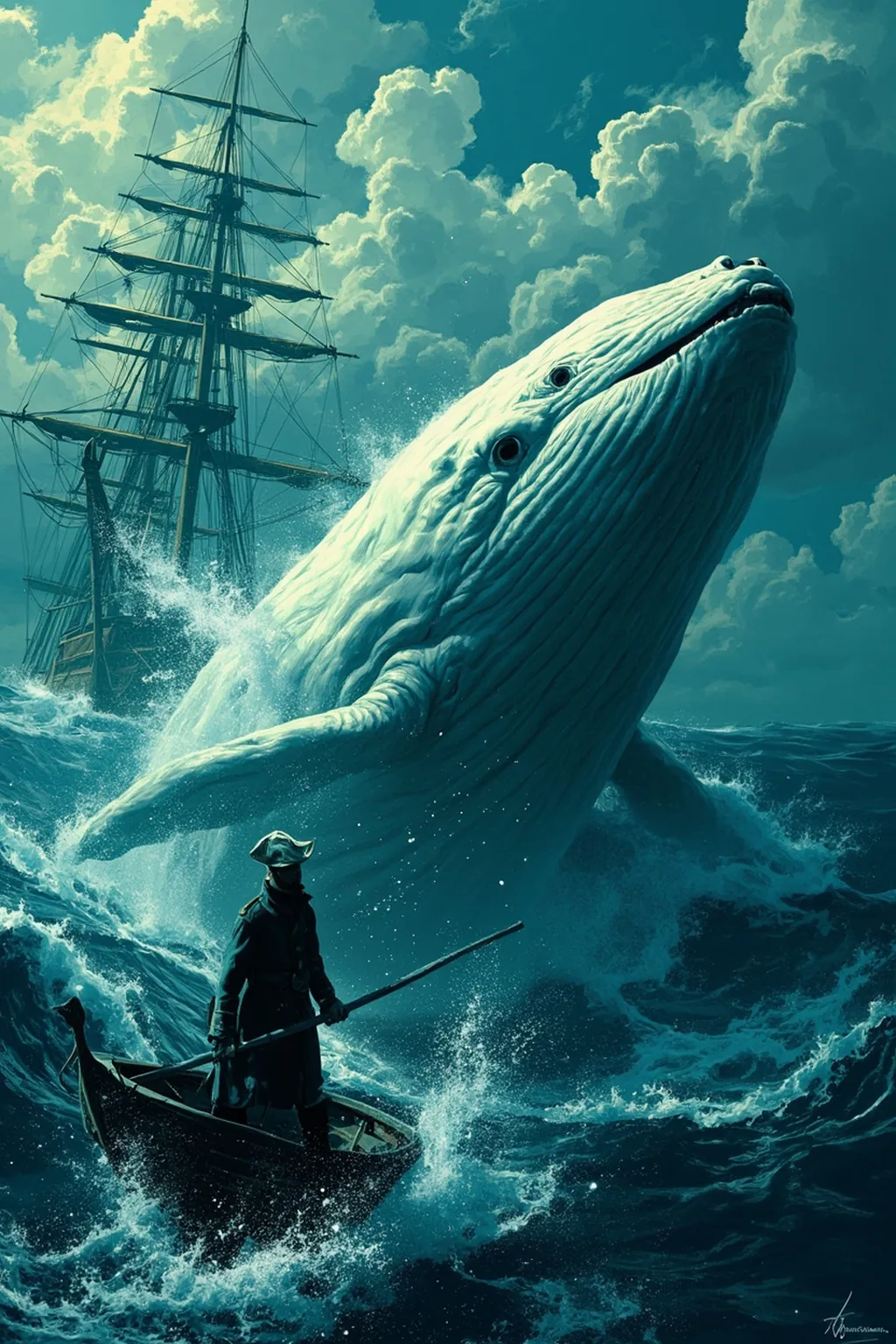
CHAPTER 116. The Dying Whale.
The encounter with the joyful Bachelor seemed to bring the Pequod luck: the next day, whales were sighted, four were slain, one of them by Ahab himself. It was late afternoon, the fight over, the four carcasses floating in the lovely sunset sea, the sun and the last whale both dying together in the rosy light. Such sweetness and plaintiveness curled up in the air, like vesper hymns freighted from the Manilla isles, that it almost seemed the Spanish land-breeze had gone to sea carrying them. Ahab sat in his boat, intently watching the whale’s final wanings, and he saw the strange, familiar sight of the dying sperm whale turning its head sunward, paying homage to the fire that was killing it. The spectacle, beheld in that placid evening light, conveyed a wondrousness he had never felt before. “He turns and turns him to it,” he murmured, “how slowly, but how steadfastly, his homage-rendering and invoking brow, with his last dying motions. He too worships fire; most faithful, broad, baronial vassal of the sun! Oh that these too-favouring eyes should see these too-favouring sights. Look! Here, far water-locked, beyond all hum of human weal or woe; in these most candid and impartial seas; where traditions no rocks furnish tablets; where for long Chinese ages the billows have rolled on speechless and unspoken to, as stars that shine upon the Niger’s unknown source; here, too, life dies sunwards full of faith; but see! no sooner dead, than death whirls round the corpse, and it heads some other way. Oh, thou dark Hindoo half of nature, who of drowned bones hast builded thy separate throne somewhere in the heart of these unverdured seas; thou art an infidel, thou queen, and too truly speakest to me in the wide-slaughtering typhoon, and the hushed burial of its after calm. Nor has this thy whale sunwards turned his dying head, and then gone round again, without a lesson to me. Oh, trebly hooped and welded hip of power! Oh, high aspiring, rainbowed jet!—that one strivest, this one jettest all in vain! In vain, oh whale, dost thou seek intercedings with yon all-quickening sun, that only calls forth life, but gives it not again. Yet dost thou, darker half, rock me with a prouder, if a darker faith. All thy unnamable imminglings float beneath me here; I am buoyed by breaths of once living things, exhaled as air, but water now. Then hail, for ever hail, O sea, in whose eternal tossings the wild fowl finds his only rest. Born of earth, yet suckled by the sea; though hill and valley mothered me, ye billows are my foster-brothers!” The sunset faded, and Ahab rowed back to the ship, the whale’s dying words echoing in his mind.
CHAPTER 117. The Whale Watch.
The four whales that died that evening had drifted wide apart in the sunset: one far to windward, one less distant to leeward, one ahead, one astern. The three to leeward and astern were brought alongside before nightfall, but the windward carcass could not be reached till morning, and the boat that had killed it—Ahab’s own boat—lay by its side all night, a waif-pole thrust upright into the whale’s spout-hole, a lantern hanging from its top casting a troubled flickering glare over the black, glossy back and the midnight waves that chafed the whale’s flank like soft surf on a beach. Ahab and his crew seemed asleep, but the Parsee Fedallah crouched in the bow, watching the sharks that spectrally played round the whale, tapping the light cedar planks with their tails. A sound like the moaning of unforgiven ghosts over Asphaltites ran shuddering through the air. Ahab started awake, face to face with Fedallah in the gloom, the two of them seeming the last men in a flooded world. “I have dreamed it again,” Ahab said. “Of the hearses? Have I not said, old man, that neither hearse nor coffin can be thine?” “And who are hearsed that die on the sea?” “But I said, old man, that ere thou couldst die on this voyage, two hearses must verily be seen by thee on the sea; the first not made by mortal hands; and the visible wood of the last one must be grown in America.” “Aye, aye! A strange sight that, Parsee: a hearse and its plumes floating over the ocean with the waves for pall-bearers. Ha! Such a sight we shall not soon see.” “Believe it or not, thou canst not die till it be seen, old man.” “And what was that saying about thyself?” “Though it come to the last, I shall still go before thee thy pilot.” “And when thou art so gone before—if that ever befall—then ere I can follow, thou must still appear to me, to pilot me still? Was it not so? Well then, did I believe all ye say, oh my pilot! I have here two pledges that I shall yet slay Moby Dick and survive it.” “Take another pledge, old man,” Fedallah said, his eyes lighting up like fire-flies in the gloom. “Hemp only can kill thee.” “The gallows, ye mean.—I am immortal then, on land and on sea!” Ahab cried, laughing in derision. “Immortal on land and on sea!” Both fell silent again, as one man. The grey dawn crept on, the slumbering crew roused themselves, and by noon the dead whale was brought alongside the ship.
The original text of this work is in the public domain. This page focuses on a guided summary article, reading notes, selected quotes, and visual learning materials for educational purposes.