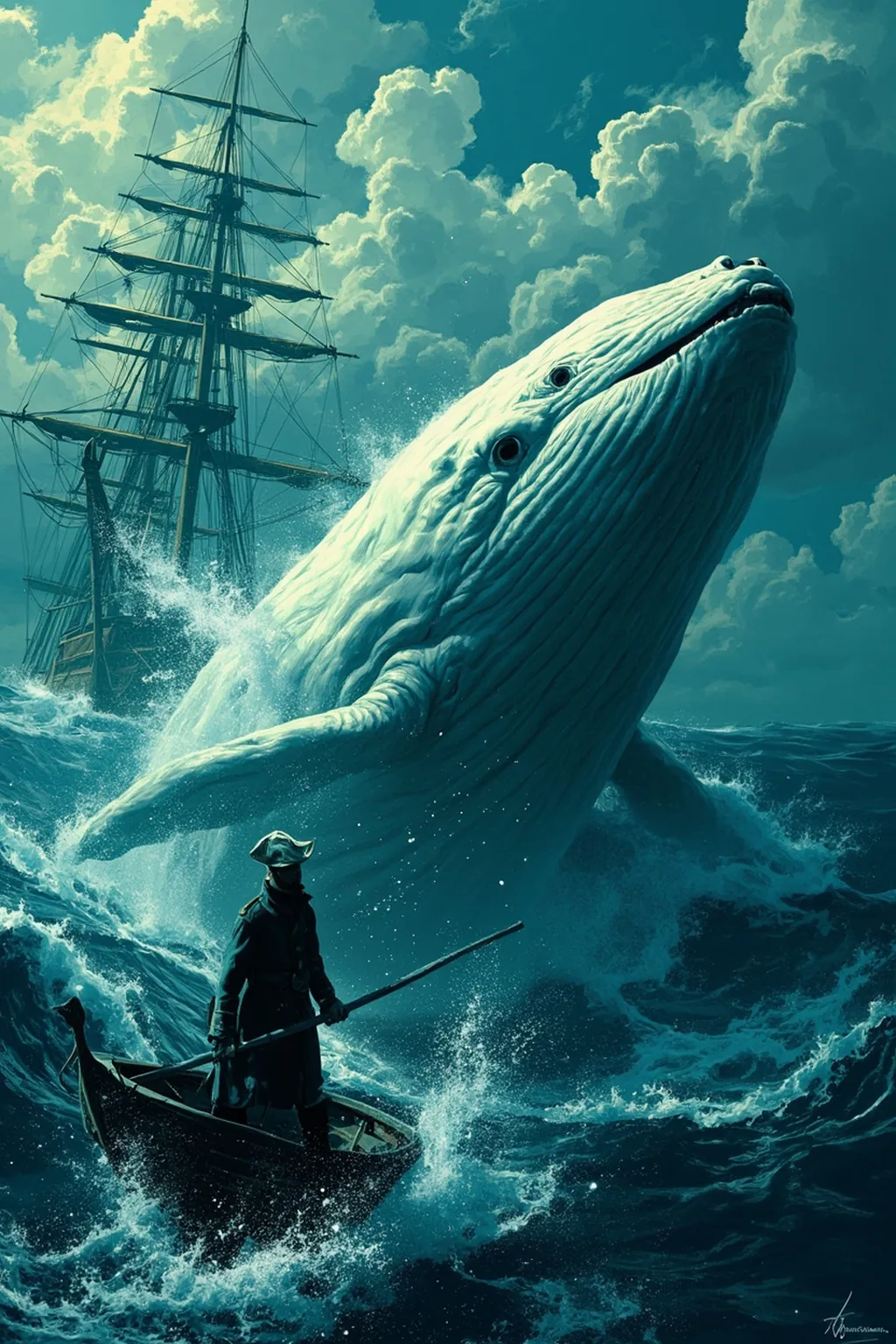
CHAPTER 131. The Pequod Meets The Delight.
The intense Pequod sailed on, the life-buoy-coffin swinging at her stern. Another ship appeared, most miserably misnamed the Delight. Upon her shears hung the shattered ribs of a whale-boat. “Hast seen the White Whale?” “Look!” replied the hollow-cheeked captain, pointing to the wreck. “Hast killed him?” “The harpoon is not yet forged that ever will do that.” Ahab snatched a levelled iron and held it out: “Look ye, Nantucketer; here in this hand I hold his death! Tempered in blood, and tempered by lightning are these barbs; and I swear to temper them triply in that hot place behind the fin!”
The captain pointed to a rounded hammock on deck. “I bury but one of five stout men who were alive only yesterday; the rest were buried before they died; you sail upon their tomb.” As the body was committed to the sea, Ahab cried, “Brace forward! Up helm!” He could not endure the sound of the splash. As the Pequod glided away, the strange life-buoy came into view. “Ha! yonder! look yonder, men! In vain, oh, ye strangers, ye fly our sad burial; ye but turn us your taffrail to show us your coffin!”
CHAPTER 132. The Symphony.
It was a clear steel-blue day. The air was transparently pure, the sea heaved with long, lingering swells. Snow-white wings of small birds glided high; mighty leviathans rushed in the deeps. The sun seemed bridegroom to the sea. Ahab stood forth, lifting his splintered brow to the fair sky. He dropped a tear into the sea—perhaps the only one shed in forty years of whaling.
Starbuck drew near, careful not to be noticed. Ahab turned. “Starbuck! Oh, Starbuck! it is a mild, mild wind, and a mild looking sky. On such a day—very much such a sweetness as this—I struck my first whale—a boy-harpooneer of eighteen! Forty—forty—forty years ago! forty years of continual whaling! forty years of privation, and peril, and storm-time! forty years on the pitiless sea! When I think of all this; when the poorest landsman has had fresh fruit to his daily hand, and broken the world’s fresh bread to my mouldy crusts—away, whole oceans away, from that young girl-wife I wedded past fifty, and sailed for Cape Horn the next day, leaving but one dent in my marriage pillow—wife? rather a widow with her husband alive!”
He shook like a blighted fruit tree. Starbuck seized the moment: “Away with me! let us fly these deadly waters! let us home! Wife and child, too, are Starbuck’s—wife and child of his brotherly, sisterly, play-fellow youth; even as thine, sir, are the wife and child of thy loving, longing, paternal old age!” But Ahab’s glance was averted. “What is it, what nameless, inscrutable, unearthly thing is it; what cozening, hidden lord and master commands me?” He spoke of the wind as a coward that strikes naked men but will not receive a blow. Finally he turned away, leaving Starbuck blanched to a corpse’s hue with despair. Fedallah motionlessly leaned over the rail, his shadow always hovering.
CHAPTER 133. The Chase—First Day.
That night, in the mid-watch, Ahab snuffed the sea air and declared a whale was near. The peculiar odor of the sperm whale was palpable. At daybreak a long sleek on the sea ahead revealed Moby Dick. “Man the mast-heads! Call all hands!” Ahab was hoisted to his perch. “There she blows!—there she blows! A hump like a snow-hill! It is Moby Dick!” The whale was seen a mile ahead, his high sparkling hump revealed at every roll of the sea.
The boats were lowered. Ahab headed the onset. As they neared him, the ocean grew smooth as a noon-meadow. The whale’s dazzling hump was visible, sliding along the sea, with soft-toed fowl perching on the shattered lance pole in his back. He seemed a glorified god. Suddenly he sounded, his vast body forming a high arch like Virginia’s Natural Bridge, and vanished.
An hour passed. Then the birds flew to Ahab’s boat. The whale’s open mouth and scrolled jaw rose from the depths, glittering teeth visible, yawned beneath the boat like an open-doored marble tomb. Ahab whirled the craft aside. The whale obliquely lying on his back slowly took the bows within his mouth, shaking the cedar as a cat with a mouse. The gunwales bent in and snapped; the boat was bitten in twain. Ahab fell flat-faced upon the sea.
Moby Dick swam swiftly round the wrecked crew, his tail lashing. Ahab, half smothered in foam, was helpless. The ship bore down and rescued him. Dragged into Stubb’s boat, his body’s strength cracked; he lay crushed at the bottom. But his spirit revived. “The harpoon—is it safe?” He learned that one man was missing—Fedallah. “The Parsee!—gone? and he was to go before!” The Pequod followed the whale through the day, Ahab aloft and pacing. At night he stood in his scuttle till dawn.
The original text of this work is in the public domain. This page focuses on a guided summary article, reading notes, selected quotes, and visual learning materials for educational purposes.