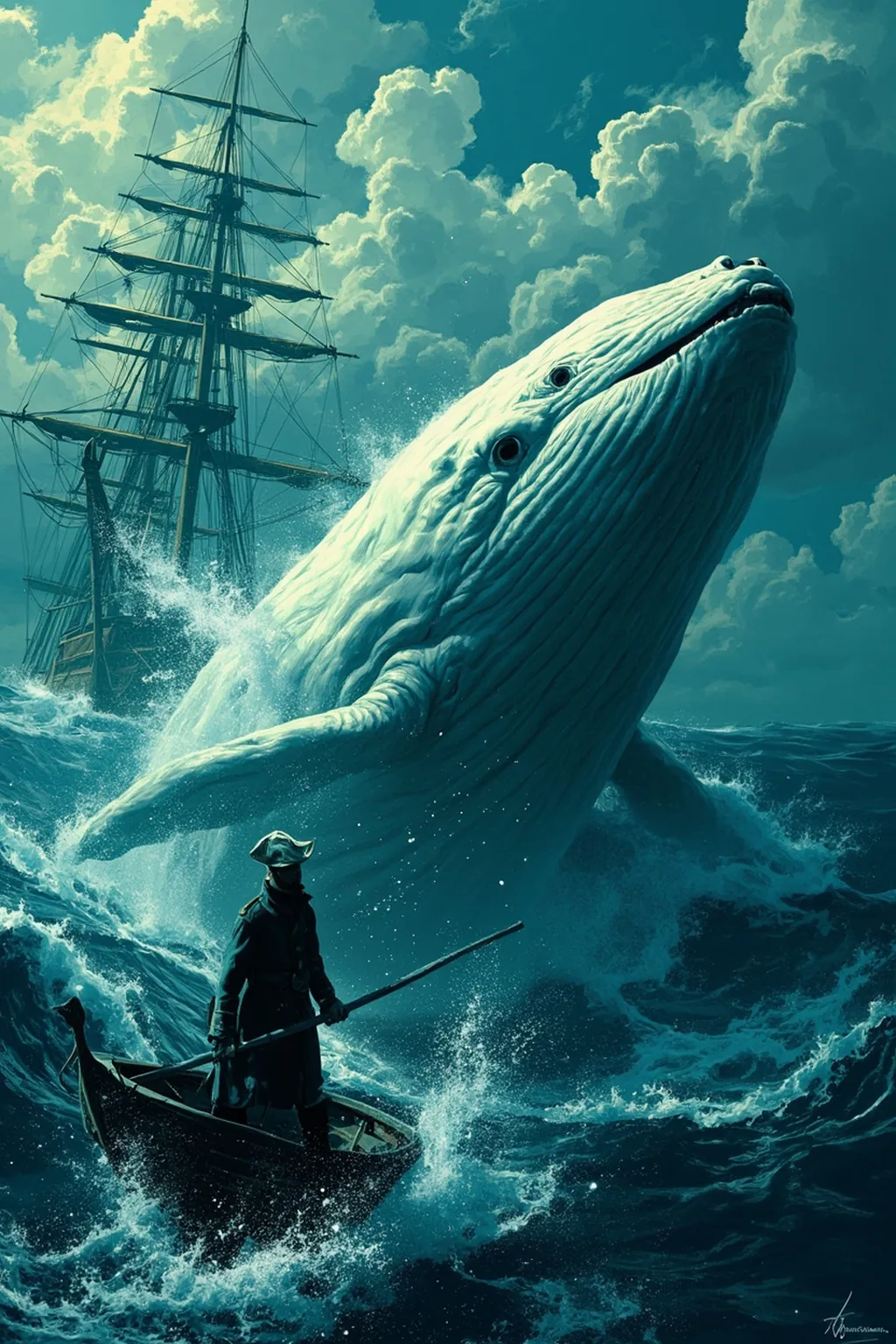
CHAPTER 134. The Chase—Second Day.
At day-break the mast-heads were manned afresh. “See nothing, sir.” “Turn up all hands and make sail!” The Pequod tore through the sea, leaving a furrow as when a cannon-ball becomes a plough-share. “By salt and hemp!” cried Stubb. “This ship and I are two brave fellows!” The crew was one man, not thirty, welded into oneness by the keel of Ahab’s purpose.
“There she blows—right ahead!” Moby Dick breached, booming his bulk into the air, a mountain of dazzling foam. “Aye, breach your last to the sun, Moby Dick!” The boats were lowered. The whale charged, jaws open, tail lashing, and smashed Stubb’s and Flask’s boats together like rolling husks, then dove into a boiling maelstrom. Ahab’s boat was sent turning over into the air; he and his men struggled out like seals from a cave.
Rescued, Ahab was found gripping his broken boat’s half. His ivory leg had been snapped off. “Aye, aye, Starbuck, ’tis sweet to lean sometimes.” But his spirit was unbroken. When the crew was mustered, the Parsee was not there. “The Parsee!” cried Stubb. “Gone among the tangles of your line!” Ahab raged: “Gone? gone? What means that little word? The harpoon, too!—toss over the litter there—’tis in the fish!” He would not relent. “I’ll ten times girdle the unmeasured globe; yea and dive straight through it, but I’ll slay him yet!”
Starbuck could bear no more. “Great God! but for one single instant show thyself. Never, never wilt thou capture him, old man. Two days chased; twice stove to splinters; thy very leg once more snatched from under thee; thy evil shadow gone—all good angels mobbing thee with warnings—what more wouldst thou have?” Ahab replied that Ahab is forever Ahab; the act was immutably decreed, rehearsed a billion years before. “Fool! I am the Fates’ lieutenant.” He claimed the omens favored him: the whale had floated two days, tomorrow would be the third. That night, hammers rang and grindstones hummed as the carpenter fitted Ahab with a new leg and the crew sharpened fresh irons.
CHAPTER 135. The Chase.—Third Day.
The morning of the third day dawned fair. Ahab paced, musing on the wind and fate. “I’ve oversailed him. How, got the start? Aye, he’s chasing me now; not I, him—that’s bad.” He turned the ship about. “Against the wind he now steers for the open jaw,” murmured Starbuck, “God keep us, but already my bones feel damp within me.” Ahab was hoisted aloft again. Time held long breaths. Then, three points off the weather bow, the spout was seen. “Forehead to forehead I meet thee, this third time, Moby Dick!”
The boats were lowered. As Ahab hovered at the descent, he paused. “Starbuck! For the third time my soul’s ship starts upon this voyage.” “Aye, sir, thou wilt have it so.” “Some ships sail from their ports, and ever afterwards are missing.” “Truth, sir: saddest truth.” Ahab, feeling old, shook hands with Starbuck. “Oh, my captain, my captain!—noble heart—go not—go not!” “Lower away!” cried Ahab, tossing the mate’s arm from him.
Sharks snapped at the oars as the boat pulled. Ahab darted his harpoon into the whale’s flank. The line ran out, then the whale turned, and Ahab saw Fedallah’s body lashed to the whale’s back, his eyes fixed on Ahab—the second hearse. “Befooled, befooled! Aye, Parsee! I see thee again.—Aye, and thou goest before; and this, this then is the hearse that thou didst promise. But I hold thee to the last letter of thy word. Where is the second hearse?”
The whale swam forward, passing the ship. Ahab ordered the boat repaired and followed. The third day’s chase was relentless. At last, close to the whale, Ahab raised his iron and his curse. The harpoon sank; the line, feeling the double strain, snapped in the empty air. Ahab stooped to clear it; the flying turn caught him round the neck, and he was shot out of the boat, voicelessly, as a Turkish mute bowstrings his victim. The heavy eye-splice flew out of the tub and disappeared.
The tranced crew looked up. The Pequod, struck by the whale, was settling. “The ship! The hearse!—the second hearse!” The whale bore down upon the bow, smiting it with his forehead. Men and timbers reeled. The ship began to sink. From the boat, Ahab saw Tashtego at the mast-head, still nailing the red flag. A sky-hawk, following the sinking mast, intercepted its wing between Tashtego’s hammer and the wood. The submerged savage kept his hammer frozen; the bird, folded in the flag, went down with the ship.
Then all collapsed. The great shroud of the sea rolled on. But one man survived: Ishmael, who had been dropped astern, floated on Queequeg’s coffin-buoy, which rose to the surface like a cunning spring. For a day and night he drifted, the sharks gliding by with padlocks on their mouths, the sea-hawks sailing with sheathed beaks. On the second day, the devious-cruising Rachel—retracing her search for her missing children—found another orphan, and lifted him from the sea.
The original text of this work is in the public domain. This page focuses on a guided summary article, reading notes, selected quotes, and visual learning materials for educational purposes.