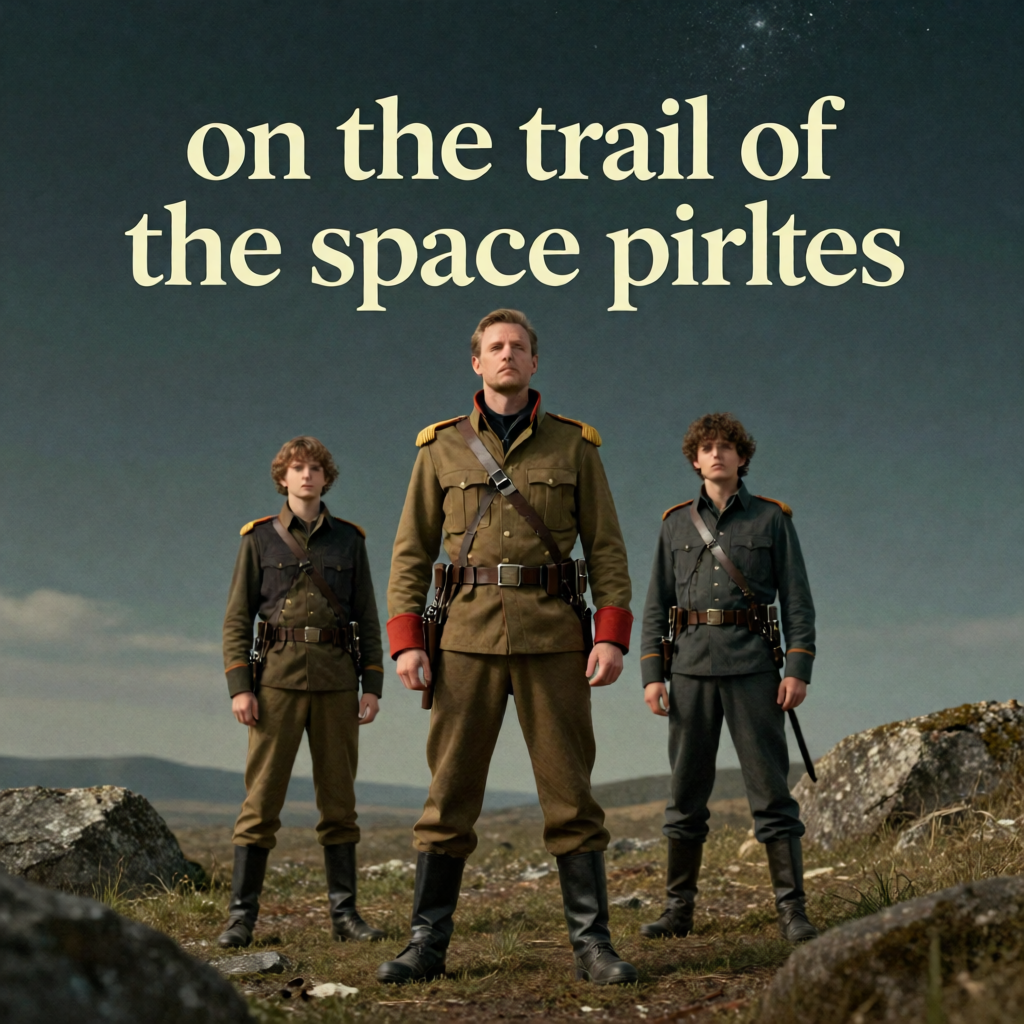
CHAPTER 1
The metallic rasp of the New Chicago Monorail Terminal’s loudspeaker echoed through the marble and aluminum concourse: “ALL ABOARD! Atom City express on Track Seven! Space Academy first stop! Passengers for Space Academy will please take seats in the first six cars!” As the crowd surged through the gate, the three cadets of the Polaris unit—tall, curly-haired 18-year-old Tom Corbett, the unit’s command cadet, his lean blond unit-mate Roger Manning, and the hulking, broad-shouldered Venusian Astro—drifted wearily toward the train, still sluggish from their whirlwind leave at Tom’s New Chicago home, stuffed full of Mrs. Corbett’s home cooking and running on barely any sleep.
They collapsed into plush seats in the third monorail car the second they stepped aboard, and Astro immediately announced he was ravenous, despite downing two full helpings of steak, French fries, beans, corn, pie, and ice cream less than an hour prior. Tom huffed but pressed a crumpled wad of credits into his friend’s ham-sized hand, telling him to hit the dining car. As Astro lumbered down the aisle, two surly civilian passengers shoved him hard off balance, sending him sprawling back onto Tom and Roger. The cadets shot to their feet, and when Roger snarled that the men had no right to push Astro, the heavier of the two sneered that he resented paying taxes to support “lazy, sassy” Space Cadets who thought they were better than ordinary citizens. Tom pulled a fuming Astro back before he could throw a punch, and Roger stepped forward to draw the men’s ire, snapping that they’d regret messing with trained Solar Guard cadets. The two men grumbled about reporting them to their “soldier bosses” before storming off to the next car, and Tom pulled out the recall audiogram reminding him the unit had to report back to Space Academy immediately for an unspecified assignment. He joked they should tell Captain Strong about the run-in to make Astro too angry to eat and cut the Academy’s food costs, earning a sleepy growl from the Venusian before the three finally drifted off to sleep, lulled by the hum of the monorail’s magnetic tracks.
The express hurtled through the early dawn, crossing the vast grazing lands that had once been the great American desert, and Tom woke to slanting morning sun shining through the viewport. He shook his unit-mates awake, and a short while later the train burst from a tunnel under the bluish, snow-capped mountain range, revealing the gleaming Tower of Galileo—built of pure Titan crystal, the headquarters of Space Academy—rising from the wide valley below. The cadets disembarked at the Academy station, weaving through crowds of Solar Guard personnel in green first-year Earthworm cadet, blue senior cadet, scarlet enlisted, and black-and-gold officer uniforms, then hopped a silent slidewalk that whisked them past the Tower’s translucent facade, soaring above the grassy Academy quadrangle. Tom paused at the Tower’s main portal for a second, taking in the sight of the 2353 Solar Alliance: humanity had colonized Mars, Venus, Earth’s moon, Jupiter’s Ganymede, and Saturn’s Titan, united under the Solar Guard that kept interplanetary peace, before leading his unit to their commander Captain Steve Strong’s office.
They snapped to attention and reported in, handing Strong their recall audiogram, and were just settling into easy grins when a teleceiver screen lit up with Commander Walters’ face, the head of Space Academy. Walters told Strong the Solar Exposition on Venus was opening sooner than expected, and the Polaris unit was to ferry the rocket cruiser Polaris to the event to serve as a public exhibit. Strong briefed them: their job was to guide fair visitors through the ship, answer questions, and give short speeches about their respective stations, staying aboard for roughly a month until another unit relieved them. He warned them it was not a vacation, but a chance to represent the entire Cadet Corps to the public. The cadets saluted, then raced to the spaceport where the sleek Polaris sat poised on her launch ramp, nose pointed to the stars, and scrambled aboard to run pre-flight checks.
Astro, a former enlisted Solar Guardsman admitted to the Cadet Corps for his engineering genius, stripped to the waist on the power deck, crawling through the ship’s bowels to adjust valves, clear reactant feeders, and secure lead baffling around the atomic engines to guard against deadly radioactivity. Roger cleaned the astrogation prism on the radar bridge, checked the scanner wiring and range finders, and tested the intercom. Tom ran systematic checks of the control panel’s dials and gauges; as the unit’s control-deck cadet and second-in-command to Captain Strong, he led the unit, but the three always spoke their minds when making tough calls, their bond forged over years of grueling Academy training. Once all departments reported clear, Tom radioed spaceport control for orbit clearance, which was granted for orbit 3847. Captain Strong arrived, took his seat in the pilot’s chair, and gave the order to energize cooling pumps, feed reactant at D-9 rate, and cut in take-off thrust. Tom counted down from five, pulled the master blast-off switch, and the Polaris lifted smoothly from the ground, roaring through the atmosphere before blasting into the dark void, nose pointed toward the distant misty curve of Venus. Once again, Tom Corbett and his unit-mates had embarked on a mission for the Solar Guard.
The original text of this work is in the public domain. This page offers a compressed quick-read summary for educational purposes.