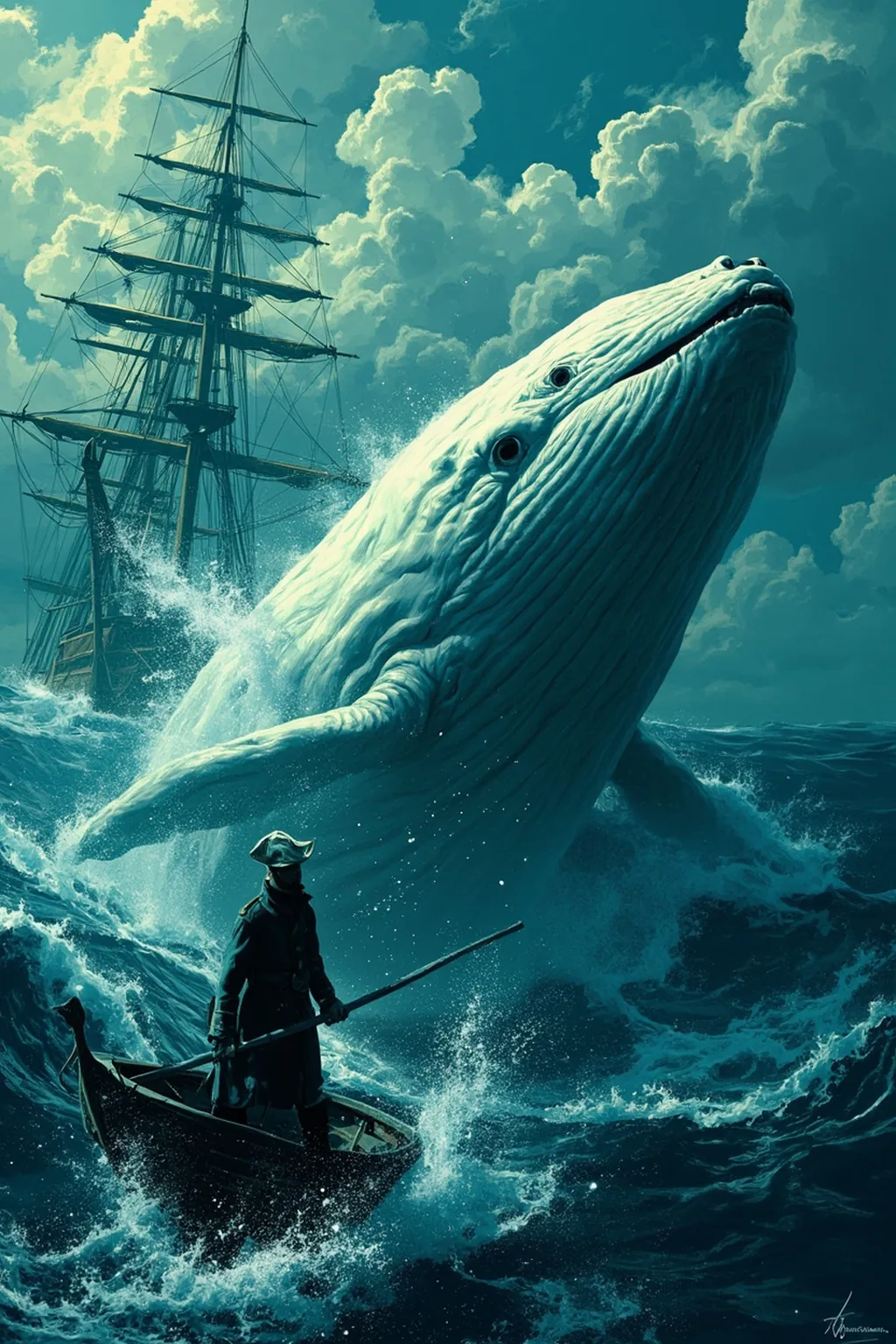
KAPITEL 83. Jonah Historically Regarded.
The chapter addresses the historical account of Jonah and the whale, a story previously referenced. While some Nantucket whalemen express skepticism about this biblical narrative, the text draws a parallel to ancient Greek and Roman skeptics who doubted similar stories about Hercules and Arion without diminishing the factual nature of those traditions.
Doubt of the Historical Jonah and Whale Narrative
The author acknowledges that skepticism toward traditional stories is not new. Ancient civilizations had their doubters who stood apart from orthodox believers, yet this doubting did not alter the factual status of those traditions.
First Objection to the Jonah Story and Bishop Jebb’s Rebuttal
An elderly whaleman from Sag-Harbor questions the biblical account partly because his old Bible contained illustrations depicting Jonah’s whale with two spouts—a feature only accurate for Right Whales, which have such small throats they could be choked by a penny roll. Bishop Jebb preemptively addresses this by suggesting Jonah was temporarily lodged in the whale’s mouth rather than in its belly, a plausible interpretation given that a Right Whale’s mouth could accommodate multiple people at whist tables.
Second Objection: Gastric Juices and Alternate Survival Explanations
The whaleman further objections to the biological implausibility of surviving inside a whale. Various continental commentators have proposed alternative explanations: that Jonah took refuge in a floating dead whale carcass (comparable to how French soldiers used dead horses as shelter), or that he escaped to a nearby vessel with a whale figurehead. Some learned exegetists have even suggested the “whale” was merely an inflated life-preserver.
Third Objection: Implausible Travel Distance to Nineveh
Sag-Harbor raises the geographical objection: Jonah was swallowed in the Mediterranean Sea but vomited up within three days’ journey of Nineveh, a city on the Tigris located much more than three days’ travel from the nearest Mediterranean coast.
Cape of Good Hope Alternate Route and Its Flaws
One might propose the whale carried Jonah around the Cape of Good Hope, but this theory fails on multiple counts: it would require circumnavigating all of Africa in three days, and the Tigris waters near Nineveh are too shallow for any whale. This explanation would also rob Bartholomew Diaz of credit for discovering the Cape.
Critique of Sag-Harbor’s Skepticism and Supporting Jonah Narrative Accounts
Despite these objections, Sag-Harbor’s arguments reveal foolish pride in reason, particularly reprehensible given his limited education. A Portuguese Catholic priest actually proposed the Cape of Good Hope route as a magnification of the miracle’s greatness. Furthermore, devout Turks still believe in the historical Jonah, and an English traveler documented a mosque honoring Jonah containing a miraculous oil-less lamp.
KAPITEL 84. Pitchpoling.
This chapter details the dangerous whaling maneuver of “pitchpoling,” in which Stubb, through remarkable skill and composure, darts a lance at a fast-swimming whale to secure the kill.
Boat Anointing
To ensure speed and agility on the water, whalers engage in the practice of anointing their boats—rubbing grease onto the bottom of the hull. This technique reduces friction, allowing the vessel to slide swiftly through the sea.
Queequeg’s Anointing
Queequeg is a strong believer in the ritual of anointing. One morning prior to the whale hunt, he takes painstaking care in treating his boat, crawling beneath it to rub in the oil. He appears to be acting on a specific premonition about the impending chase.
The Whales Raised
Around noon, a school of whales is spotted from the ship. The animals become aware of the approaching vessel and immediately flee with startling speed and precipitation.
Disordered Flight
The chaotic and rapid retreat of the whales is compared to the flight of Cleopatra’s barges from the Battle of Actium, signifying a panicked and disorderly dispersal across the ocean.
Stubb’s Pursuit
Despite the whales’ swift escape, the whaleboats give chase. Stubb’s boat takes the lead in the pursuit of the fleeing prey.
Tashtego Plants Iron
Through significant effort, Tashtego successfully throws and plants a harpoon into one of the whales. However, the wounded whale does not dive but continues its horizontal flight at an increased speed, risking the loss of the harpoon if the strain continues.
The original text of this work is in the public domain. This page focuses on a guided summary article, reading notes, selected quotes, and visual learning materials for educational purposes.