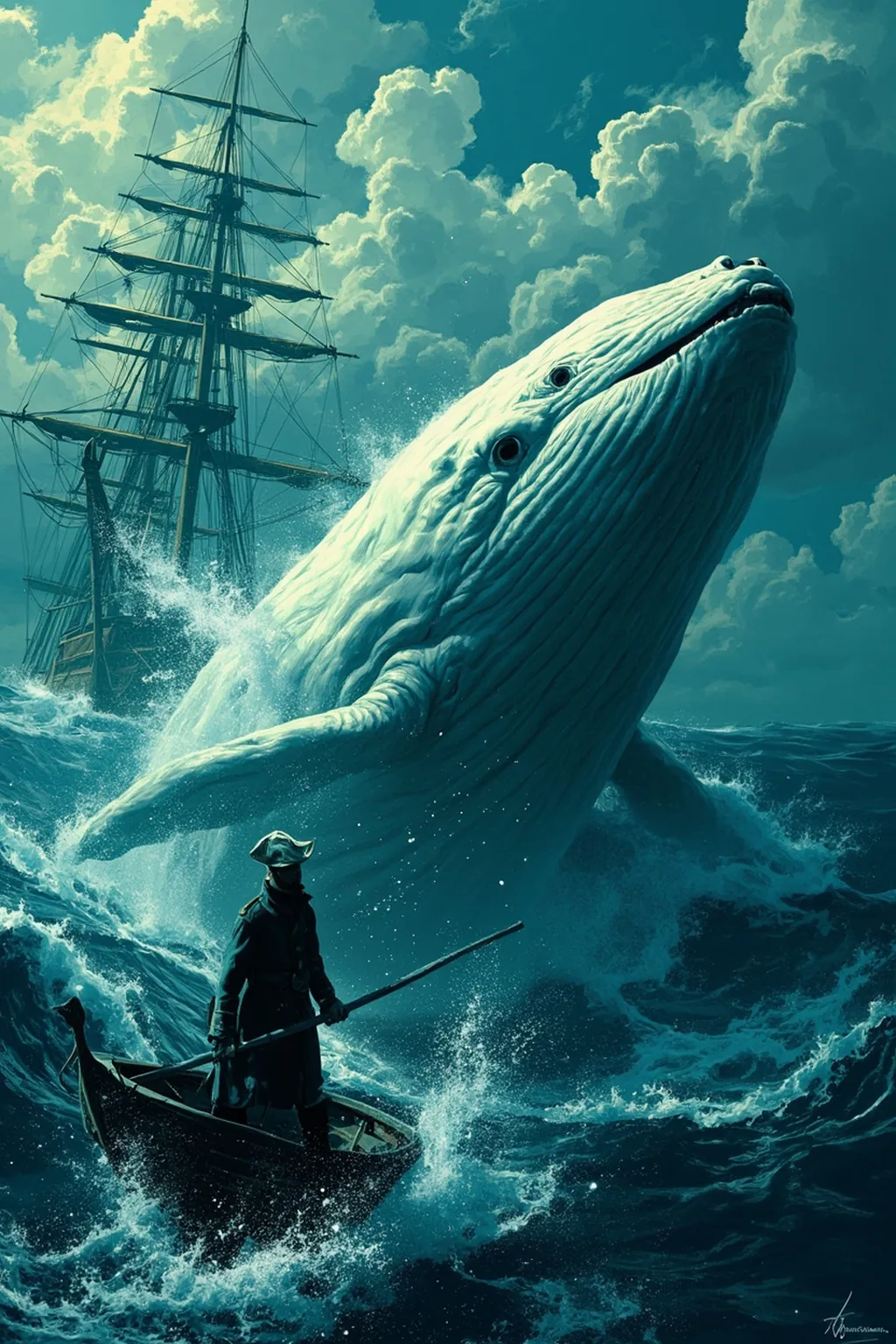
KAPITEL 24. The Advocate.
In Chapter 24, Ishmael acts as “The Advocate” for the whaling profession, directly addressing landsmen who consider whaling an unpoetical and disreputable pursuit, and seeking to convince them of the injustice done to those who hunt whales. He challenges the common perception that whaling is merely a “butchering sort of business” by pointing out that butchers have also included the most honored Martial Commanders, and he promises to reveal facts about the cleanliness of whale-ships compared to the defilements of battle-fields. The narrator argues that the whaleman receives the world’s “profoundest homage” since almost all illumination around the globe burns as tribute to the sperm whale fishery, and he marshals historical evidence including Dutch admirals of whaling fleets, French royal support from Louis XVI, and substantial British bounties exceeding £1,000,000 between 1750 and 1788 to demonstrate whaling’s respected past. Ishmael declares that the whale-ship pioneered exploration of the remotest parts of the earth, opening savage harbors to American and European warships and even facilitating the liberation of South American colonies from Spanish rule, while also giving Australia to the enlightened world and saving early settlers there from starvation through charitable supplies. He rebuts every objection to the dignity of his calling by citing biblical authority in Job’s Leviathan account, royal patronage in Alfred the Great’s Norwegian whale-hunter narrative and Edmund Burke’s parliamentary eulogy, Franklin’s Nantucket whaleman ancestry, and even celestial validation through the constellation Cetus, concluding that if any honor awaits him, it stems entirely from whaling, which he declares was his “Yale College and Harvard.”
Opening Purpose: Vindicating Whaling to Landsmen
The narrator, having embarked on the business of whaling alongside Queequeg, expresses concern that landsmen regard whaling as an unpoetical and disreputable pursuit. He aims to convince these critics of the injustice done to whale hunters and to defend the honor of his profession against widespread misconceptions.
Rebuttal of Perceptions of Whaling as Lowly and Unclean
The text addresses the common view that whaling ranks below liberal professions and that presenting oneself as a harpooneer would not enhance one’s social standing. The narrator argues that while whalemen are indeed butchers, so too have been honored martial commanders. Regarding cleanliness, he promises to reveal facts showing the sperm whale-ship among the tidiest things on earth, comparing the alleged uncleanliness of whale decks favorably to the carrion of battlefields. The narrator emphasizes that while soldiers’ perils enhance their prestige, many veterans would recoil at the sight of a sperm whale’s tail, suggesting whaling’s terrors surpass those of conventional warfare.
Evidence of State and National Patronage of Whaling
The narrator presents historical evidence of governmental support for whaling: Dutch admirals commanded whaling fleets during De Witt’s time; Louis XVI of France personally funded whaling expeditions from Dunkirk and invited Nantucket families to settle there; Britain paid over £1,000,000 in bounties to whalemen between 1750 and 1788. American whalemen now outnumber all others worldwide, operating a fleet of 700 vessels manned by 18,000 men, consuming $4,000,000 annually, with ships worth $20,000,000 and importing $7,000,000 yearly—a demonstration of whaling’s powerful significance.
Whaling’s Exploratory and Civilizational Global Impact
The narrator asserts that the whale-ship pioneered exploration of the remotest regions, charting seas and archipelagoes where no navigators like Cook or Vancouver had sailed. Whalemen interpreted between Europeans and savages, enabling subsequent naval and missionary presence worldwide. The text credits whaling with breaking Spanish colonial trade restrictions, facilitating South American independence, discovering Australia (where whale-ships saved early settlers from starvation), and establishing commerce throughout Polynesia. The narrator suggests Japan may only open to the world through whaling expeditions.
Rebuttals to Claims of Whaling’s Lack of Nobility
The narrator addresses multiple charges of ignobility: claiming whaling has no famous chroniclers, he cites Job’s Leviathan account and Alfred the Great’s recording of Norwegian whale-hunter Other; regarding lack of respectable bloodlines, he notes that Benjamin Franklin’s grandmother was Mary Morrel of Nantucket, ancestress to harpooneers. When confronted with claims of disrespectability, he points to English law declaring whales “royal fish.” Against assertions that whales never figured grandly, he references Roman triumphs displaying whale bones. Finally, he invokes the constellation Cetus in the South and celebrates a man who took 350 whales as more honorable than generals who captured walled towns, declaring his own education acquired aboard a whale-ship.
The original text of this work is in the public domain. This page focuses on a guided summary article, reading notes, selected quotes, and visual learning materials for educational purposes.