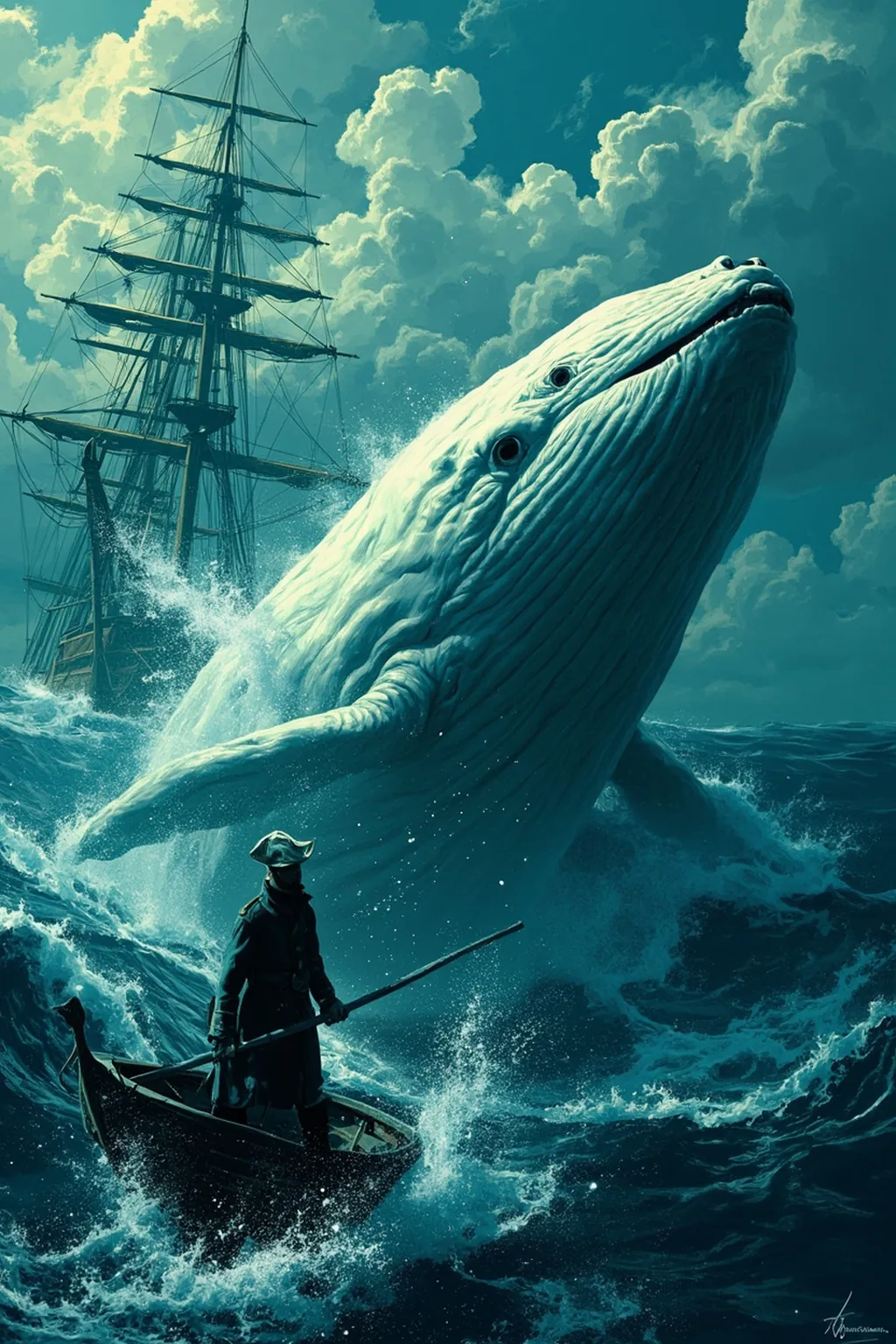
Celebration of the Sperm Whale’s Tail
Celebration of the Sperm Whale’s Tail While other poets have sung the praises of the antelope’s soft eye and the plumage of the bird that never alights, this chapter celebrates a tail. The speaker claims less celestial subject matter than those predecessors, yet finds profound meaning in the sperm whale’s tail. This opening establishes the chapter’s central premise: that the whale’s tail deserves poetic attention comparable to the conventional objects of poetic admiration.
Sperm Whale Tail Size and Fluke Form
Sperm Whale Tail Size and Fluke Form The tail begins where the trunk tapers to a man’s girth and measures at least fifty square feet on its upper surface alone. Its root expands into two broad, firm, flat flukes that gradually thin to less than an inch in thickness. At the junction, the flukes slightly overlap before receding sideways like wings, leaving a wide vacancy between them. The crescentic borders of these flukes display some of the most exquisitely defined lines of beauty found in any living thing. When fully grown, the whale’s tail exceeds twenty feet across.
Triune Tail Structure and Roman Wall Parallel
Triune Tail Structure and Roman Wall Parallel The tail consists of three distinct strata: upper, middle, and lower. The upper and lower layers contain long, horizontal fibers, while the middle layer has very short fibers running crosswise between the outside layers. This triune structure particularly contributes to the tail’s power. Students of ancient Roman architecture will recognize a parallel to the thin courses of tiles alternating with stone in those ancient walls, which contributed so greatly to the masonry’s strength.
Tail Power and Strength-Beauty Harmony
Tail Power and Strength-Beauty Harmony Beyond the tail’s local tendinous power, the entire Leviathan is covered with a warp and woof of muscular fibers and filaments that pass on either side of the loins and run down into the flukes, blending insensibly with them and contributing largely to their might. The confluent measureless force of the whole whale seems concentrated in the tail. This strength does not cripple the graceful flexion of the tail’s motions; instead, power bestows beauty and harmony. Real strength never impairs beauty but often bestows it, and in everything imposingly beautiful, strength has much to do with the magic.
Tail Strength Parallels in Art and Anatomy
Tail Strength Parallels in Art and Anatomy The chapter draws parallels between strength and beauty in art and anatomy. Removing the tied tendons bursting from the marble in carved Hercules would destroy its charm. When Eckerman lifted the linen sheet from Goethe’s corpse, he was overwhelmed by the massive chest that seemed a Roman triumphal arch. Even when Angelo paints God the Father in human form, mark what robustness appears there. Conversely, the soft, curled, hermaphroditical Italian pictures embodying Christ’s idea are so destitute of brawniness that they hint at no power beyond the mere negative, feminine virtue of submission and endurance.
First Great Tail Motion: Aquatic Propulsion
First Great Tail Motion: Aquatic Propulsion The first of five great motions is when the whale uses its tail as a fin for progression. Being horizontal in position, the Leviathan’s tail acts differently from all other sea creatures—it never wriggles. In man or fish, wriggling is a sign of inferiority. For the whale, the tail is the sole means of propulsion. Scroll-wise coiled forwards beneath the body and then rapidly sprung backwards, this mechanism creates the singular darting, leaping motion when the monster furiously swims. The side fins only serve to steer.
Second Great Tail Motion: Combat Use
Second Great Tail Motion: Combat Use The second motion is when the whale uses its tail as a mace in battle. While sperm whales fight each other with head and jaw, in conflicts with man they chiefly use their tail contemptuously. When striking a boat, the whale swiftly curves away its flukes from it, and the blow is inflicted by the recoil alone. If made in the unobstructed air, especially descending to its mark, the stroke is simply irresistible—no ribs of man or boat can withstand it. One’s only salvation lies in eluding it, but side blows often result in merely a cracked rib or a dashed plank.
The original text of this work is in the public domain. This page focuses on a guided summary article, reading notes, selected quotes, and visual learning materials for educational purposes.