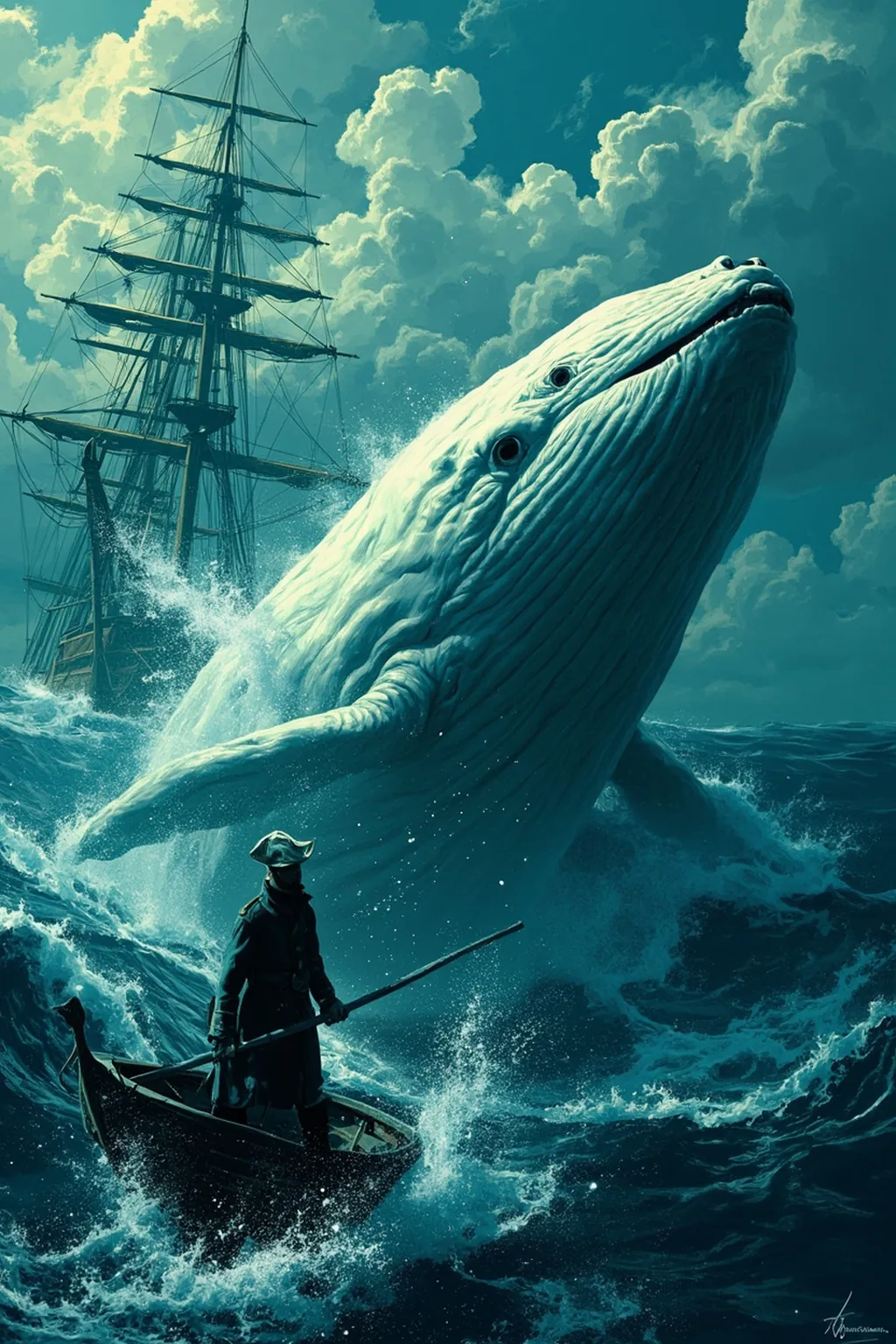
Pure Unrefined Whaleman Oil
The whaleman burns the purest oil in its unmanufactured, unvitiated state. This fluid remains unknown to any terrestrial contrivances, described as sweet as early April grass butter.
Sourcing Fresh Whaleman Oil
The whaleman hunts for his own oil to guarantee its freshness and genuineness, comparable to how a prairie traveler hunts to secure his own supper.
CAPÍTULO 98. Stowing Down and Clearing Up.
This chapter concludes the description of processing the whale, focusing on transferring oil into casks and stowing them below deck, where the leviathan returns metaphorically to his native depths, though never to rise and blow again.
Final Leviathan Oil Stowage
The warm oil, compared to hot punch, is received into six-barrel casks while the ship may pitch and roll in the midnight sea. Every sailor becomes a cooper, hammering the hoops as casks are maneuvered into position.
Warm Oil Cask Handling on Rolling Deck
The enormous casks are slewed around and turned end for end, sometimes scooting perilously across the slippery deck like landslides until man-handled and stayed. Rap, rap, go the hammers on all the hoops as the sailors work urgently.
Final Cask Stowage and Hatches Sealing
When the last pint is casked and everything cools, the great hatchways are unsealed, the ship’s bowels opened, and the casks go down to their final rest in the sea. The hatches are then replaced and hermetically closed, like a walled-up closet.
Chaotic Post-Whaling Deck Conditions
This scene in the sperm fishery ranks among the most remarkable in whaling. One day the planks stream with blood and oil, enormous masses of whale head pile the quarter-deck, rusty casks lie about like a brewery yard, smoke has besooted the bulwarks, and the entire ship seems transformed into great leviathan himself with deafening din on all hands.
Post-Processing Ship Cleaning
A day or two later, the ship appears as a silent merchant vessel with a most scrupulously neat commander. The unmanufactured sperm oil possesses a singularly cleansing virtue. From whale ash scraps, potent lye is made to exterminate adhesiveness. The crew diligently cleans bulwarks, brushes soot from rigging, scrubs the great hatch, coils tackles, and by combined industry transforms the entire ship.
Crew Post-Cleaning Musings
With elated step, cleaned crew members discourse humorously of parlors, sofas, carpets, and fine cambrics. They propose to mat the deck, think of hanging fixtures, and imagine taking tea by moonlight on the forecastle piazza. To hint of oil, bone, and blubber to these musked mariners would be audacity—they know not the thing you distantly allude to.
New Whale Sightings Disrupt Cleanliness
At the three mast heads, three men stand watching for more whales, which will again soil the ship and drop grease-spots. Many times, after the severest uninterrupted labors continuing for ninety-six hours, just as the crew finishes cleaning and buttons clean frocks, they are startled by “There she blows!” and away they fly to fight another whale.
Whaling as Mortal Life Cycle Metaphor
The narrator reflects on the weariness of extracting life’s small but valuable sperm from the world’s vast bulk, then cleansing oneself from defilements to live in clean tabernacles of the soul—only to have the ghost spouted up again, sailing away to fight some other world and repeat life’s old routine. This is man-killing, yet this is life.
Closing Metempsychosis and Pythagorean Anecdote
The narrator exclaims about metempsychosis and Pythagoras, who died good, wise, and mild in bright Greece two thousand years ago. Humorously, the narrator claims to have sailed with Pythagoras along the Peruvian coast and, foolish as he is, taught the ancient philosopher—as a green simple boy—how to splice a rope.
CAPÍTULO 99. The Doubloon.
The chapter centers on a doubloon— purest gold from Ecuador—nailed to the Pequod’s mainmast. The coin bears images of three Andean peaks, a tower, a flame, a crowing cock, and a zodiacal arch with the sun entering Libra. The crew reveres this doubloon as the White Whale’s talisman, wondering who will claim it when the whale is slain. Captain Ahab pauses before the coin as morning light catches it, and the chapter unfolds through multiple crew members’ interpretations of its imagery.
The original text of this work is in the public domain. This page focuses on a guided summary article, reading notes, selected quotes, and visual learning materials for educational purposes.