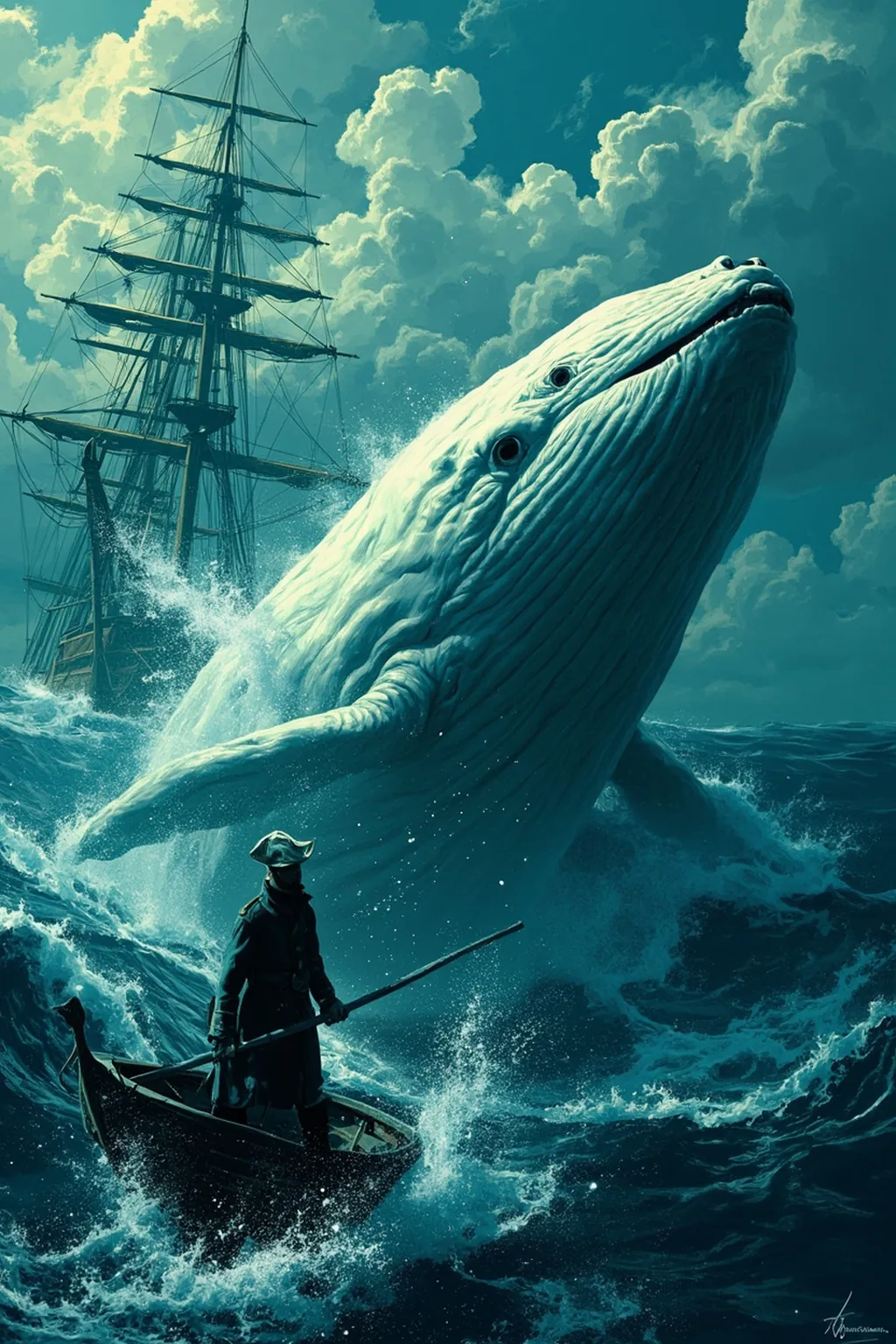
Ahab at the Doubloon
Captain Ahab resumes his habit of pacing the quarter-deck, pausing at the binnacle and mainmast. While he previously fixed his javelin-like glance on the compass needle, he now lingers before the nailed doubloon. His mood is intense yet touched with wild longing. On this morning, he appears newly drawn to the strange figures stamped upon the gold, as if for the first time attempting to interpret their monomaniac significance. He recognizes that some meaning lurks in all things, else existence would be worthless.
The Golden Coin’s Origin
The Ecuadorian doubloon originated from the heart of gorgeous South American hills, near the head-waters of Pactolus-like rivers flowing over golden sands. Cast midway up the Andes in an eternal spring climate, the coin preserves its Quito glow despite surrounding rust and verdigris. The chapter notes that South American gold coins serve as medals of the sun and tropic tokens. The doubloon’s round border bears the inscription REPUBLICA DEL ECUADOR: QUITO, identifying its equatorial origin. Its imagery includes palms, alpacas, volcanoes, sun’s disks, stars, ecliptics, horns-of plenty, and rich banners—designs the narrative describes as “Spanishly poetic.”
Ahab’s Egotistical Vision
Ahab interprets the doubloon’s imagery entirely through the lens of his own ego. He declares that mountain-tops and towers possess something ever egotistical. He identifies the three peaks as “as proud as Lucifer,” and announces that the firm tower is Ahab, the volcano is Ahab, and the courageous fowl is also Ahab. He proclaims the round gold mirrors the rounder globe and reflects each man’s mysterious self. Observing the sun entering the sign of storms at the equinox, Ahab declares his deterministic philosophy: “Born in throes, ’tis fit that man should live in pains and die in pangs!”
Starbuck’s Religious Meditation
Starbuck, leaning against the bulwarks, murmurs to himself that “fairy fingers” could not have pressed this gold—only “devil’s claws” could have left such mouldings. Comparing Ahab to Belshazzar reading the writing on the wall, Starbuck examines the coin for himself. He perceives a dark valley between three heaven-abiding peaks, symbolizing the Trinity, and describes the scene as a vale of Death where God girds humanity round. He finds hope in the sun of Righteousness shining above, but acknowledges the great sun is no fixture and cannot be found at midnight. Starbuck finds the coin speaks “wisely, mildly, truly, but still sadly” and decides to quit it.
Stubb’s Zodiacal Sermon
Stubb soliloquizes at the try-works, noting Ahab and Starbuck studying the coin with lengthy faces. He expresses puzzlement at their fascination, declaring he would spend any doubloon immediately. However, he retrieves his almanac and Bowditch’s navigator to interpret the zodiac on the coin. Stubb delivers a comic sermon equating each zodiac sign to a stage of life: Aries begets us, Taurus bumps us, Gemini represents Virtue and Vice, Cancer drags us back, Leo bites us, Virgo is our first love, Libra weighs happiness as wanting, Scorpio stings us from behind, Sagittarius shoots arrows, Capricornus batters us, Aquarius drowns us, and Pisces we sleep. He concludes with jolly resignation that the sun emerges from this cycle “all alive and hearty.”
Flask’s Materialistic View
Flask approaches the doubloon with complete practicality. He sees only “a round thing made of gold” belonging to whoever raises the whale. Dismissive of the others’ staring, he calculates its worth as sixteen dollars, equivalent to nine hundred and sixty cigars at two cents each. Unlike Stubb who smokes dirty pipes, Flask likes cigars and announces his intention to go aloft to spy them out. His interpretation reduces all the elaborate imagery to mere monetary value and personal consumption.
The Manxman’s Prophecy
Stubb announces the arrival of the old Manxman, whom he compares to a hearse-driver. The Manxman studies the doubloon, walks around to its other side where a horseshoe is nailed, and mutters about signs. He declares that if the White Whale is raised, it must happen when the sun stands in one of the zodiac signs within a month and a day. He explains he studied signs for forty years under an old witch in Copenhagen. The Manxman identifies the horseshoe as the lion sign—the “roaring and devouring lion”—and shakes his old head with foreboding about the ship’s fate.
The original text of this work is in the public domain. This page focuses on a guided summary article, reading notes, selected quotes, and visual learning materials for educational purposes.