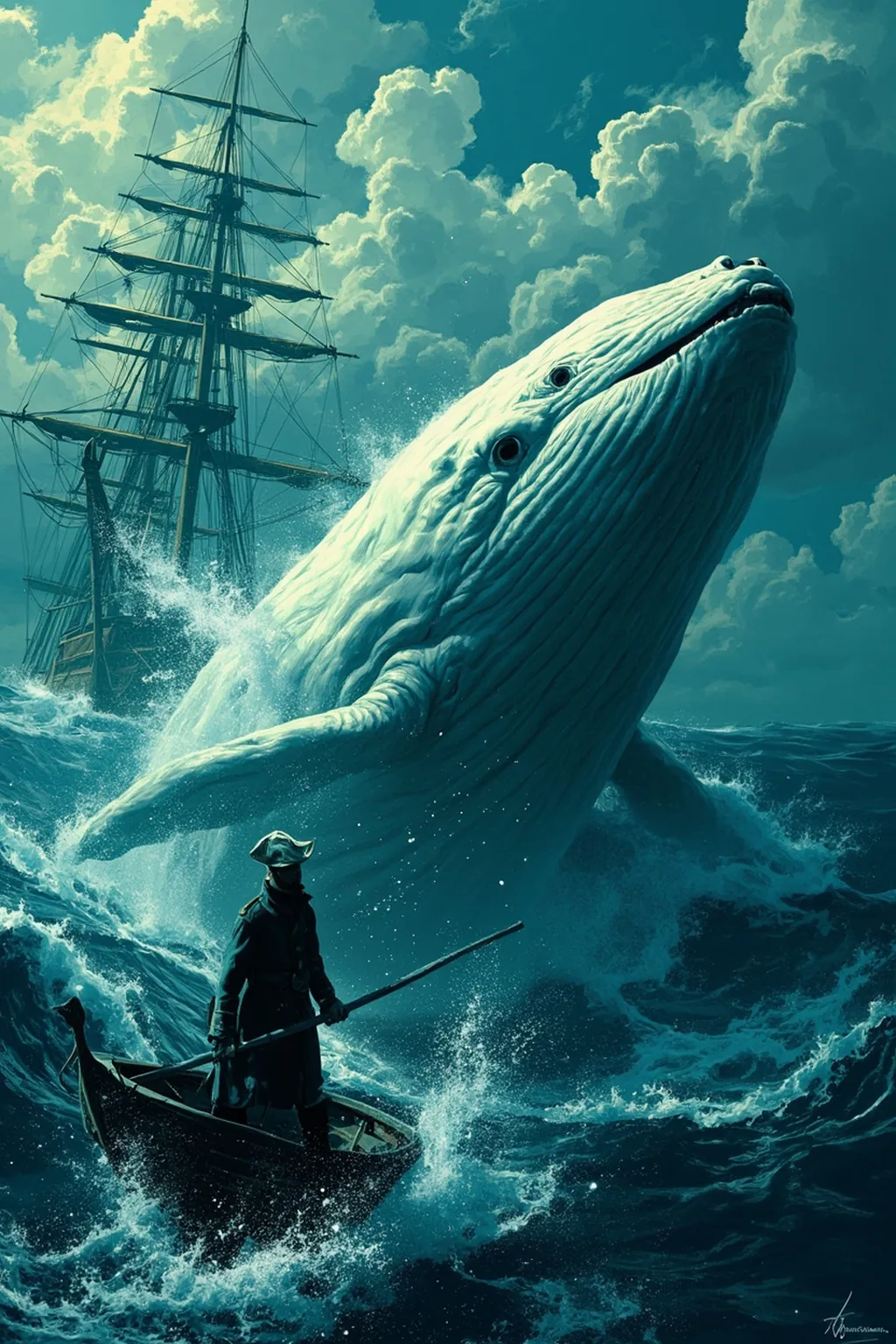
Ahab’s White Whale Obsession
Ahab stands at his customary post near the mizen rigging, inhaling the contrasting scents of the Bashee Isles and the new sea. Unlike the narrator’s spiritual appreciation, Ahab perceives the Pacific only as the hunting ground where the White Whale swims. His purpose intensifies as the ship glides toward Japanese waters; his firm lips compress like a vice, his veins swell, and even in sleep he cries out commands to hunt the White Whale, whom he envisions spouting thick blood.
CAPÍTULO 112. The Blacksmith.
This chapter introduces Perth, an elderly blacksmith aboard the Pequod, presenting his current circumstances and tragic backstory through a series of interconnected narratives.
The Forge on Deck
The chapter opens with Perth’s forge remaining on deck rather than being stored in the hold after completing work on Captain Ahab’s leg. During the mild summer weather, the blacksmith is now constantly summoned by the headsmen, harpooneers, and bowsmen to repair and reshape their weapons and boat equipment. He is surrounded by an eager group waiting for his services, watching his sooty movements intently. Despite his laborious work, Perth remains patient and silent, his hammer striking steadily as he toils over his chronically broken back. The narrator reflects that this is “most miserable.”
Perth’s Lameness
The blacksmith’s peculiar walk, marked by a slight but painful yawing gait, had earlier in the voyage drawn the curiosity of the mariners. Their persistent questioning eventually led Perth to reveal the shameful story of his wretched fate, which then became known to everyone aboard.
The Barn Accident
One bitter winter’s midnight, while traveling between two country towns, the blacksmith—belated and not entirely innocent—felt a deadly numbness stealing over him and sought refuge in a leaning, dilapidated barn. The consequence of this night was the loss of the extremities of both feet.
The Happy Blacksmith
Before his ruin, Perth had been a craftsman of renowned excellence with abundant work. He owned a house and garden, had a youthful and loving wife thirty years his junior, and three blithe, ruddy children. Every Sunday the family attended a cheerful church planted in a grove. The blacksmith’s shop occupied the basement of their dwelling with a separate entrance, and his wife would listen with pleasure to the stout ringing of his hammer. Through the floors and walls, these reverberations reached her in the nursery like an iron lullaby, rocking their infants to slumber.
The Bottle Conjuror
The term “Bottle Conjuror” refers to the fatal incident that destroyed Perth’s happiness. One night, under cover of darkness, a desperate burglar infiltrated their home—though the blacksmith himself unknowingly guided this intruder into his family’s heart. The phrase evokes the legend of a con man who claims to have imprisoned a devil in a bottle, whose release upon opening the cork destroys everything. This event marked the beginning of their undoing.
The Ruin
At nearly sixty years old, Perth encountered ruin in life’s sorrows. The blows of his hammer grew fainter and more infrequent each day. His wife sat frozen at the window with tearless eyes, watching their children’s weeping faces. The bellows fell, the forge choked with cinders, and the house was sold. The mother descended into the churchyard grass, her children following her twice. The houseless, familyless old man staggered away in crape—a worse than useless figure, his grey head a scorn to flaxen curls.
The Call of the Ocean
For men like Perth, whose interior compunctions prevent suicide, the ocean presents itself as an alluring alternative. Death is only the beginning of strange possibilities—the “Untried,” the “immense Remote, the Wild, the Watery, the Unshored.” From infinite Pacifics, a thousand mermaids sing invitingly: “Come hither, broken-hearted; here is another life without the guilt of intermediate death.” The sea promises supernatural wonders and oblivion from the landed world, offering marriage to the depths.
Perth Goes Whaling
East and West, by early sunrise and fall of eve, Perth’s soul answered the ocean’s call: “Aye, I come!” Thus Perth went a-whaling, drawn by the sea’s promise of escape from his earthly misery.
The original text of this work is in the public domain. This page focuses on a guided summary article, reading notes, selected quotes, and visual learning materials for educational purposes.