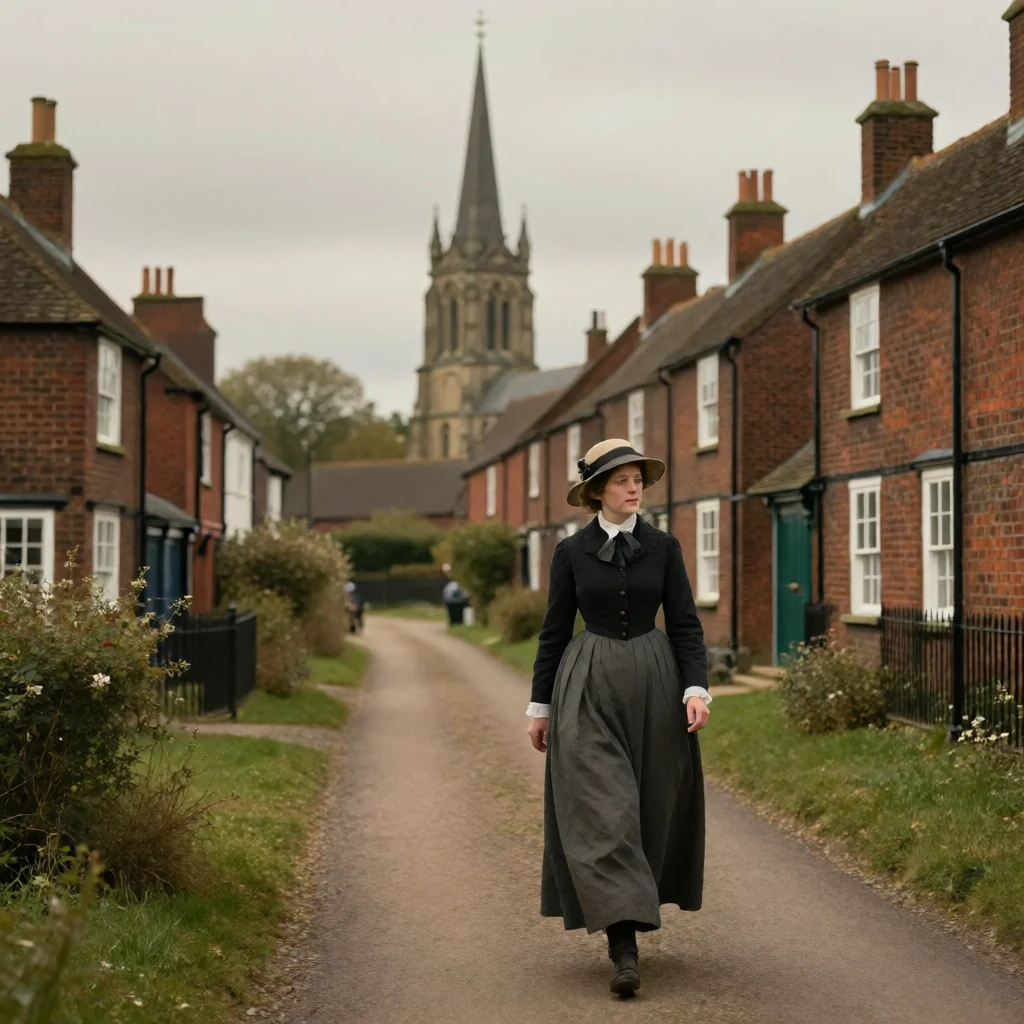
A Parting in the Orchard
Farebrother finds Mary and Letty in the orchard gathering apples in the western light, and offers a detailed portrait of Mary: a small, plump, brownish figure of firm but quiet carriage, with a broad face, square brow, marked eyebrows, curly dark hair, and features otherwise insignificant. The narrator remarks on the charm of her teeth, the quietness of her anger, and her fidelity to kindness. Mary is said to admire the Vicar, and her known imperfections of judgment are noted—she is more severe on Fred in advance than on Farebrother in fact. Farebrother asks if she has a message for Fred, whom he is going to see; Mary shakes her head, saying Fred would be worse than ridiculous as a clergyman, but is glad he is going to work. Farebrother invites her to visit his mother. Mary, unused to happiness, jokes that losing the longing for home leaves her feeling empty. Letty, after being noticed by the Vicar, hurries home to report.
Farebrother’s Internal Dialogue
As Farebrother walks to Lowick, he carries on an inward dialogue. He suspects there is more between Fred and Mary than childhood friendship, but questions whether Fred is worthy of her, and shrugs once at the thought. He then laughs at himself for feeling jealousy, given that his own financial position, balanced like a ledger, makes marriage impossible for him, and shrugs a second time. The narrator observes that charm is not explained by plainness, and that a human being is a slow product of long interchanging influences.
Caleb’s Proposal for Fred
Alone with Susan, Caleb proposes a plan for Fred Vincy. With Christy gone and Alfred soon to follow, and Jim five years from being ready, he will need help in the business, and believes Fred could learn the trade and become a useful man if he gives up the idea of being a parson. Mrs. Garth doubts the Vincy family would accept such honest work, and suspects Mrs. Vincy would say the offer was really for Mary’s sake. Caleb dismisses such objections as nonsense, declaring that no work is done well if one minds what fools say, so long as the plan is right. Mrs. Garth, knowing when her husband is firmest, declines to oppose him outright, but suggests waiting to see what Fred chooses after returning to college. Caleb agrees to wait, but is confident of having enough work for two.
Rigg Featherstone and Bulstrode
Caleb mentions an odd coincidence: two men asked him to value the same piece of land. One was Rigg Featherstone, the other Bulstrode; Caleb has decided to do it for Bulstrode, though he does not yet know whether mortgage or purchase is intended. Mrs. Garth wonders whether Rigg could really be selling the land he has only just inherited, but Caleb, who refers the knowledge of discreditable doings to no higher power than the deuce, says Bulstrode has long wanted a handsome piece of land and finds it hard to come by. Caleb notes the irony: the land long expected for Fred was never meant for him, and Featherstone’s “side-slip” of a son, kept in the dark, was positioned to vex everyone. If the land were now to pass to Bulstrode, whom the old man hated and never banked with, that would be curious. Mrs. Garth asks why Featherstone would hate a man he had nothing to do with. Caleb responds with one of his characteristic phrases about the soul of man, the diction of which, the narrator notes, he can associate with a sense of awe though he could not strictly quote.
CHAPITRE XLI.
The chapter centers on a bitter confrontation between Joshua Rigg Featherstone and his stepfather John Raffles at Stone Court, where the calculating and cool-tempered Rigg refuses to give his unscrupulous stepfather money for a tobacco business venture, instead offering only a minimal weekly allowance for his mother and threatening to drive Raffles off with dogs and a wagoner’s whip should he return. Rigg recalls their troubled shared past—how Raffles kicked him as a boy, consumed all the best food away from him and his mother, and repeatedly came home only to sell and pocket everything before leaving them in hardship. Though Rigg’s rejection is absolute, Raffles is undaunted and manages to extract both brandy and a sovereign for his journey back to town. As Raffles departs through the rural landscape toward Brassing, he casually picks up a folded paper that has fallen within the fender—a letter signed by Nicholas Bulstrode—and uses it as a convenient wedge to steady his flask, unaware or unconcerned that this bit of ink and paper may yet prove to be the opening of a catastrophe, as the narrator has philosophically suggested such humble documents sometimes become.
The original text of this work is in the public domain. This page focuses on a guided summary article, reading notes, selected quotes, and visual learning materials for educational purposes.